Faith & Freedom News
The British Mandate, Transjordan, and the Partition That Shaped Modern Jordan and the Israeli-Palestinian Conflict
A viral Instagram post revives a century-old question: was the creation of Transjordan in 1921 an act of British appeasement that quietly redrew the map of the Jewish national home — and, if so, what does that mean for how the region’s conflicts are understood today?

An Instagram post from the account @jdr.podcast (Jewish Diaspora Podcast / Jewish Diaspora Report) has renewed a long-running historical argument about the origins of modern Jordan and the British Mandate for Palestine. Posted with hashtags including #freepalestinefromjordan, #arabcolonizers, #muslimconquest, #decolonizejudea, and #israel, the caption argues that Britain, entrusted by the League of Nations with helping to re-establish a Jewish state in Palestine, instead made its first major concession to Arab opposition by cutting the Mandate territory in two.
Rather than creating a distinct “Palestinian” Arab state — one the post claims none of the Arabs at the time actually wanted — Britain handed the eastern portion, Transjordan, to Emir Abdullah, a Hashemite prince from the Hejaz in western Arabia with no prior roots in the territory. The post cites a British account describing how Abdullah “left the Hejaz swearing to drive the British and French out of Syria,” moved on to Amman, and was ultimately handed Transjordan “without asking the inhabitants.” Its pointed question: does that not sound like colonization?
The post reflects a recurring theme in pro-Israel historical commentary — that the bulk of the territory originally earmarked for a Jewish national home was carved away early and given to an outside Hashemite ruler, forming the core of today’s Jordan, while the remaining western land became the enduring center of Jewish-Arab conflict. Below is an examination of the documentary record behind that claim.
World War I, Balfour, and the Mandate System
The Ottoman Empire’s collapse after the First World War left the Allied powers to divide its former territories into League of Nations mandates. The 1917 Balfour Declaration expressed British support for “the establishment in Palestine of a national home for the Jewish people,” while specifying that nothing should prejudice the civil and religious rights of existing non-Jewish communities. That language was carried into the 1920 San Remo Conference and, ultimately, into the formal League of Nations Mandate for Palestine, approved in July 1922 and effective from September 1923.
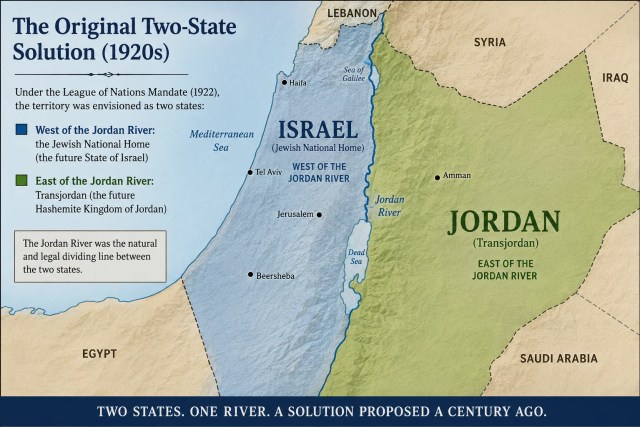
Article 2 of the Mandate charged Britain with placing the country under conditions that would secure the Jewish national home, facilitate Jewish immigration and settlement, and safeguard the rights of all inhabitants. The original Mandate spanned territory on both sides of the Jordan River — what is today Israel, the West Bank, Gaza, and the Kingdom of Jordan. Boundaries were not rigidly fixed at the outset, and early Zionist aspirations frequently extended to the eastern bank.
At the same time, Britain carried separate wartime commitments to Arab leaders, most notably through the Hussein-McMahon correspondence with Sharif Hussein of Mecca, father of both Abdullah and Faisal. Those exchanges offered vague assurances of Arab independence in return for the Arab Revolt against the Ottomans — commitments that collided with the Sykes-Picot arrangement, French control of Syria, and a tangle of competing postwar claims.
Abdullah’s March North and the Cairo Conference
After the French ousted his brother Faisal from Syria in 1920 following the Battle of Maysalun, Abdullah led several hundred to roughly two thousand armed men north from the Hejaz. He reached Ma’an — then part of the Hejaz — in November 1920, and arrived in Amman by early March 1921, with the stated aim of recovering Syria for the Hashemites and confronting French rule there.
“The Emir Abdullah [along with his men] left the Hejaz swearing to drive the British and French out of Syria… Abdullah moved on to Amman and the [British] Government then started to try to find a formula. A formula was found of the usual type. We made Abdullah a present of Trans-Jordania, without asking the inhabitants…”
Facing instability east of the Jordan — a sparsely populated expanse of tribes and villages without strong central authority after Ottoman withdrawal — and eager to reward a wartime Hashemite ally while stabilizing its own position, Britain convened the Cairo Conference in March 1921 under Colonial Secretary Winston Churchill. In talks there and afterward in Jerusalem, an arrangement took shape: Abdullah would administer the land east of the Jordan under the broader Palestine Mandate, provisionally at first, with British financial and military backing. In exchange, he would refrain from attacking the French in Syria and accept that the Jewish national home provisions would not extend east of the river.
Article 25 of the Mandate gave Britain the authority to “postpone or withhold” the Jewish national home provisions east of the Jordan, and a British memorandum approved by the League of Nations in September 1922 formally excluded Transjordan from those clauses and from Jewish settlement. The Emirate of Transjordan was established that April, with Abdullah installed as Emir. Churchill would later describe the decision as having been made “with the stroke of a pen one Sunday afternoon in Cairo” — a phrase now often invoked, including in the viral post, to underline how little deliberation, and how little local consultation, preceded it.
At the time, the region had no strong, preexisting centralized Palestinian Arab national movement pressing for statehood there; local political life was tribal and regional rather than national. Abdullah himself was an outsider — a Hashemite from the Hejaz with no deep local roots — installed by British decision and backed by a modest fighting force rather than by any local mandate.
From Emirate to Kingdom
Transjordan developed for the next quarter-century under close British tutelage, including subsidies and military guidance channeled through the Arab Legion under officers such as Frederick Peake and later John Bagot Glubb (“Glubb Pasha”). Full independence arrived with the 1946 Treaty of London, when Abdullah became king of the Hashemite Kingdom of Transjordan.
Following the 1948 Arab-Israeli War, Jordan occupied and later annexed the West Bank, renaming itself the Hashemite Kingdom of Jordan in 1949 — a status it held until losing the territory in the 1967 Six-Day War. That history, combined with successive waves of displacement, means a majority of Jordan’s population today traces its roots to Palestinian families.
Abdullah’s own record was more complicated than a simple client relationship with London. He pursued expansionist ambitions of his own at times — including interest in a “Greater Syria” and in parts of Palestine — while maintaining pragmatic, often secret, contacts with Zionist leaders. He was assassinated in Jerusalem in 1951 by a Palestinian gunman amid fierce opposition to his policies.
Weighing the Post’s Argument
Several of the Instagram post’s core factual claims hold up against the documentary record:
- The original Mandate for Palestine did include territory east of the Jordan River.
- Britain severed Transjordan early and excluded it from the Jewish national home provisions, largely to accommodate Abdullah and broader strategic concerns.
- Abdullah arrived from outside the region with an armed retinue and was installed by British decision rather than through any local process of self-determination.
- The move removed a large majority of the Mandate’s total area from the territory available to the Jewish national home project.
Whether this amounts to “colonization,” as the post’s hashtags suggest, is a matter of interpretation rather than settled fact. Seen through the lens the post adopts, it was a British concession that handed the bulk of Mandate territory to a foreign Hashemite dynasty, narrowing the Jewish national home and producing what critics call an artificial state. Others counter that the Mandate always envisioned protections for Arab rights, that Transjordan’s population was and remains overwhelmingly Arab, that Britain was juggling multiple wartime obligations and postwar realities — including French control of Syria and the need for regional stability — and that no independent Palestinian Arab state was genuinely on the table in 1921 in the first place. Local inhabitants were not consulted in any democratic sense, but that absence of consultation was the norm across the mandate system and the broader imperial reshuffling of the era, not unique to this decision.
The post’s claim that “none of the Arabs at the time wanted” a Palestinian Arab state in the western portion reflects a real historical current: many Arab leaders and communities rejected the legitimacy of a Jewish national home outright and gravitated toward broader Arab or Syrian frameworks rather than a distinct Palestinian entity confined to part of the Mandate. A separate, fully articulated Palestinian national identity crystallized more fully later — especially after 1948, and further still under the Palestine Liberation Organization from the 1960s onward.
A Longer Shadow
Jordan’s subsequent history — its role in the 1948 war, its annexation of the West Bank, the 1970 Black September conflict with the PLO, and its 1994 peace treaty with Israel — has added further layers to this debate. Arguments that “Jordan is Palestine,” pointing to its large Palestinian-origin population and its territorial origins in the Mandate, surface periodically in political rhetoric on the Israeli right and in certain Arab political currents alike, though Jordan’s Hashemite monarchy and official state identity firmly reject the framing as a threat to the kingdom’s very existence.
The @jdr.podcast post uses this history to challenge narratives that cast Israel as a colonial implant while treating neighboring Arab states — Jordan chief among them — as organic, uncontested nations. It points to what it frames as a selective application of “decolonization” language, and to the role external Arab actors, in this case Hashemites from the Hejaz, played in drawing the region’s modern borders. Whatever conclusion one draws from that argument, the documentary record is clear on one point: the creation of Transjordan was a deliberate British geopolitical choice, made over a matter of months in 1921, that permanently altered the territorial scope of the Jewish national home first envisioned in the Balfour Declaration and the original Mandate for Palestine.
■ ■ ■
About The Author

Discover more from Faith & Freedom News - FFN
Subscribe to get the latest posts sent to your email.


