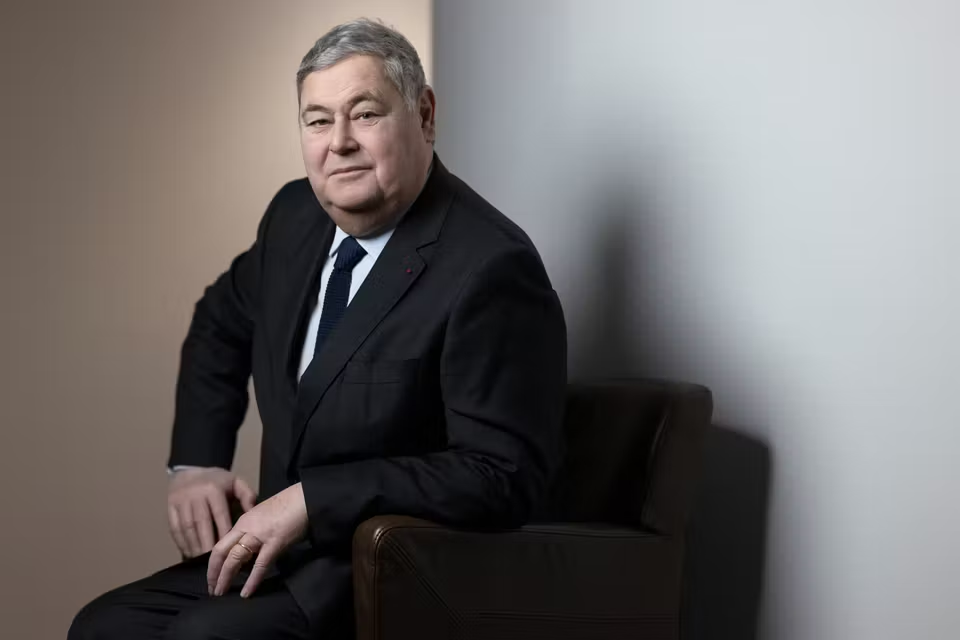
Pierre-François Veil,
President of the Foundation for
the Memory of the Shoah,
Has Died at 72
Simone Veil’s youngest son — lawyer, champion of Holocaust memory, and inheritor of his mother’s lifelong commitment to dignity and justice — has passed away. He placed his presidency of the Fondation pour la Mémoire de la Shoah “in continuity with his mother.” Today, the world of human rights and memory loses one of its most principled voices.

A Life in the Service of Memory: Who Was Pierre-François Veil
The Foundation for the Memory of the Shoah announced on Wednesday, May 6, 2026, the death of its president, Pierre-François Veil, at the age of 72. He was the youngest son of Simone Veil — one of the most significant figures in twentieth-century French public life, survivor of Auschwitz, author of the law legalising abortion in France in 1975, President of the European Parliament, and the first president of the Foundation for the Memory of the Shoah — and of Antoine Veil.
Pierre-François Veil had been a member of the Paris Bar since 1979. He was a lawyer by training and a guardian of memory by vocation. He never knew his maternal grandparents, André Jacob and Yvonne Steinmetz, who were victims of the Holocaust — but he dedicated a significant part of his professional and civic life to ensuring that their fate, and that of the six million murdered Jews of Europe, was never forgotten and never distorted.
“Pierre-François Veil was convinced that education and the transmission of history and the understanding of contemporary political issues were the essential weapons to combat anti-Semitism in France and in the world.”
Source: Fondation pour la Mémoire de la Shoah ↗
From the Paris Bar to the Presidency of the Shoah Foundation: A Timeline of Commitment
- 1953 · Birth Born to Simone and Antoine Veil. The youngest of their three sons. His maternal grandparents, André Jacob and Yvonne Steinmetz, were Holocaust victims — a family history that would shape his entire civic and professional life.
- 1979 · Legal Career Admitted to the Paris Bar, where he would practice law for decades. His legal background informed his understanding of the frameworks — legislative, judicial, and educational — through which historical memory must be protected and antisemitism combated.
- 2001 · Legion of Honour Appointed Knight of the Legion of Honour in recognition of his public service and commitment to French values and historical memory.
- 2010 · Promoted Promoted to the rank of Officer of the Legion of Honour — France’s highest civilian distinction — reflecting the depth and duration of his commitment.
- 2014 · Foundation Board Joined the board of directors of the Foundation for the Memory of the Shoah in his capacity as president of the French Committee for Yad Vashem, where he had worked to gain recognition for the Righteous Among the Nations.
- 2023 · Foundation President Became President of the Fondation pour la Mémoire de la Shoah — placing “his term in continuity with his predecessors, including his mother, Simone Veil, the Foundation’s first president.” He understood this role as both an inheritance and a responsibility.
- 6 May 2026 · Death Pierre-François Veil died at the age of 72. The Foundation described him as “an exceptional, committed, courageous man of profound humanity.” He is survived by his brother Jean. His other brother, Claude-Nicolas, a doctor, had predeceased him in 2002.
Carrying a Mother’s Flame: The Veil Family and the Weight of History
To understand Pierre-François Veil is to understand the shadow and the light of Simone Veil — one of the most admired figures in modern French history. Simone Veil survived Auschwitz. She rebuilt her life within the institutions of the French republic. She authored the law that gave French women the right to control their own bodies. She served as President of the European Parliament. She became the first president of the Foundation for the Memory of the Shoah — and she was, by universal consensus, one of the greatest moral authorities France has produced in the post-war era.
Pierre-François was the youngest of her three sons. He was deeply marked by his mother’s experience, her values, and her commitment. He described himself as carrying her legacy forward — not merely as a filial duty, but as a genuine vocation. He was, in the words of those who knew him, a feminist inspired by his mother’s figure: a man who understood that the struggles for women’s rights, for Jewish memory, and for human dignity were not separate causes but expressions of the same fundamental commitment.
“He placed his term in continuity with his predecessors, including his mother, Simone Veil, the Foundation’s first president — whose memory he kept alive.”
Fondation pour la Mémoire de la Shoah · Official Statement · May 6, 2026“Education and the Transmission of History Are the Essential Weapons Against Antisemitism”
Pierre-François Veil’s approach to combating antisemitism was not primarily legalistic or punitive — though he understood the importance of law — but educational. He believed, as the Foundation’s statement makes clear, that “education and the transmission of history and the understanding of contemporary political issues were the essential weapons to combat anti-Semitism in France and in the world.”
This belief in education as the primary defence against hatred is not a naive one. It is the conviction of a man who had grown up in the shadow of what happens when a society forgets — or chooses not to teach — its history. The Holocaust did not happen because of individual monsters acting alone. It happened because entire societies participated, acquiesced, or looked away. The antidote is not merely better laws, but better memories: communities that know what was done, understand how it was possible, and are therefore equipped to recognise the precursors of hatred before it reaches its endpoint.
Pierre-François Veil served as president of the French Committee for Yad Vashem, working to gain recognition for the Righteous Among the Nations — those non-Jews who risked their lives to save Jewish people during the Holocaust. In this role, he was not only preserving history but actively shaping its moral meaning: insisting that the Shoah is not only a story of perpetrators and victims, but also of those who chose to act differently, at enormous personal cost.
“A long-time advocate for preserving the memory of the Holocaust, he worked to gain recognition for the Righteous Among the Nations as president of the French Committee for Yad Vashem.”
Fondation pour la Mémoire de la Shoah · Official StatementA Man I Had the Privilege to Know: The Human Being Behind the Public Figure
Pierre-François Veil was, in the words of those who knew and worked with him, a man of profound humanity. He combined the rigour of a lawyer with the sensitivity of someone who understood, at a personal and familial level, what antisemitism costs — not in abstract policy terms, but in actual human lives: his maternal grandparents, murdered in the Shoah; his mother, forever marked by Auschwitz; the millions of others whose names he helped preserve and transmit to future generations.
He was also, as I saw in my encounters with him, a feminist — a man genuinely inspired by his mother’s courage and her commitment to women’s rights. He understood that the struggle for Jewish memory and the struggle for women’s dignity were not parallel or separate causes. They were expressions of the same moral imperative: the insistence that every human being has inherent worth, and that the forces of hatred and degradation must be named, confronted, and defeated through education, through law, and through the determined transmission of historical truth.
The Foundation for the Memory of the Shoah has announced his death. The Foundation will continue — the work of memory does not stop when those who lead it pass on, because that is the nature of memory: it must be held by the living, not preserved only by those who were closest to the events. Pierre-François Veil understood this. He spent the last years of his life ensuring that younger generations would have the institutions, the resources, and the moral framework to carry it forward.
He was the son of Simone Veil. He was the president of the Foundation for the Memory of the Shoah. He was an Officer of the Legion of Honour. He was a champion of the Righteous Among the Nations. He was a feminist and a humanist. He was a man who believed that education was the essential weapon against hatred. And he was, as I can attest from personal encounter, a human being of warmth, conviction, and profound integrity. Rest in peace, Pierre-François Veil. Your work, and your mother’s work, will endure.
About The Author

Discover more from Faith & Freedom News - FFN
Subscribe to get the latest posts sent to your email.


