
The Emerging Saudi-Pakistan-Turkiye Nexus
Pakistan is capitalizing on its military ties with Saudi Arabia and Turkiye to gain strategic influence amid Middle East rivalries and economic trade-offs — but its history of neutrality raises questions about how far Riyadh can rely on it.
In a Nutshell
- Pakistan seeks clout via pacts with Saudi Arabia and Turkiye.
- Islamabad aims to earn foreign exchange by selling military expertise.
- The pact’s real test hinges on Pakistan’s response to attacks on Saudi Arabia.
Pakistan, the only nuclear weapons power in the Muslim world, is seeking to wield its military strength to become a key player in the Middle East. Beyond acting as a mediator between the United States and Iran, Islamabad is pursuing defense agreements and military sales. Its success in carving out a significant regional role will depend on its ability to navigate complex rivalries and on whether Middle Eastern nations are willing to risk their growing economic ties with India for security partnerships with Pakistan.
Historically, Pakistan has viewed India as its primary adversary since 1947, when the British Raj partitioned the subcontinent into two countries. India and Pakistan have fought several wars, most recently in May 2025, and both are armed with nuclear weapons. Pakistan has often sought support from Muslim states in North Africa and West Asia in its rivalry with India, but many Arab countries have avoided taking a clear side.
Pakistan’s leaders believe they have shifted this historical dynamic by signing a Strategic Mutual Defense Agreement (SMDA) with Saudi Arabia on September 17, 2025. The two countries have maintained a security partnership that includes the deployment of Pakistani troops in Saudi Arabia and the training of Saudi personnel in Pakistan. The SMDA rests on the understanding that an attack on either country constitutes an attack on both.
The details of the agreement are not public. However, if statements by Saudi and Pakistani leaders are to be believed, the pact is more substantive than symbolic. In January 2026, Pakistan, Saudi Arabia, and Turkiye announced negotiations for a broader defense agreement, raising the prospect of a treaty-based, institutionalized collective defense system resembling NATO.
“Joint defense usually involves a shared enemy, but most countries in the Muslim world have differing concerns.” Husain Haqqani
Pakistan’s perceived enemy, India, maintains a $41 billion annual trade relationship with Saudi Arabia, nearly half of Pakistan’s total trade volume of $90 billion. Riyadh is unlikely to envisage fighting India alongside Pakistan. The likely purpose of the SMDA is instead to enable Saudi Arabia to draw on battle-hardened Pakistani troops, pilots, and drone operators for its defense, in exchange for Pakistani access to Saudi capital for its military industries. If Turkiye formalizes military cooperation with Pakistan and Saudi Arabia through a treaty or joint agreement, it would similarly secure Saudi capital for its own military manufacturing while pursuing co-production with, or sales to, Pakistan.
Pakistan’s Enduring Middle East Ambitions
Pakistan has championed security cooperation with other Muslim countries since the 1950s. At the height of the Cold War, Islamabad supported the U.S. proposal for a Middle East Defense Organization and joined the Baghdad Pact, later renamed the Central Treaty Organization (CENTO). Although Turkiye and Iran, then ruled by the Shah, joined these Western-led efforts to create a “Northern Tier” of defense along the Soviet Union’s southern border, Arab countries notably stayed away.
Since the formal end of CENTO in 1979 and subsequent shifts in regional security priorities, Pakistan has sought to capitalize on its large armed forces to exert influence across West Asia, viewing defense partnerships with Middle Eastern states as a means of boosting its military and economic strength while avoiding complete dependence on either the U.S. or China.
For many years, Saudi Arabia has served as Pakistan’s ally of last resort, motivated by both ideological and strategic considerations. Strong ties with the nation that hosts Islam’s holiest sites have helped bolster Pakistan’s image as a leader among Muslim nations, while Saudi economic support and energy resources have been critical to Pakistan, often in exchange for Pakistani labor and military cooperation. During the 1970s and 1980s, Pakistani forces were deployed in Saudi Arabia to defend its territory, operate Saudi aircraft, and train its military; in exchange, Riyadh frequently funded Islamabad’s purchases of advanced military equipment from the United States and its Western allies. This dynamic shifted after the 1991 Gulf War, which allowed the deployment of U.S. forces in the Kingdom.
Saudi Arabia now appears to be preparing for a possible reduction in Washington’s global security footprint, particularly in the Middle East. The SMDA elevates long-standing cooperation from a flexible partnership to a more explicit mutual obligation. The immediate catalyst for the agreement may have been Israel’s September 9, 2025, attack on Hamas leadership in Doha, Qatar. The U.S. failure to deter Israel, along with its tolerance of an attack on a country hosting an American base, signaled future threats to Gulf countries. Riyadh entered the agreement with Islamabad as part of a hedging strategy amid uncertainty over existing security guarantees and heightened regional volatility. Both countries have fueled speculation over whether the pact implies nuclear commitments.
For Pakistan, the pact reflects a calculated effort to convert security cooperation into economic advantage. Cash-strapped Islamabad sees defense ties with Saudi Arabia, and potentially Turkiye, as a way to monetize its military expertise, transforming training, deployments, and arms sales into foreign exchange and budgetary relief. Beyond the military sphere, Pakistan hopes to expand cooperation into the maritime domain by linking the ports of Gwadar and Karachi to Jeddah and Dammam through proposed gateway terminals — integration that could create a maritime energy and trade corridor, anchoring Saudi commercial interests within the China-Pakistan Economic Corridor and embedding Pakistan more deeply in the Gulf’s economic and security architecture.
A Reliability Problem
However, Pakistan’s reliability as a security partner for the Saudis in the new Middle East environment remains questionable. The rise of an Iranian threat across much of the Arab world has challenged Pakistan’s traditional paradigm of uniting Muslim countries against non-Muslim powers such as the former Soviet Union or Israel. Several regional conflicts now pit Muslims against Muslims, and Pakistan has often been reluctant to take sides.
Saudis still remember Pakistan’s refusal to commit troops to the 2015 military offensive against the Yemeni Houthis. At the time, Saudi Arabia requested warships, aircraft, and troops, but Pakistan’s parliament voted unanimously for neutrality in the Yemen conflict. The Iranian regime’s recent attacks on Gulf countries in response to U.S.-Israeli strikes on Iran created a similar dilemma. U.S. President Donald Trump’s need for a mediator with Tehran, combined with Pakistan’s willingness to play that role, prevented the Saudi-Pakistan agreement from being fully tested. As a mediator, Pakistan could not be expected to join military operations on behalf of Saudi Arabia — a position the Saudis appear to accept, though others, such as the United Arab Emirates, find it problematic.
The UAE has taken the stance that friends and allies of Gulf countries should treat Iran’s attacks as aggression and either defend the Gulf states or pressure Tehran to halt the assaults. Had Saudi Arabia adopted a similar position, Pakistan would have faced pressure to defend the Kingdom rather than mediate.
The Turkiye and China Factors
Like Saudi Arabia, Pakistan’s relations with Turkiye date back to the Cold War, when the two countries participated in past regional security arrangements, often in partnership with the U.S. From Ankara’s perspective, the emerging Saudi-Pakistan-Turkiye framework represents repositioning to build influence, not a full realignment. Turkiye is not leaving NATO; instead, it is cultivating parallel partnerships to enhance strategic flexibility and bargaining power, allowing Ankara to expand its regional role with fewer binding commitments.
Turkiye’s interest is reinforced by its improved relationship with Saudi Arabia. Since 2021, the two nations have repaired ties and aligned positions on Syria, Sudan, and Somalia. Ankara, one of the world’s fastest-growing arms exporters, seeks direct defense-industrial gains through partnerships with Pakistan and Saudi Arabia, including access to Gulf procurement pipelines for drones, armored vehicles, naval platforms, and air-defense systems, as well as opportunities for co-production, licensed assembly, and technology transfer within Saudi Arabia. A trilateral security framework lowers political risk for long-term contracts, embeds Turkish firms in Saudi defense localization efforts, and positions Turkiye as a preferred supplier and systems integrator alongside Pakistan.
China is neither a signatory to the Pakistan-Saudi SMDA nor identified as a formal participant in the emerging Saudi-Pakistan-Turkiye defense framework, yet it stands to gain indirect strategic benefits from the deepening institutionalization of Saudi-Pakistan defense ties. Approximately 80 percent of Pakistan’s recent defense imports originate from China, including aircraft, drones, and missile systems. Any expansion of its defense cooperation increases Saudi and Turkish interaction with systems of Chinese origin or co-produced by China and Pakistan, such as the JF-17 aircraft.
Scenarios Ahead
Pakistan as Mediator, Not Combatant
The first and most significant test of the SMDA is unfolding in Pakistan’s handling of the ongoing Iran conflict. Immediately after the war began, Pakistan expressed full solidarity with Saudi Arabia, and senior leaders traveled to the Kingdom to reaffirm support and remind Iran of the mutual defense agreement in an effort to deter attacks on Saudi territory.
While balancing ties with the U.S., Iran, and Saudi Arabia, Pakistan must also manage strong domestic opposition to U.S. strikes on Iran; its Shia community has largely sided with Tehran, more than 20 Pakistanis died during protests at the U.S. Consulate in Karachi, and President Asif Ali Zardari expressed sympathy for Iran. At the UN, Pakistan adopted an inconsistent position, co-sponsoring the Bahrain-led resolution condemning Iranian attacks on Gulf states while also voting in favor of a Russian-led resolution calling for an immediate end to all military activities without assigning blame to Iran. Should the fighting expand, Islamabad may face pressure to provide direct military support to Saudi Arabia or risk undermining the credibility of its mutual defense commitments.
Direct Military Involvement
The second, more limited test of the SMDA is how Saudi Arabia engages with South Asia given Pakistan’s declaration of an “open war” with Afghanistan. Riyadh has sought to position itself as a credible regional mediator and is working to de-escalate tensions; just as Pakistan has avoided military entanglement in the Middle East, Saudi Arabia has shown reluctance to become directly involved in South Asian conflicts.
Both countries currently appear to favor diplomatic rhetoric over military involvement when the other faces regional crises. How they respond to these volatile situations will ultimately determine the practical strength of the SMDA’s mutual security provisions, and indicate whether a broader “Muslim NATO” concept is strategically viable.
Read the Complete Analysis
This report draws on original analysis by Husain Haqqani, published by GIS Reports Online.
Read the Full Article at GIS Reports Online →
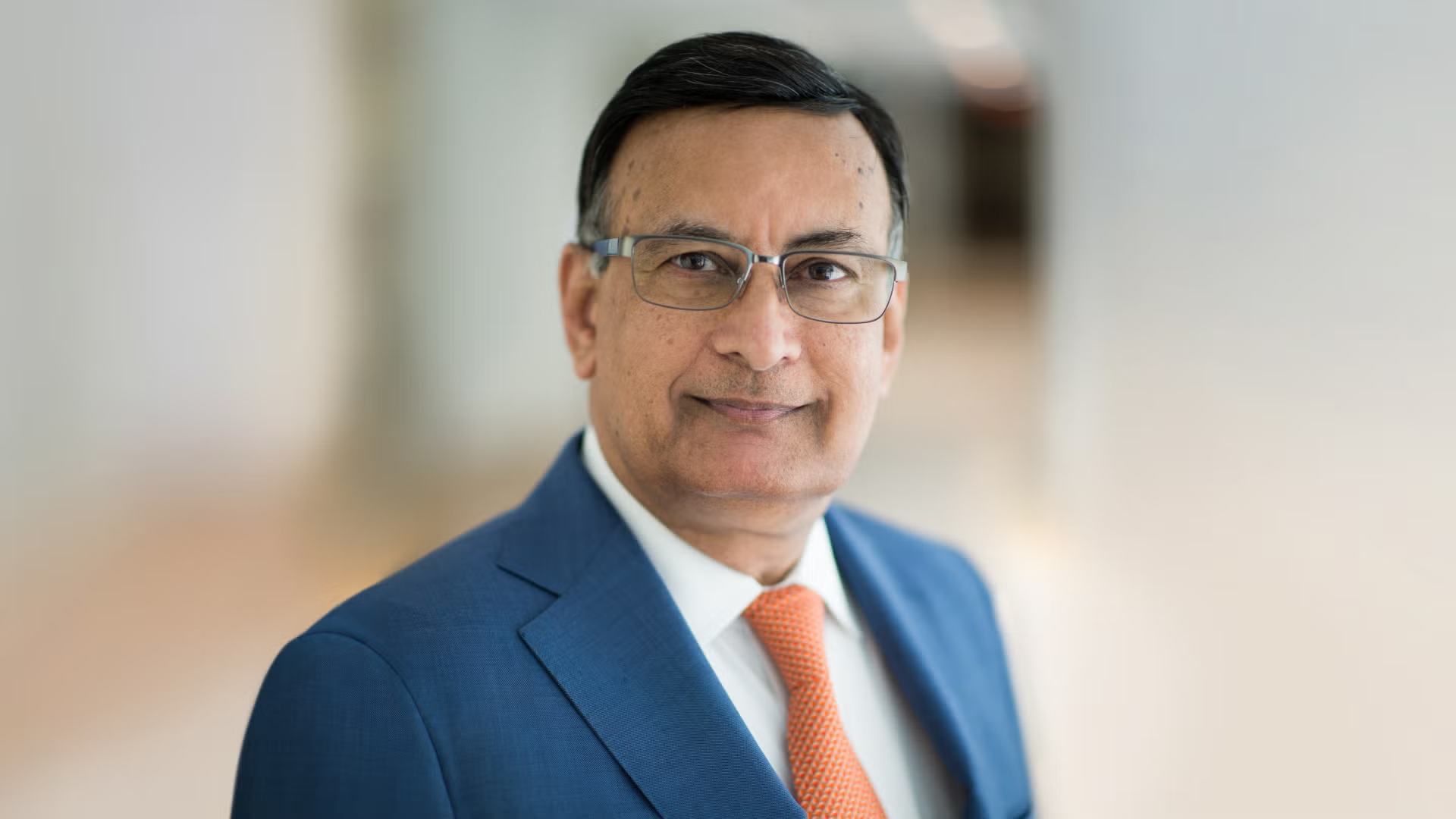
Husain Haqqani
Husain Haqqani served as Pakistan’s ambassador to the United States from 2008 to 2011 and is widely credited with managing a difficult partnership during a critical phase in the global war on terrorism. Read more about the author at the Hudson Institute.
About The Author

Discover more from Faith & Freedom News - FFN
Subscribe to get the latest posts sent to your email.


