Faith & Freedom News
First Regular Hearing of Junaid Hafeez’s Death Sentence Appeal in Lahore High Court, Arguments Sought on Electronic Evidence
Nearly six years after it was filed, the appeal received its first substantive hearing on Tuesday, with a two-judge bench directing prosecutors to establish the legal standing of the social-media evidence at the heart of the case.
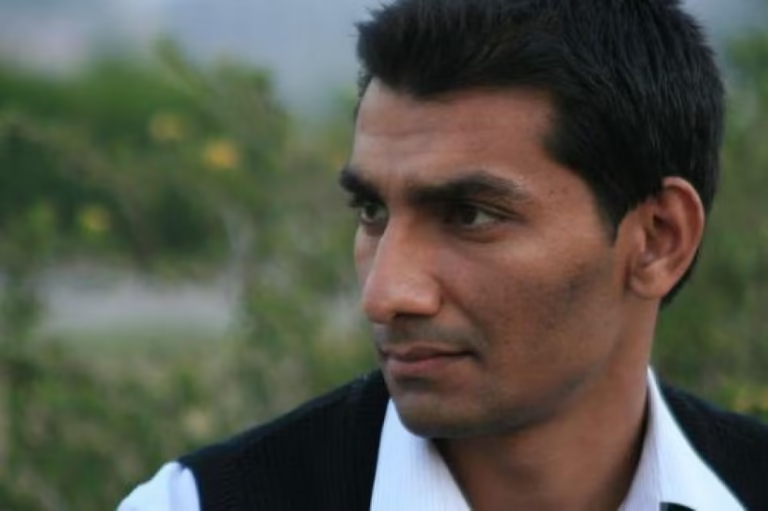
LAHORE — The Lahore High Court on Tuesday heard an appeal filed by Junaid Hafeez, a former lecturer at Bahauddin Zakariya University (Multan) who was sentenced to death in a blasphemy case, and sought arguments from the prosecution regarding the legal status and admissibility of the electronic evidence presented against him.
Junaid Hafeez filed an appeal against his death sentence in the Lahore High Court on January 9, 2020. Nearly six years later, the appeal received its first regular hearing. A two-member bench comprising Justice Sadiq Mahmood Khurram and Justice Javed Zafar directed the prosecution to satisfy the court and Junaid Hafeez’s lawyers regarding the electronic evidence presented against him.
Junaid Hafeez’s lawyer, Asad Jamal, told BBC Urdu that significant progress had been made in the appeal on Tuesday. He said the court had sought clear arguments from the prosecution regarding the legal status and admissibility of the electronic evidence.
The next hearing of the appeal has been scheduled for October 10.
Junaid Hafeez’s legal team also includes lawyer Saif-ul-Malook. During the proceedings, the court specifically directed the prosecution to establish the electronic evidence in accordance with the law so that the court could rely on it while deciding the case.
Junaid Hafeez was a lecturer at Bahauddin Zakariya University in Multan and was sentenced to death after being accused of blasphemy. His appeal had remained pending before the Lahore High Court for a prolonged period. Tuesday’s hearing is being regarded as significant progress in the case.
“The court has sought answers on two key issues at the next hearing — the legal distinction between a Facebook page and a Facebook group, and the forensic authenticity of the social media posts attributed to Junaid Hafeez.”
After so many years of waiting, Junaid Hafeez’s case finally saw meaningful and substantive progress today. The Lahore High Court formally admitted his appeal against the death sentence for hearing and issued notices to the prosecution.
The court has sought answers on two key issues at the next hearing. The first is the legal distinction between a Facebook page and a Facebook group, and the second concerns the forensic authenticity of the social media posts attributed to Junaid Hafeez. A date for the next hearing has not yet been formally fixed.
Outside the courtroom proceedings, one of the most moving scenes was the presence of Junaid’s father and brother. At the conclusion of the hearing, tears were visible in his father’s eyes. This is a family that has endured severe emotional and psychological distress for the past thirteen years. The price they have paid while waiting for justice has been extraordinarily heavy.
Junaid Hafeez has been in prison since 2013 and has been held on death row since he was sentenced in 2019. His appeal has remained pending since 2020.
Members of civil society were also present in the courtroom to express solidarity with him. Their presence reflected the view that the case is being seen not merely as a legal proceeding, but also in the context of a fair trial, timely justice, and the protection of everyone involved in such sensitive cases.
Today’s hearing has certainly raised a ray of hope, but it has also brought a bitter question about the years that have passed. The judges expressed surprise that, after the case was transferred to Lahore, notices had not even been issued to the parties. They also questioned why efforts had not been made through the legal procedure to secure an early hearing of such an old and sensitive case.
For Junaid’s family, however, this is not simply an old case buried in a court file. It represents the loss of thirteen precious years of their lives and the story of every moment spent waiting for justice.
For everyone gathered outside the court today, there was one simple hope: that the case would now proceed without further delay, that the evidence would be examined properly and transparently, and that, ultimately, justice would prevail.
At a Glance
- Arrested: March 2013, on blasphemy allegations while teaching at BZU Multan
- Death sentence handed down: December 2019, by an anti-terrorism court
- Appeal filed: January 9, 2020, in the Lahore High Court
- First regular hearing: this week, nearly six years after filing
- Next hearing: October 10
- Legal team: Asad Jamal and Saif-ul-Malook
Petition: Fair Trial and Immediate Release of Professor Junaid Hafeez
Fair Trial and Immediate Release of Professor Junaid Hafeez
The Issue
I started this petition out of a deep sense of injustice and frustration. In March 2013, while teaching at BZU University Multan in the English Literature Department as a visiting lecturer, Junaid Hafeez was arrested on false blasphemy charges. The fabricated accusations were associated with students linked to the Islami Jamiat-e-Talaba extremist religious group concerned with the protection of Namoos-e-Risalat, but extremists targeted him over social media posts and his progressive lectures — a matter also linked to internal university politics, as Hafeez was being considered for an Assistant Professor position that certain groups wanted to prevent.
Junaid Hafeez grew up in Rajanpur, Pakistan, earned top marks in his intermediate studies, and initially attended King Edward Medical College. He left medicine to study English literature at BZU in Multan, breaking a 38-year scoring record with a 3.99 GPA. He was chosen to study theater, photography, and literature at Jackson State University in Mississippi as a Fulbright Scholar. After returning to Pakistan, he became a visiting lecturer in English at BZU.
After his arrest in 2013 he was placed in prolonged solitary confinement. His defense lawyer, Rashid Rehman, was threatened and murdered in his office in 2014 after taking on the case. In 2019, an anti-terrorism court sentenced him to death, drawing widespread condemnation from human rights organizations worldwide.
Hundreds of individuals find themselves ensnared by these draconian laws, facing prison, threats to their lives, and even extrajudicial killings. Most troubling is the fact that many charged are denied fair judicial hearings, an essential right in any democratic society. The blasphemy law, in its current form, is both punitive and prone to misuse without the checks and balances that should be mandated.
Compounded by his solitary confinement for over thirteen years, Professor Hafeez’s health continues to deteriorate, and his prospects for a fair trial have been continually delayed.
Human rights lawyer Saif-ul-Malook joined the legal team for Hafeez’s high-court appeal; he is known for successfully defending the high-profile blasphemy case of Aasia Bibi.
We collectively appeal to the judiciary and the government and state of Pakistan for a fair trial and immediate release of Professor Junaid Hafeez.
Please join us in urging for the immediate release and a fair trial for Professor Junaid Hafeez — by signing this petition, your voice joins a global chorus advocating for fairness, justice, and humanity. Sign now to make a difference. Professor Hafeez needs our support. #JusticeForJunaidHafeez
Sign the Petition →About The Author

Discover more from Faith & Freedom News - FFN
Subscribe to get the latest posts sent to your email.