Law Over Slogans: The Two Legislative Campaigns Behind Kashif Mirza’s America 250 IRF Courage Award
From a minorities-rights commission bill that cleared Parliament to a still-unfinished fight for a Punjab ban on forced conversion, the award citation honoured an advocate who turned interfaith roundtables into legislation.


WASHINGTON / ISLAMABAD — When the America 250 International Religious Freedom (IRF) Courage Award was conferred on Muhammad Kashif Mirza, the citation pointed to two legislative efforts above all others: advocacy that helped advance Pakistan’s National Commission for Minorities Rights Bill through Parliament, and an ongoing campaign for enforceable provincial anti-forced-conversion legislation in Punjab. Together, the award materials say, they mark his move from grassroots interfaith organising into policy.
Chapter 1The award and the citation
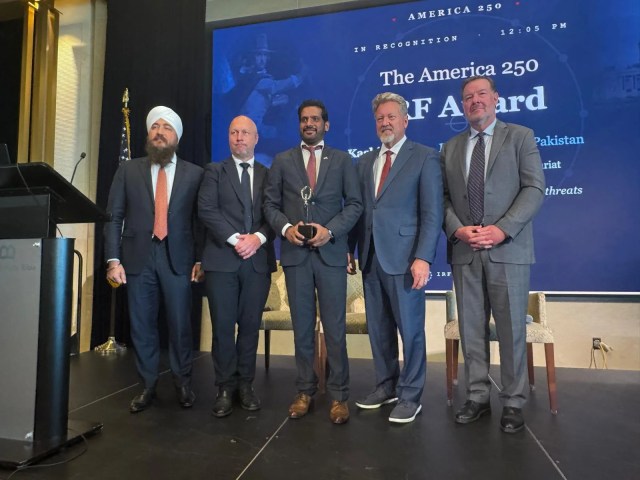
Mirza, Director of IRF Roundtable Pakistan, received the award at the America 250 IRF Peacebuilders Forum and Awards Ceremony at the Museum of the Bible in Washington, D.C., on July 17, 2026, in recognition of more than 15 years of work on religious freedom, minority rights and equal citizenship. Business Recorder reported the honour, and a press release carried by The Commercial Appeal followed.


The event slide read “Honoring leadership in the face of grave threats,” and the citation stressed that Mirza returns to Pakistan after each international engagement, where the risks of minority-rights advocacy remain real.
Chapter 2The National Commission for Minorities Rights Bill
The award citation credits Mirza and the IRF Roundtable Pakistan coalition with helping move the bill through Parliament. It was designed to create a statutory mechanism protecting minority interests and to give constitutional minority guarantees an institutional enforcement channel. The award materials call its passage a “landmark” achievement and describe Mirza as a primary catalyst of the coalition’s parliamentary advocacy.
What the commission is meant to do
In practical terms, it gives religious minorities a formal body to receive complaints, monitor violations, press government institutions and push for remedies.
Chapter 3The Punjab anti-forced-conversion campaign
Mirza’s current campaign seeks an enforceable ban on forced conversion in Punjab, legislation Pakistan has not previously had, with a focus on vulnerable young women and children from religious-minority communities. The framework described in the award materials has four elements. Select each to expand.
Clear prohibition on coerced conversion
Statutory language that names coerced religious conversion as an offence.
Judicial oversight of voluntariness
A court would assess whether a conversion or marriage was freely chosen.
Protective protocols for minors and young women
Special safeguards for those from minority backgrounds who are most exposed.
Enforcement mechanisms
Tools to prevent forced conversions from being presented as voluntary decisions.
Chapter 4Side by side: status of the efforts
Status: described in the award as having passed through Parliament.
Mirza’s role: coalition advocacy credited with helping move the bill forward.
Status: ongoing state-level campaign.
Mirza’s role: leading advocacy for an enforceable ban, judicial safeguards and protections for vulnerable women and children.
Status: ongoing legal and civic follow-up after the 2023 attacks on churches and Christian homes.
Mirza’s role: pressing courts for accountability and monitoring legal follow-through. IRF Roundtable Pakistan welcomed the Supreme Court’s order to expedite the cases.
| Legislative effort | Status in award | Recognised role |
|---|---|---|
| National Commission for Minorities Rights Bill | Passed through Parliament | Coalition advocacy helped move the bill |
| Punjab anti-forced-conversion law | Ongoing campaign | Leading advocacy for ban and safeguards |
| Jaranwala accountability | Ongoing follow-up | Pressing courts, monitoring follow-through |
Chapter 5From law to enforcement
Mirza’s organisation links legislation to implementation. Its Laws vs Reality research calls for operationalising the minority commission and enforcing mandatory FIRs in abduction cases. This echoes his stated focus on the “bureaucratic gap” between legal guarantees and delivery, described on his website.

“Every person is born with the freedom to liberty, life, and to practice their conscience. When this freedom is protected, societies flourish; when it is denied, societies suffocate and hate prevails.”— Muhammad Kashif Mirza, acceptance remarks
Mirza dedicated the award to Pakistani grassroots activists and religious communities, to journalist and roundtable member Imtiaz Mir, who was assassinated in Karachi in September 2025, and to late founding member Seema Kasim. Afterwards he said the recognition must translate into legal aid, victim support, parliamentary engagement and monitoring of government commitments.

Chapter 6What it means
The award recognised a legislative record built on institutional protection for minorities and preventive legal safeguards against forced conversion, not a single law. Whether the Punjab bill is enacted, and whether the commission is made fully operational, will decide if the recognition is matched by results on the ground. The IRF Roundtable network says it operates across 20 Pakistani cities with more than 40 roundtables engaging over 1,100 communities.
Chapter 7Sources and further reading
- Business Recorder — Kashif Mirza receives religious freedom award in Washington
- The Commercial Appeal / EIN Presswire — America 250 IRF Courage Award
- IRF Roundtable Pakistan and Laws vs Reality (PDF)
- National Law Review — Supreme Court order on Jaranwala cases
- The Express Tribune — Ghost commitments: Pakistan’s child rights crisis
- Kashif Mirza — official website
About The Author

Discover more from Faith & Freedom News - FFN
Subscribe to get the latest posts sent to your email.


