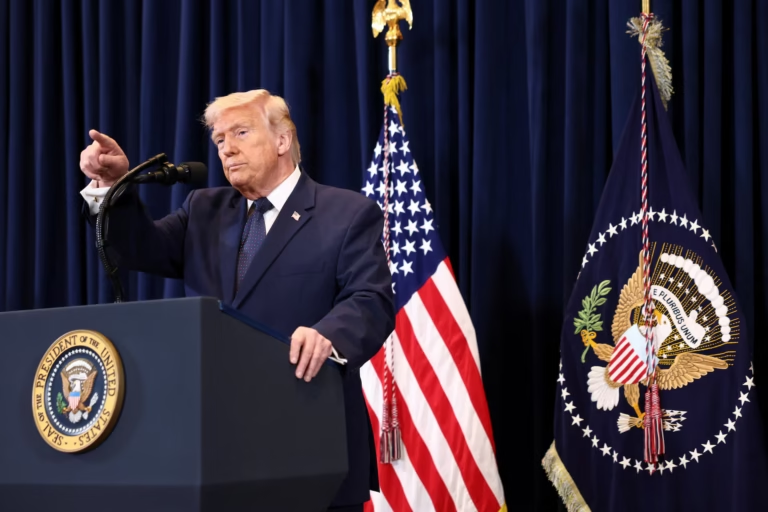
Gaza Ceasefire Opens Door to Expanded Abraham Accords
Trump Administration Eyes Historic Peace Initiative with Saudi Arabia and Indonesia
A Historic Opportunity Emerges
For the first time in decades, momentum for peace feels real. Streets in Gaza, Tel Aviv, and Ramallah echo with cautious relief, while global capitals — from Washington to Riyadh, Jakarta, and Islamabad — speak of a historic opportunity. The ceasefire and hostage-exchange deal have opened the door to broader reconciliation.
It is this rare momentum that the Trump administration now seeks to harness — not just to stop war, but to build a durable peace across the Muslim and Jewish worlds.
The Vision Reignited
The Abraham Accords were never just agreements on paper; they were a blueprint for coexistence. During President Trump’s first term, the Accords brought together nations that had been divided for generations — the United Arab Emirates, Bahrain, Sudan, and Morocco — in open relations with Israel.
Now, as the guns cool over Gaza, that same vision is being reignited. The White House is already in talks with Saudi Arabia and Indonesia — the two most significant prizes in the next phase of normalization.
Saudi Arabia: Ready to Join
A senior administration official recently revealed significant progress with Saudi Arabia:
Now, under Trump’s renewed leadership, that conversation is back on track — and this time, the mood is far more hopeful. Saudi Arabia represents far more than a diplomatic victory: it is a symbol of faith, leadership, and a shared future between the world’s major Muslim nations and Israel.
Key Regional Developments
- Gaza Ceasefire: Thousands of displaced Palestinians have begun returning to their shattered neighborhoods
- Diplomatic Shift: Arab capitals express cautious optimism that revenge cycles may give way to reconciliation
- Economic Focus: Regional leaders discuss development, knowledge-sharing, and collective security alongside humanitarian relief
- Framework Resilience: The Abraham framework, tested by war, has proven its staying power
Kushner Returns to the Diplomatic Stage
At the center of this diplomatic reawakening stands President Donald J. Trump, whose reputation as a “President of Peace” has gained new life. His trusted envoy, Jared Kushner, architect of the original Abraham Accords, has returned to the diplomatic stage with renewed purpose.
Kushner’s deep ties with Gulf leaders and his understanding of regional sensitivities make him the natural choice to lead this second wave of normalization. His vision remains clear: peace is not a political illusion, but an achievable architecture built on mutual interests.
Pakistan Weighs Its Options
Even in Pakistan — a country historically distant from Israel — the debate on joining the Abraham framework has intensified. Prime Minister Shehbaz Sharif, speaking at the Sharm El Sheikh Peace Summit, hailed Trump’s efforts, calling the Gaza ceasefire “a historic opportunity.”
PM Sharif’s Vision: “Durable peace between the Palestinian people and Israel would be essential for political stability and economic growth in the region.”
Within Pakistan, differing views are emerging:
- Defence Minister Khawaja Asif: Emphasizes prioritizing national interests
- Adviser Rana Sanaullah: Advocates aligning with Saudi Arabia and Arab partners on the Abraham initiative
Yet beneath these debates lies a growing realization — that in a world turning toward cooperation, disengagement is no longer an option.
A New Map of the Middle East
The next chapter of the Abraham Accords could be the most consequential. With Saudi Arabia and Indonesia on board, alongside potential openings with Mauritania, Algeria, and Lebanon, the peace framework could extend from the Atlantic coast to the Pacific, covering nearly half the Muslim world.
- Shared trade routes
- Integrated defense structures
- Joint development projects redefining prosperity
- Israel’s isolation becoming a relic of history
Faith and Realism, Hand in Hand
The genius of the Abraham Accords lies in their moral and spiritual foundation. As President Trump often reminds audiences, the name “Abraham” itself speaks of unity — the patriarch revered by Jews, Christians, and Muslims alike.
This sentiment underpins the emerging new order. Peace, in this vision, is not imposed — it is shared. It is born from the recognition that coexistence is not weakness but wisdom.
Toward a Shared Destiny
The Middle East stands on the edge of a transformation once thought impossible. The war in Gaza has scarred the region deeply, but it has also reminded the world of the urgency of peace.
With the Trump administration steering diplomacy with vigor and conviction, and with leaders from Riyadh to Islamabad signaling readiness to engage, the dream of a cooperative, integrated Middle East no longer feels distant.
If the Abraham Accords can expand into this next phase — encompassing Saudi Arabia, Indonesia, and beyond — it will not just reshape geopolitics; it will redefine the moral geography of our times.
And in this moment, as Gaza breathes again and the region turns toward dialogue, the world can at last glimpse what seemed impossible for generations: a Middle East where faith and diplomacy walk hand in hand toward a shared destiny.
About The Author

Discover more from Faith & Freedom News - FFN
Subscribe to get the latest posts sent to your email.