“Failed Miserably”:
Dr. Gargash Says Iran’s
Ferocious Attacks Were
Premeditated — And Containment Is Over
The UAE’s diplomatic adviser to President Sheikh Mohamed has delivered the most candid assessment of the Iran war yet: the attacks were not reactive but planned, containment strategies across the Gulf have failed without exception, and the threat Iran poses could extend for decades. A reckoning for the entire region.

No Diplomatic Cushioning: What Dr. Gargash Said — and Why It Matters
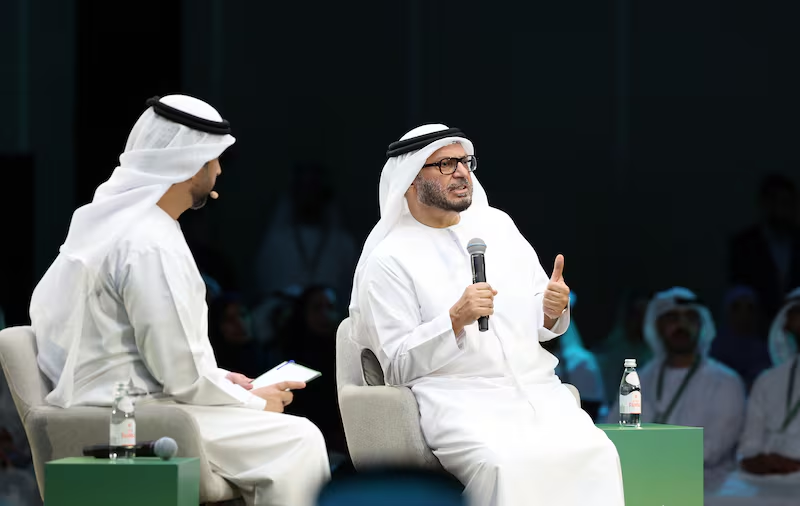
Dr. Anwar Gargash, diplomatic adviser to UAE President Sheikh Mohamed, chose the Gulf Creators forum in Dubai on April 27, 2026, to deliver what may be the most consequential public statement by a senior Gulf official since the Iran war began on February 28. His assessment is unsparing, documented, and demands to be heard by every government that has spent the past decade treating Iranian aggression as a manageable variable in regional diplomacy.
The attacks, Gargash said, were not the product of escalatory miscalculation or reactive fury. They were premeditated. Planned. Executed with “ferocity and recklessness” that even experienced Gulf security officials found unexpected in its scale. And the diplomatic consensus that had sustained Gulf states through years of Iranian provocations — the steady accumulation of agreements, mediations, energy partnerships, and trade relationships designed to create enough mutual interest to prevent open conflict — has been exposed, in his words, as a failure. Complete. Without exception.
“This was a premeditated plan, not a decision made in 24 or 48 hours. Iran’s attack on its Arab neighbours is a planned attack, part of a confrontation scenario devised by Iranian planners, who built the necessary fortifications and armed themselves accordingly.”
Dr. Anwar Gargash · Diplomatic Adviser to UAE President · Gulf Creators, Dubai · April 27, 2026537 Ballistic Missiles. 2,256 Drones. The UAE Has Never Seen This Before — And Neither Has the Gulf.
The statistics are not abstractions. They represent the physical reality of what the UAE — and Gulf states more broadly — absorbed from February 28 onward: a sustained, multi-vector attack that mobilised ballistic missiles, cruise missiles, and drones in numbers that no regional conflict had previously generated. The UAE’s air defence systems were tested at a scale that was, in Gargash’s own framing, historically unprecedented.
Two UAE Armed Forces personnel and a Moroccan civilian contractor working for the military were killed in the attacks. These are not abstract strategic losses — they are individuals who did not survive an assault that Gargash insists was designed not as a defensive response to US military action but as a premeditated assault on Iran’s Arab neighbours. The missiles and drones that Tehran described as defensive capabilities directed at US forces were, in his words, “turned against us, turned against its neighbours.”
“Failed Miserably”: Every Gulf Strategy — Mediation, Trade, Energy — Has Been Undone
Perhaps the most significant dimension of Gargash’s statement is his comprehensive indictment of the containment strategies that Gulf states — including the UAE — have pursued over decades. His list is exhaustive because it needs to be: every modality through which Gulf governments attempted to create a stable relationship with Iran, or at least a predictable one, has been tried and has failed.
“Every Gulf state has pursued a policy of containing Iran, and all of those containment policies have failed — whether this containment took the form of mediation, or participation in shared energy fields, or strategic agreements, or — as in the case of the UAE — through trade relations. They have failed miserably.”
Dr. Anwar Gargash · Gulf Creators, Dubai · April 2026“Imagine If Iran Had Nuclear Weapons”: The Question That Now Haunts Every Gulf Planning Room
Among the most alarming passages in Gargash’s remarks is his projection of what the current conflict would have looked like had Iran possessed nuclear military capabilities. The point is not hypothetical scaremongering — it is a strategic assessment with direct implications for every discussion of the Iranian nuclear programme and of the adequacy of current deterrence architectures.
The breach of trust Gargash describes is not merely diplomatic — it is civilisational in its implications for the Gulf. States that spent decades building commercial and human ties with Iran, that allowed Iranian traders to operate from Dubai, that participated in Iranian energy projects, now face the reality that all of that economic integration provided no deterrent. The asymmetry of the relationship — in which the UAE and Gulf states had real economic stakes in stability while Iran had a pre-prepared military plan to attack regardless — has been laid bare.
GCC at Its Weakest: The Case for Gulf Solidarity and a Strengthened US Role
Gargash’s assessment of the GCC’s performance during the crisis is blunt: the Gulf Cooperation Council is at its “weakest in history,” and Gulf solidarity “was not up to the task.” This is not a criticism of any individual state — it is a structural observation about the gap between the GCC’s collective security architecture and the reality of the threat it faced.
On the American role, Gargash takes a notably different position from the narrative that US military engagement in the region has become less necessary or desirable. The Iran war, in his assessment, has done the opposite — it has made the American role more important, not less. And he frames that role in its full breadth: not merely military facilities, but a defence architecture, political support, and economic and financial engagement.
What Dr. Gargash Has Said That Must Not Be Left Unheard
As Founder and President of the European Association for the Defense of Minorities, I have spent years documenting what happens to vulnerable communities — Christians, Yazidis, Kurds, Arab Sunnis, and others — when regional security architectures fail and Iran’s proxies fill the vacuum. The consequences are always borne disproportionately by the most vulnerable. The Iran war has confirmed, in the most direct and violent way possible, that the containment model was not merely insufficient — it was, as Gargash says, a failure across every modality in which it was attempted.
His call for Gulf unity, for a reassessment of how peace can be achieved without creating future crises, and for the strengthening of the American role in regional security architecture resonates deeply. Europe, too, must listen — because the Iranian threat to European soil, documented in more than 100 plots across EU member states, is part of the same strategic pattern that produced the February 28 attacks. The Gulf and Europe face the same adversary. The response must be coordinated, serious, and grounded in the kind of honest assessment that Dr. Gargash has now made public.
Any political solution must address the interests of all countries involved. We want a political solution — but not one that will create future crises. The region has paid too high a price for solutions that only postponed the reckoning.
Dr. Anwar Gargash · April 2026 — endorsed by Manel Msalmi, FFN Chief ExecutiveThe UAE has demonstrated, over decades, that an open, tolerant, economically diversified society is not only possible in the Gulf — it is the strongest possible foundation for genuine resilience. Gargash’s confidence in the UAE’s fundamentals — its diversified economy, its governance capacity, its leadership — is not misplaced. It is a confidence built on substance, not optimism. And his acknowledgment that certain sectors, including tourism, have suffered serious damage, combined with his insistence that recovery requires active work rather than passive waiting, reflects exactly the combination of honesty and determination that the current moment demands.
Dr. Gargash’s remarks at Gulf Creators are not merely a retrospective on a conflict. They are a framework for what must come next: Gulf unity rebuilt on honest assessment, a reassessment of Iran that acknowledges the depth of the trust collapse, a strengthened security partnership with the United States, and a political solution that genuinely addresses all interests rather than papering over the structural contradictions that produced this war.
From Brussels, I endorse this analysis without reservation. The era of containment through accommodation is over. What replaces it must be built on clarity, solidarity, and the kind of principled determination that the Gulf — and the world — will need for the decades ahead.
About The Author

Discover more from Faith & Freedom News - FFN
Subscribe to get the latest posts sent to your email.


