US–Iran Peace Talks Begin in Islamabad — JD Vance Leads American Delegation as Pakistan Hosts Historic Negotiations
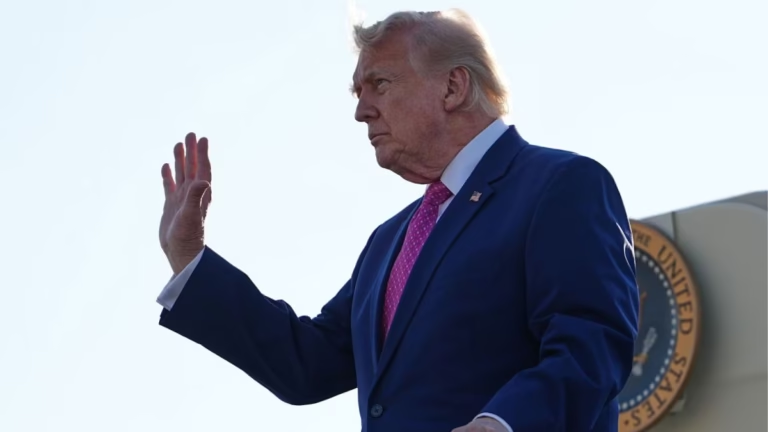
High-level direct negotiations between Washington and Tehran opened today in Islamabad, Pakistan, with VP JD Vance heading the U.S. team. The talks aim to transform a fragile two-week ceasefire into a lasting end to a six-week war that devastated Iran’s military and brought the Strait of Hormuz to the brink of full closure.
History is being made in the Pakistani capital today. For the first time in decades, senior American and Iranian officials are sitting across from each other in direct, face-to-face negotiations — not through intermediaries, not through back-channels, but in the same room — as the world holds its breath over whether the most dangerous regional conflict in a generation can be brought to a durable end.
The talks, hosted and mediated by Pakistan under Prime Minister Shehbaz Sharif, formally commenced this afternoon local time at a heavily secured venue in Islamabad. A two-day public holiday has been declared in the city, with army and paramilitary deployments, road closures, and security cordons around the Serena Hotel and convention centers. Billboards across Islamabad display the “Islamabad Talks April 2026” with flags of the United States, Iran, and Pakistan.
Current Status — As of 7:35 p.m. PKT (2:35 p.m. GMT)
Direct US–Iran talks are underway with Pakistani mediators in the room. Early sessions are focused on bridging the 15-point US framework against Iran’s 10-point counter-proposal. No breakthrough announced. Ceasefire holds but remains fragile. Both delegations remain at the venue.
The delegations
- VP JD VanceDelegation Lead
- Steve WitkoffTrump’s Special Envoy
- Jared KushnerSenior Adviser
- Mohammad Bagher GhalibafParliament Speaker · Lead
- Abbas AraghchiForeign Minister
- Ali Akbar AhmadianSNSC Secretary
- PM Shehbaz SharifHost & Facilitator
- FM Mohammad Ishaq DarForeign Minister
- Gen. Asim MunirArmy Chief
What’s on the table — and where the gaps are
The US and Iran arrived in Islamabad with starkly different starting positions. Washington submitted a 15-point proposal; Tehran countered with a 10-point framework of its own. Little initial overlap exists. Yet Trump described Iran’s plan as a “workable basis” — a remark interpreted by analysts as an effort to keep Tehran at the table rather than a substantive concession.
Key Agenda Items & Sticking Points
Key statements from the principals
“The Iranians don’t seem to realize they have no cards, other than a short-term extortion of the world by using international waterways. The only reason they are alive today is to negotiate!”
“If the Iranians are willing to negotiate in good faith, we’re certainly willing to extend an open hand. If they’re going to try to play us, then they’re going to find that the negotiating team is not that receptive.”
“The Pakistani leadership will make sure these talks are successful by putting in their best efforts… It is all in God’s hands. These are make-or-break talks for the region’s future.”
“The US–Iran talks in Islamabad are aimed at helping end an illegal war against the Iranian nation. Iran’s preconditions — Lebanon ceasefire and sanctions — must be respected.”
“No nuclear weapon. That’s 99% of it.”
— President Donald Trump, on core US demands entering the Islamabad talksPakistan’s role as host and mediator has been praised internationally as a rare success in shuttle diplomacy. It was Islamabad that brokered the initial ceasefire through back-channel contacts, and Prime Minister Sharif who personally invited both delegations to use Pakistan as neutral ground. Former Pakistani ambassador Maleeha Lodhi has appeared on Al Jazeera and other outlets discussing what this moment means for Pakistan’s global standing.
Even as diplomats talk, the Strait of Hormuz situation remains on a knife’s edge. Iran has not fully lifted restrictions, with reports of selective passage and transit fees. Trump warned bluntly that the Strait “will open… with or without” Iran — and US warships are being reloaded if needed. A US warship reportedly advanced toward Iranian positions just hours before talks opened, prompting an Iranian warning that it would be “targeted within 30 minutes.”
Live reaction — coverage from X
The Islamabad talks have generated an enormous volume of real-time reporting and commentary on X. Below are all significant posts from the past 24 hours, organized by source.
What success looks like — and what happens if talks fail
Analysts caution against expecting a comprehensive agreement from these opening sessions. The more realistic near-term goal is an extension of the fragile ceasefire and agreement on a framework for further negotiations. Longer-term issues — nuclear enrichment limits, sanctions architecture, proxy militia disarmament — will likely require multiple rounds of talks spanning months even in the best-case scenario.
But the stakes of failure are equally stark. A collapse of the Islamabad talks would likely trigger a resumption of hostilities, renewed full closure of the Strait of Hormuz, and a return to missile and drone exchanges — this time potentially on terms even more dangerous than the six-week war that just ended. The world is watching Islamabad today with that knowledge front and center. FFN will continue live updates throughout the day.
About The Author

Discover more from Faith & Freedom News - FFN
Subscribe to get the latest posts sent to your email.