The United States and Iran are locked in the most dangerous nuclear standoff in a generation — and the world may learn this week whether diplomacy or military force will define what comes next. Talks between American and Iranian envoys resume Thursday in Geneva, Switzerland, even as the largest U.S. naval and air deployment to the Middle East in over two decades takes shape on Iran’s doorstep.
President Donald Trump, in his State of the Union address delivered Tuesday evening, February 24, laid out his position with characteristic bluntness: Iran must renounce nuclear weapons entirely — or face the consequences. “My preference is to solve this problem through diplomacy,” Trump told a joint session of Congress. “But one thing is certain: I will never allow the world’s number one sponsor of terror to have a nuclear weapon. Can’t let that happen.”
We are in negotiations with them. They want to make a deal, but we haven’t heard those secret words — ‘We will never have a nuclear weapon.’
— President Donald J. Trump, State of the Union Address, Feb. 24, 2026Operation Midnight Hammer: The Strike That Changed Everything
The backdrop to this week’s talks is last summer’s dramatic military operation. On June 21, 2025, the United States military — in coordination with Israel — launched Operation Midnight Hammer, a series of precision strikes targeting Iran’s primary nuclear enrichment facilities at Fordow, Natanz, and Isfahan. Trump described the strikes as having “obliterated” Iran’s nuclear weapons program, though U.S. assessments note significant damage rather than complete elimination.
In his State of the Union, Trump recalled the operation with characteristic pride, framing it as a fulfillment of longstanding American policy: “For decades, it had been the policy of the United States never to allow Iran to obtain a nuclear weapon — many decades. Since they seized control of that proud nation 47 years ago, the regime and its murderous proxies have spread nothing but terrorism and death and hate.”
After Midnight Hammer, they were warned to make no future attempts to rebuild their weapons program, in particular nuclear weapons, yet they continue starting it all over. We wiped it out and they want to start all over again. And are at this moment again pursuing their sinister ambitions. We are in negotiations with them. They want to make a deal, but we haven’t heard those secret words — ‘We will never have a nuclear weapon.’ My preference is to solve this problem through diplomacy. But one thing is certain, I will never allow the world’s number one sponsor of terror, which they are by far, to have a nuclear weapon. Can’t let that happen.
Where Each Side Stands
The core dispute is clear — but the gap between the two positions remains vast. The U.S. demands a complete end to uranium enrichment on Iranian soil and verifiable dismantlement of any nuclear weapons pathway. Iran insists it has an “inalienable right” to peaceful nuclear technology and will not surrender domestic enrichment as a matter of national sovereignty and regime legitimacy.
Zero enrichment & full dismantlement
- No domestic uranium enrichment — full stop
- Intrusive, verifiable inspections required
- Iran must declare: “We will never have a nuclear weapon”
- Sanctions relief only in exchange for verified concessions
- Deal must exceed the abandoned 2015 JCPOA in rigor
Enrichment rights are non-negotiable
- Willing to ship out stockpile of highly enriched uranium
- Open to regional enrichment consortium arrangement
- Demands U.S. recognition of enrichment rights
- Seeks sanctions relief in return
- Will not yield sovereignty — warns of “firm retaliation” to any attack
Iranian Foreign Minister Abbas Araghchi, speaking on February 24, said a deal was “within reach” and described potential terms as “unprecedented.” Tehran’s proposal — still being finalized as of Wednesday — reportedly involves shipping out much of its highly enriched uranium stockpile and diluting the rest, in exchange for sanctions relief and formal recognition of enrichment rights. The U.S. has signaled it may be open to “token” enrichment for medical purposes if truly non-weaponizable, but zero enrichment remains its stated red line.
The Military Buildup: A Message in Steel and Fire
Running parallel to the diplomatic track is what analysts are calling the largest U.S. military posture in the Middle East since the lead-up to the 2003 Iraq invasion. The deployment is widely understood as a pressure tactic — but it carries with it the very real risk of miscalculation.
in the Arabian Sea
Deployed to Region
Now Positioned
The USS Abraham Lincoln and the USS Gerald R. Ford — the world’s largest aircraft carrier — are both positioned in the Arabian Sea and Persian Gulf area, accompanied by roughly 16 surface warships. Over 150 additional combat aircraft, including F-35s, F-22s, and F-16s, have been moved to bases across the Gulf and Europe since mid-February. The build exceeds even the pre-Midnight Hammer posture from last year.
Joint Chiefs Chairman General Dan Caine has reportedly briefed Trump on the risks of prolonged conflict: Iranian retaliatory missile strikes against U.S. bases, attacks on Israel and Gulf allies, and potential disruption of global oil shipments through the Strait of Hormuz — one of the world’s most critical chokepoints for energy supply.
A Timeline of Crisis
Operation Midnight Hammer: U.S. and Israeli forces strike Iran’s nuclear facilities at Fordow, Natanz, and Isfahan. Significant damage confirmed; Iran’s program set back but not eliminated.
Oman-mediated indirect talks resume. First round in Oman sees limited progress. Iran requests time to prepare a formal proposal.
Second round in Geneva. Described publicly as “positive” but privately approaching impasse on core issues. U.S. officials express frustration with Iran’s pace.
Trump delivers State of the Union. Issues public ultimatum to Iran and acknowledges ongoing negotiations. Describes military buildup and $1 trillion defense budget. Iran’s Foreign Minister says deal is “within reach.”
Third round of talks in Geneva. Iran expected to present detailed proposal. U.S. envoys Steve Witkoff and Jared Kushner lead American delegation. This round may determine whether diplomacy holds — or collapses.
Perspectives: A ‘Dangerous Mismatch’
Foreign policy analysts warn that both sides may be badly misreading each other’s intentions — a recipe for catastrophic miscalculation. The United States views its overwhelming military presence as legitimate leverage to extract a verifiable deal. Iran’s leadership, by contrast, reportedly views major concessions as an existential threat to the regime itself — potentially riskier than absorbing another round of strikes.
“There is a dangerous mismatch in perceptions,” one analyst noted. “Washington sees pressure as deal-making. Tehran sees it as a prelude to regime change. That gap does not close easily at a negotiating table.” The International Crisis Group has noted that Iran’s rulers believe yielding to U.S. demands would invite endless further pressure, making capitulation politically suicidal for the clerical government.
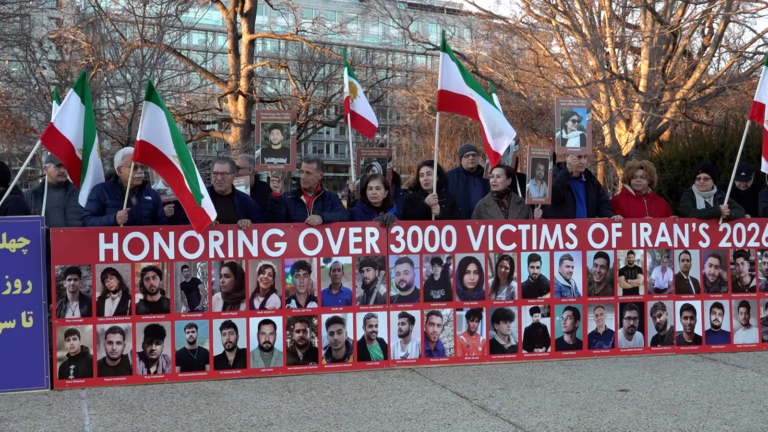
For ordinary Iranians — already battered by years of sanctions, internal unrest, and the trauma of government crackdowns that Trump cited in his speech — the coming days carry a weight that is deeply personal. Iran, a proud civilization of millennia, finds itself at a crossroads between a defiant regime and a world that grows less patient by the hour.
No nation should ever doubt America’s resolve. We have the most powerful military on earth — and hopefully we will seldom have to use this great power that we built together.
— President Trump, State of the Union, February 24, 2026What Comes Next
Thursday’s Geneva session may be the most consequential diplomatic encounter in years. If Iran tables a proposal that credibly addresses American core demands — even in part — the window for diplomacy could widen. If the proposal is seen in Washington as stalling, sources suggest Trump could authorize new military action within days or weeks. Trump has reportedly given Iran a 10 to 15 day deadline from mid-February.
The Faith & Freedom News team will continue to monitor this situation as it develops. Readers are encouraged to pray for wisdom in the halls of power, protection for American servicemen and women in the region, and for the people of Iran — who did not choose this regime and do not deserve this suffering.
— FFN Staff, Washington Bureau
About The Author

Discover more from Faith & Freedom News - FFN
Subscribe to get the latest posts sent to your email.