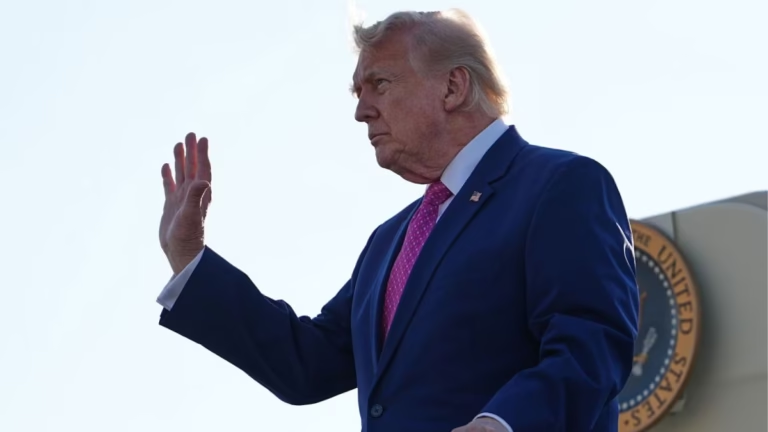
Trump Leads Historic Board of Peace Meeting With $17 Billion in Pledges for Gaza
Nearly 50 nations gathered in Washington for the inaugural summit of the Board of Peace at the Donald J. Trump Institute of Peace — a landmark moment in multilateral diplomacy aimed at turning ceasefire into lasting reconstruction.

WASHINGTON, D.C. — The inaugural summit of the Board of Peace at the Donald J. Trump Institute of Peace marked an ambitious and consequential moment in contemporary diplomacy. With nearly 50 nations in attendance and more than $17 billion pledged for Gaza’s reconstruction and stabilization, the gathering sent an unambiguous signal: the international community is prepared to move from rhetoric to rebuilding.
The meeting, presided over by US President Donald Trump, set an unapologetically results-driven tone from the outset. By its conclusion, over $17 billion had been committed for the stabilization and rebuilding of Gaza — with the United States alone pledging $10 billion. Further contributions came from partners across the Middle East, Central Asia, and beyond. Plans for an International Stabilization Force of up to 20,000 personnel underscored that reconstruction would proceed in tandem with concrete security guarantees, not in spite of them.
“What we’re doing is very simple: peace. It’s called the Board of Peace, and while it’s an easy word to say, it’s a tough one to create.”— President Donald J. Trump, Inaugural Board of Peace Summit
President Trump’s address defined the event’s character. He described the board as the most prestigious ever assembled and framed its mission in unambiguous terms: demilitarization, rebuilding, and economic revival must advance together, not sequentially. He also issued a pointed warning regarding Iran, making clear that military options remain on the table if diplomatic engagement falters.
Senior American officials reinforced the summit’s ambition. Vice President JD Vance stressed that the nations represented collectively account for trillions of dollars of investment in the United States — investment made possible, he argued, by President Trump’s peace leadership. Secretary of State Marco Rubio credited the president’s vision with achieving what observers had considered impossible just months prior: a coordinated global commitment to resolving the Gaza crisis. “We are here today because of President Trump’s vision,” Rubio stated. “If we go back just a few months ago, people thought what was happening in Gaza was impossible to solve.”
Former British Prime Minister Tony Blair added international weight to the proceedings. Speaking in support of the president’s plans, Blair expressed hope that Hamas would ultimately disarm and transition into political activity, insisting the focus must now shift toward providing solutions for the people of Gaza rather than dwelling on the scope of the problems.
Israeli Foreign Minister Gideon Sa’ar welcomed the plan’s comprehensive architecture — addressing the disarmament of Hamas and Islamic Jihad, the demilitarization of the Gaza Strip, and the deradicalization of Palestinian society — describing the president’s vision as creating, for the first time, a genuine opportunity for a better future.
The summit’s international dimension was equally striking. The UAE’s Sheikh Abdullah bin Zayed, Deputy Prime Minister and Minister of Foreign Affairs, announced an additional $1.2 billion contribution. Kazakhstan’s President Kassym-Jomart Tokayev pledged both financial support and university scholarships for Gazan students — a recognition that investing in human capital is inseparable from physical reconstruction. Pakistan’s Prime Minister Shehbaz Sharif adopted a forward-looking tone, expressing confidence that decisive international leadership can guide Gaza from devastation to development. President Trump acknowledged Pakistan’s contribution personally, praising both PM Sharif and Chief of Army Staff Field Marshal Syed Asim Munir by name.
“For the first time in months, the conversation in Washington centered not on escalation — but on investment, stabilization, and opportunity.”— Times of Israel
Gaza’s path forward nonetheless remains formidable. Demilitarization, reconstruction, and political reconciliation will test the resolve of every party at the table. Yet the summit’s significance lay not only in the figures pledged, but in the coalition assembled: Muslim-majority nations and Western powers aligned around a shared reconstruction vision, with a technocratic model of governance at its center. If the commitments translate into concrete action on the ground, this inaugural Board of Peace meeting will be remembered as the opening chapter of a structured, internationally backed effort to achieve a just and lasting peace in Gaza.

Expert on the Middle East & Human Rights Advocate
This article is based on reporting originally published in The Times of Israel. Read the full original article:
blogs.timesofisrael.com/trump-leads-historic-board-of-peace-meeting/ →About The Author

Discover more from Faith & Freedom News - FFN
Subscribe to get the latest posts sent to your email.