Trump Hits ISIS in Nigeria on Christmas, Citing Mass Christian Killings
“Our Country Will Not Allow Radical Islamic Terrorism to Prosper” – President Authorizes Deadly Strike Against ISIS Terrorists in Northwest Nigeria
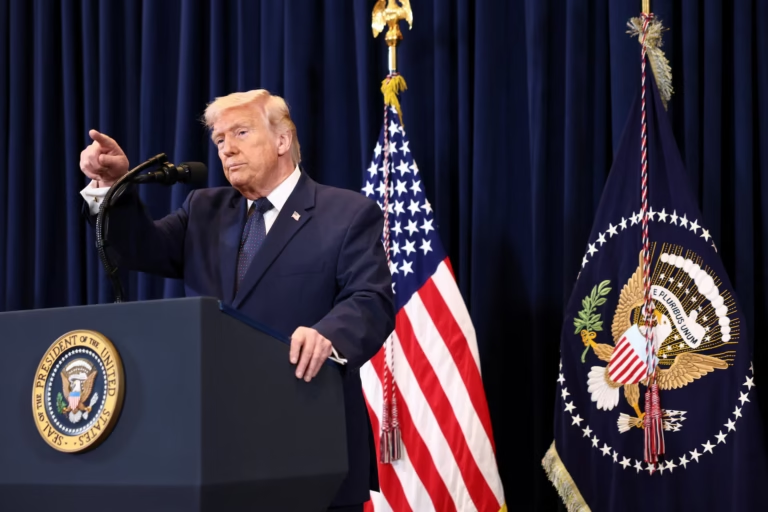
Acting in his capacity as Commander in Chief, President Trump announced the operation via Truth Social, describing the assault as a “powerful and deadly strike against ISIS Terrorist Scum” and emphasizing that the action was a direct response to ongoing violence against innocent Christians at levels not seen in years, possibly centuries.
Presidential Statement
“Tonight, at my direction as Commander in Chief, the United States launched a powerful and deadly strike against ISIS Terrorist Scum in Northwest Nigeria, who have been targeting and viciously killing, primarily, innocent Christians, at levels not seen for many years, and even Centuries!”
“I have previously warned these Terrorists that if they did not stop the slaughtering of Christians, there would be hell to pay, and tonight, there was. The Department of War executed numerous perfect strikes, as only the United States is capable of doing.”
“Under my leadership, our Country will not allow Radical Islamic Terrorism to prosper. May God Bless our Military, and MERRY CHRISTMAS to all, including the dead Terrorists, of which there will be many more if their slaughter of Christians continues.”
PRESIDENT OF THE UNITED STATES OF AMERICA
Operation Details and Execution
The military operation involved precision-guided munitions, including Tomahawk cruise missiles launched from a U.S. Navy vessel stationed in the Gulf of Guinea. The strikes decimated multiple ISIS camps located in remote forested areas of Sokoto State in northwest Nigeria.
Operational Achievements
- Multiple ISIS terrorist camps destroyed in Sokoto State
- Key terrorist infrastructure eliminated
- Several high-value ISIS operatives neutralized
- No reported civilian casualties according to official statements
- Operation conducted with full Nigerian government cooperation and intelligence support
Initial assessments from U.S. Africa Command (AFRICOM) confirmed the successful elimination of several terrorists and the destruction of critical operational infrastructure. Nigerian authorities cooperated closely throughout the operation, providing intelligence and granting approval for the strikes, highlighting strengthened bilateral counterterrorism efforts between the United States and Nigeria.
Background: ISIS in Nigeria and Christian Persecution
ISIS’s West Africa Province (ISWAP), an affiliate of the global terrorist network, has been active in Nigeria since approximately 2015, after splintering from Boko Haram. The group has established strongholds in the northwest regions and Lake Chad basin, conducting brutal campaigns that include bombings, kidnappings, and mass executions.
The Scale of Persecution
Christian communities have been disproportionately targeted in a region already plagued by ethno-religious tensions. According to credible reports, thousands of Christians have been killed in Nigeria over the past decade, with ISIS and similar extremist groups responsible for:
- • Church burnings and desecration of holy sites
- • Forced conversions to Islam
- • Mass displacement creating humanitarian crises
- • Systematic village raids targeting Christian populations
- • Kidnappings for ransom and forced labor
Organizations like Open Doors rank Nigeria among the top countries worldwide for anti-Christian violence. The persecution is not isolated but part of a broader pattern where Islamist extremists exploit Nigeria’s porous borders and governance challenges to expand their influence and terrorize religious minorities.
ISIS West Africa Province Emerges: ISWAP splits from Boko Haram and begins establishing territorial control in northwest Nigeria and Lake Chad region.
Decade of Terror: Sustained campaign of violence results in thousands of Christian deaths, with attacks intensifying around Christmas and Easter holidays.
Record Violence: Over 5,000 Christians killed in targeted attacks by ISIS affiliates and other extremist groups.
U.S. Military Response: President Trump authorizes precision strikes against ISIS camps in Sokoto State, eliminating key terrorist infrastructure.
Strategic and Moral Justification
From a strategic counterterrorism perspective, these strikes represent a significant blow to ISIS operations in West Africa. The terrorist group poses not merely a local threat but a regional one with the potential to destabilize West Africa and export fighters to other continents.
The timing of the strikes carries both symbolic and psychological significance. By conducting the operation on Christmas Day, President Trump framed it as delivering a “Christmas present” to the terrorists, adding an element of psychological warfare designed to demoralize enemies while boosting allied morale.
Strategic Impact and Implications
🎯 Counterterrorism
Disrupts ISIS operational capacity, recruitment, and planning in West Africa, preventing expansion of terrorist activities.
🛡️ Religious Freedom
Sends clear message that violence against religious minorities will be met with decisive military response.
🌍 Regional Stability
Strengthens Nigeria’s security apparatus and prevents spillover of extremism to neighboring West African nations.
🤝 International Partnership
Reinforces U.S.-Nigeria bilateral security cooperation and intelligence sharing mechanisms.
Moral Imperative and Human Rights
Beyond strategic considerations, the operation represents a defense of fundamental human rights. Christians in Nigeria face existential threats that are often underreported in international media due to the region’s complexity and distance from Western news centers.
President Trump’s explicit focus on this demographic counters narratives that downplay or ignore the religious motivations behind jihadist violence. The strikes acknowledge that ISIS’s radical ideology inherently targets non-Muslims and seeks to establish religious supremacy through violence and intimidation.
Why This Action Matters
- Protects vulnerable religious minorities facing genocidal violence
- Establishes clear red lines against religiously motivated terrorism
- Demonstrates U.S. commitment to international religious freedom
- Prevents humanitarian crises and refugee flows that strain global resources
- Deters future attacks through credible deterrence strategy
Critics may argue that military strikes risk escalation or unintended consequences. However, historical evidence demonstrates that appeasement and inaction embolden terrorist organizations. The unchecked growth of ISIS in Iraq and Syria between 2013-2014, which led to the establishment of a self-declared caliphate, serves as a stark reminder of the costs of delayed action.
International Response and Future Operations
Public and expert reactions have been largely supportive among security professionals and conservative policy circles. On social media platform X (formerly Twitter), users hailed the strikes as an “amazing Christmas present” to Nigerian Christians, with posts emphasizing President Trump’s decisiveness and commitment to protecting religious freedom.
Nigerian government officials confirmed the joint nature of the operation and praised U.S. assistance in combating terrorist threats. The collaboration highlights the effectiveness of international partnerships in addressing transnational security challenges.
President’s Warning to Terrorists
President Trump concluded his statement with a clear warning: there will be “many more” strikes if the killings of Christians continue. This establishes a policy of sustained pressure and credible deterrence, signaling that the United States will not tolerate religious persecution or terrorist violence against innocent civilians.
The operation may inspire similar decisive actions against terrorist groups in other regions, sending a message to organizations like Hamas, Al-Qaeda, and their affiliates that the United States under President Trump will actively confront and eliminate threats to religious freedom and international security.
Broader Implications for Regional Security
Stabilizing Nigeria—Africa’s largest economy and a major oil producer—carries significant economic implications for global markets. Reduced instability in the region helps prevent price spikes and supply disruptions that affect worldwide energy markets.
Furthermore, the operation demonstrates that the U.S. maintains global reach and the capability to conduct precision strikes anywhere terrorists threaten American interests or fundamental human rights. This capability serves as a deterrent to extremist groups worldwide while reassuring allies and partners of continued American leadership in global security.
Looking Forward: A Comprehensive Strategy
The Christmas strikes on ISIS in Nigeria represent more than a single military operation—they signal a comprehensive approach to combating radical Islamic terrorism that combines:
Intelligence
Close cooperation with Nigerian and regional partners for actionable intelligence
Precision
Advanced military capabilities that eliminate terrorists while avoiding civilian casualties
Deterrence
Clear messaging that violence against religious minorities will be met with overwhelming force
Partnership
Strengthened bilateral relationships that enhance long-term regional stability
Conclusion
President Trump’s Christmas strikes on ISIS in Nigeria represent bold, effective leadership in the global fight against terrorism. By citing mass Christian killings and acting decisively to protect religious minorities, this operation not only addresses an urgent humanitarian crisis but also reaffirms America’s commitment to religious liberty, human rights, and international security. The strikes demonstrate that under President Trump’s leadership, the United States will not tolerate radical Islamic terrorism and will take swift, decisive action to protect innocent lives and defend fundamental freedoms worldwide.
About The Author

Discover more from Faith & Freedom News - FFN
Subscribe to get the latest posts sent to your email.