Trump Declares “Productive Regime Change” in Iran as Ceasefire Hangs in the Balance
President Trump announces a nuclear deal framework, markets surge, and Pete Hegseth declares all U.S. military objectives met — but Tehran accuses Washington of breaking the truce.
Key developments
- Trump posts on Truth Social declaring a “very productive Regime Change” in Iran
- Framework eliminates uranium enrichment; “nuclear dust” to be located and removed
- Defense Secretary Hegseth: all U.S. military objectives in Iran have been achieved
- Iran’s parliamentary speaker accuses U.S. of violating ceasefire terms
- UAE calls for “complete and unconditional” reopening of the Strait of Hormuz
President Donald Trump announced a major breakthrough in U.S.–Iran relations Wednesday, posting on Truth Social that Iran has undergone what he called a “very productive Regime Change” — opening the door to direct cooperation between Washington and Tehran for the first time in decades.
According to the president’s statement, the two nations will now work together under a framework that eliminates uranium enrichment, a longstanding red line for the United States and its allies. Trump said American efforts will focus on locating and removing deeply buried nuclear material — described as “nuclear dust” — including remnants from prior U.S. B-2 bomber strikes.
“Many of the 15 points” of a broader agreement have reportedly already been agreed upon, with discussions including potential tariff reductions and sanctions relief contingent on Iran’s full compliance.
— President Donald J. Trump, via Truth SocialTrump emphasized that Iran’s nuclear infrastructure has remained untouched since the strikes and is being closely monitored through advanced satellite systems operated by the U.S. Space Force. He added that negotiations are already progressing on a broader multi-point agreement.
From a conservative standpoint, the announcement reflects a continuation of Trump’s “peace through strength” doctrine — applying decisive military and economic pressure to force adversaries into meaningful concessions. Supporters argue that halting uranium enrichment and securing cooperation on nuclear cleanup represents a landmark victory for U.S. national security and regional stability in the Middle East.
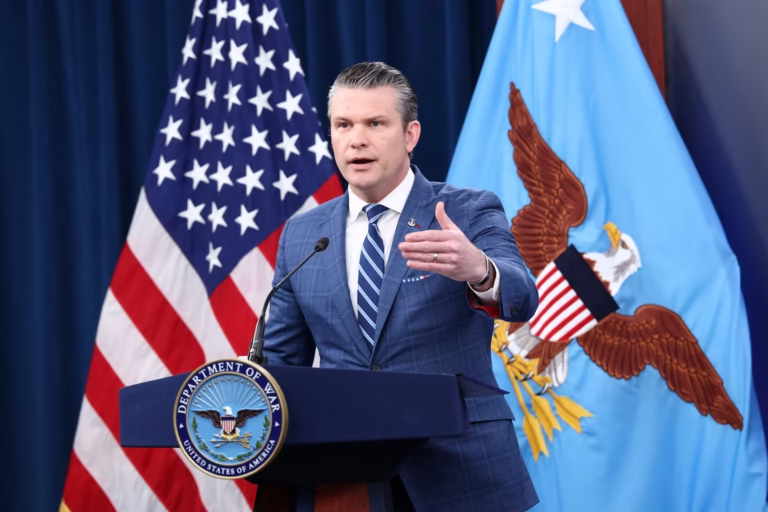
U.S. Defense Secretary Pete Hegseth — whom the Trump administration has referred to as “Secretary of War” — declared that all U.S. military objectives in Iran had been achieved, signaling a successful conclusion to the conflict. His remarks came as global markets reacted sharply and positively to the ceasefire announcement.
The S&P 500 rose 2.7 percent and the tech-heavy Nasdaq 100 gained 3.5 percent at the open, while global oil benchmark Brent crude fell 15 percent to around $93 a barrel — reflecting investor optimism that Middle East tensions may ease after weeks of conflict.
Iran’s parliamentary speaker, Mohammad Bagher Ghalibaf, wasted little time accusing Washington of violating the two-week ceasefire agreement, posting a statement on social media that cited what he described as the United States’ repeated failure to honor its commitments throughout history.
“The deep historical distrust we hold toward the United States stems from its repeated violations of all forms of commitments — a pattern that has regrettably been repeated once again.”
— Mohammad Bagher Ghalibaf, Iranian Parliamentary SpeakerHis remarks came as Iranian President Masoud Pezeshkian urged European nations to play an “effective” role in ensuring lasting stability and security in the region. In a phone call with French President Emmanuel Macron, Pezeshkian called on Europe to pressure both the United States and Israel to adhere to their ceasefire commitments and counter any violations.
Pezeshkian also raised the need for a ceasefire in Lebanon, describing it as a key condition in Iran’s reported 10-point peace plan. The Iranian president’s remarks came even as the broader ceasefire’s durability remained in question on multiple fronts.
The United Arab Emirates sought formal clarification on the ceasefire terms, stressing the importance of ensuring Iran’s full commitment to an immediate halt in hostilities. The UAE’s Foreign Ministry called for the “complete and unconditional reopening” of the Strait of Hormuz — a vital global oil shipping route through which roughly 20 percent of the world’s oil supply flows.
In a formal statement, the UAE ministry stressed the need for “a comprehensive approach that addresses Iran’s full range of threats” and warned against risks to freedom of navigation in the strait. The UAE also reaffirmed that it is not a party to the armed conflict and stated it had undertaken intensive diplomatic efforts to prevent its outbreak.
Vice President JD Vance, speaking from Budapest, said the fragile ceasefire could hold if Tehran follows through on commitments to reopen the Strait of Hormuz — but cautioned that the situation remains uncertain. Vance pointed to Iran’s foreign minister as a sign of possible progress, noting the minister had publicly accepted U.S. terms and pledged to open the waterway.
“The Iranians are better negotiators than they are fighters.”
— Vice President JD Vance, BudapestVance warned that other voices inside Iran were actively undermining the agreement, and stressed that the deal — only hours old at the time of his remarks — depended entirely on Iran acting in good faith. He warned that failure could trigger renewed U.S. military, diplomatic, and economic pressure.
While questions remain about the long-term reliability of Iran’s new leadership and the durability of any framework built on such recent conflict, the Trump administration is framing the development as a pivotal moment — one that could reduce the threat of nuclear proliferation and reshape the balance of power across the Middle East for a generation.
About The Author

Discover more from Faith & Freedom News - FFN
Subscribe to get the latest posts sent to your email.