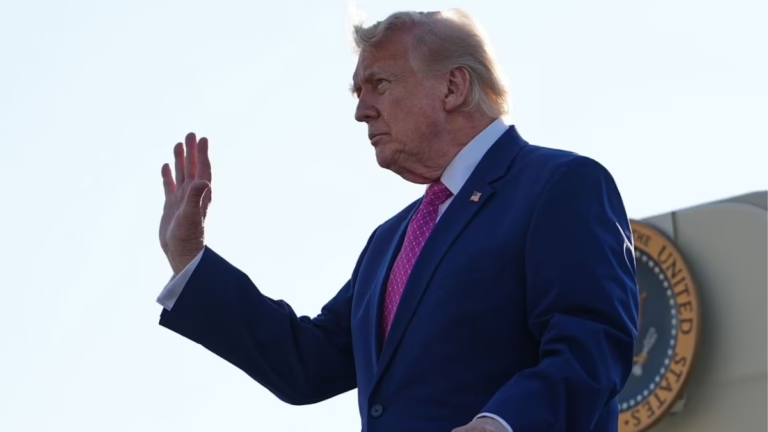
This Week at State: Board of Peace, Munich Security Conference & Central Europe Diplomacy
From the inaugural Board of Peace meeting in Washington to high-stakes talks at the Munich Security Conference and bilateral visits to Slovakia and Hungary — a defining week for American diplomacy on multiple fronts.
- President Trump convened the inaugural meeting of the Board of Peace at the Donald J. Trump Institute of Peace, Washington, D.C.
- Secretary Rubio delivered a keynote address at the Munich Security Conference in Germany and met with President Zelenskyy and G7 counterparts.
- Secretary Rubio traveled to Bratislava and Budapest to strengthen strategic energy, security, and bilateral ties with Slovakia and Hungary.
President Trump Convenes Inaugural Board of Peace Meeting

On February 19, President Donald Trump delivered remarks at the first-ever meeting of the Board of Peace, held at the Donald J. Trump Institute of Peace in Washington, D.C. The board — composed of more than two dozen founding member nations, with representatives drawn from across the Middle East and Asia — convened to formalize a $5 billion commitment toward the reconstruction and stabilization of Gaza, establishing both a financial baseline and a governing framework for what the administration has described as a new model of international peacekeeping.
The meeting’s stated objectives centered on three pillars: establishing an international stabilization force, creating a framework for what officials described as “modern and efficient governance” capable of attracting global investment, and formalizing the multilateral architecture needed to sustain long-term reconstruction efforts.
“We are here today because the President has both an ability and a willingness to use the power of his office to think outside the box… This Gaza situation was impossible to solve under existing structures.”— Secretary of State Marco Rubio, Board of Peace, February 19, 2026
Secretary Rubio, a member of the board’s executive committee, praised the initiative as a paradigm shift in international diplomacy — one that operates outside the constraints of institutions that have, in his assessment, proven unequal to the challenge. His remarks framed the Board of Peace not merely as a mechanism for Gaza, but as a proof of concept: that American leadership, backed by genuine political will, can convene coalitions and deliver outcomes where conventional multilateral structures have stalled.
- More than two dozen founding member nations participated in the inaugural meeting.
- A $5 billion commitment was formalized toward Gaza’s reconstruction and stabilization.
- Plans were advanced for an international stabilization force to support security on the ground.
- A governance framework to attract global investment into a rebuilt Gaza was outlined.
- Secretary Rubio served on the board’s executive committee.
Leading at Munich: Secretary Rubio at the Security Conference

From February 13 to 15, Secretary of State Marco Rubio attended the Munich Security Conference in Germany — one of the world’s most significant annual gatherings of heads of state, defense ministers, and senior diplomatic officials. In his keynote address, Rubio struck a tone of transatlantic solidarity while signaling high expectations for a more self-reliant and capable Europe.
“We want Europe to be strong. We believe that Europe must survive, because the two great wars of the last century serve for us as history’s constant reminder that ultimately, our destiny is and will always be intertwined with yours.”— Secretary of State Marco Rubio, Munich Security Conference, February 14, 2026
The Secretary’s appearance at Munich served dual purposes: to reaffirm the United States’ enduring commitment to European security and democratic values, and to advance a series of bilateral engagements with key allies and partners. During the conference, Rubio met with his G7 counterparts, held talks with Ukrainian President Volodymyr Zelenskyy, and conducted bilateral meetings with a range of diplomatic counterparts on shared priorities including defense investment, conflict resolution, and energy security.
- Keynote address affirming the US-Europe partnership and the shared historical memory of two world wars.
- Bilateral meeting with Ukrainian President Volodymyr Zelenskyy.
- Consultations with G7 foreign ministers.
- Bilateral counterpart meetings covering defense, energy, and conflict resolution.
Strengthening Cooperation in Central Europe: Bratislava & Budapest


Following the Munich Security Conference, Secretary Rubio undertook a two-city diplomatic visit to Central Europe on February 15 and 16, traveling first to Bratislava and then to Budapest for bilateral meetings with Slovak Prime Minister Robert Fico and Hungarian Prime Minister Viktor Orbán respectively. The visits underscored the United States’ commitment to deepening strategic partnerships across the NATO alliance, with a particular focus on energy independence and regional security.
In Bratislava, Secretary Rubio met with Prime Minister Fico and senior members of the Slovak government. The talks encompassed a broad range of shared priorities: advancing regional security interests, strengthening bilateral cooperation on nuclear energy and energy diversification, and supporting Slovakia’s military modernization program in line with NATO commitments. Slovakia’s strategic importance as a frontline NATO ally and its role in Central European energy infrastructure gave the meeting particular weight.
In Budapest, the Secretary met with Prime Minister Orbán and key Hungarian officials to bolster shared bilateral and regional interests. Discussion centered on commitments to ongoing peace processes aimed at resolving global conflicts — a theme consistent with the broader diplomatic architecture being advanced by the Trump administration — and on the US-Hungary energy partnership, which both sides affirmed as a cornerstone of the bilateral relationship.
- Bratislava: Advanced regional security interests and strengthened bilateral cooperation on nuclear energy and energy diversification.
- Bratislava: Supported Slovakia’s military modernization and reaffirmed NATO commitments.
- Budapest: Bolstered the US-Hungary bilateral energy partnership.
- Budapest: Discussed shared commitments to international peace processes and conflict resolution.
About The Author

Discover more from Faith & Freedom News - FFN
Subscribe to get the latest posts sent to your email.