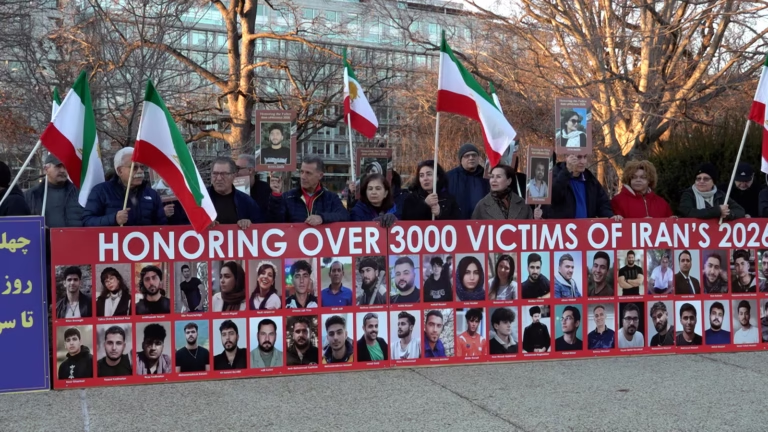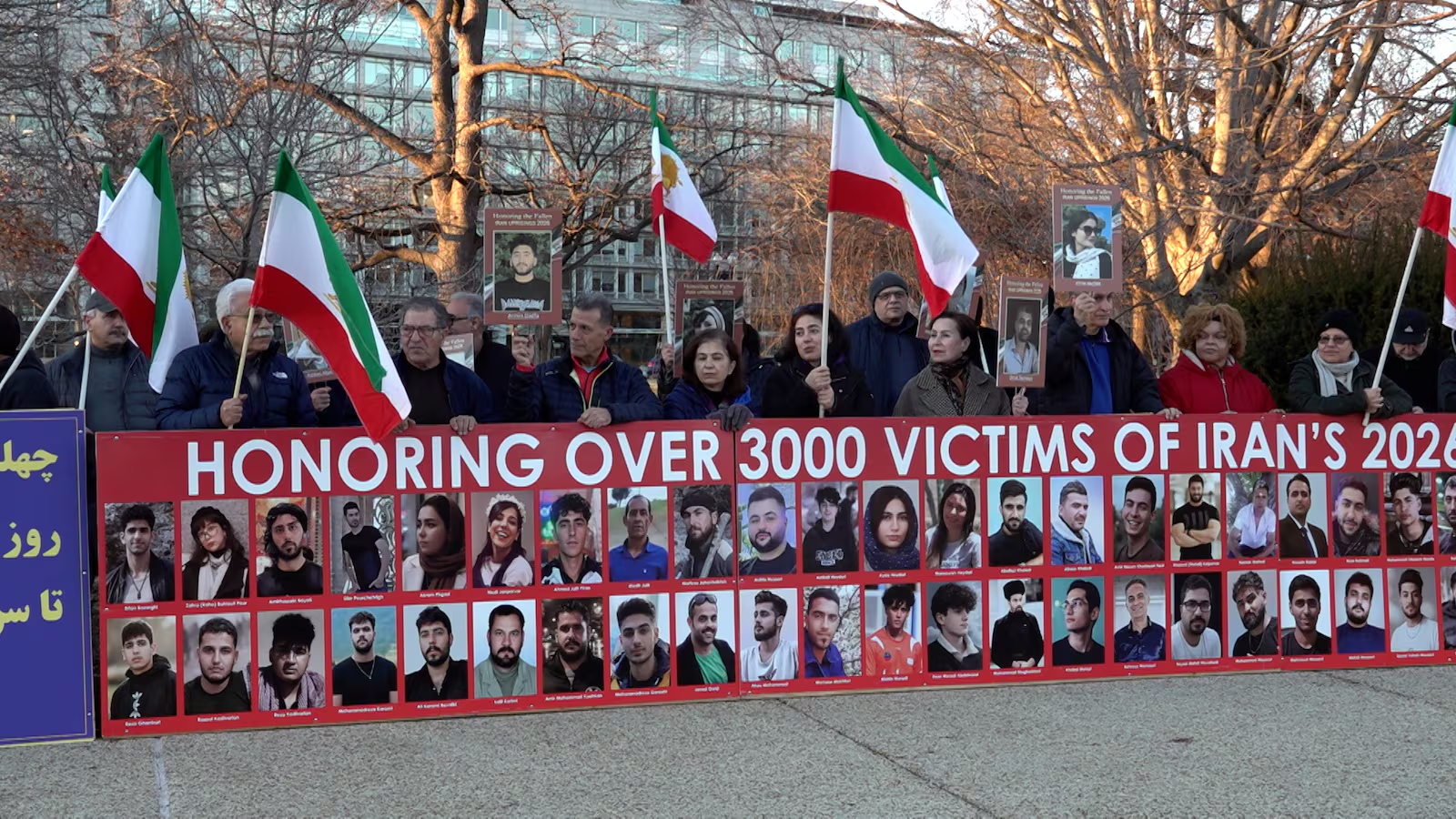
Iranian Americans holding a sign near the U.S. Capitol honoring the victims or protest crackdowns in Iran. Photo taken in Washington on Friday. Feb. 20, 2026.
The Situation of Ethnic & Religious Minorities in Iran — A Deepening Crisis
As arrests of Christians nearly double and Baha’i face hundreds of persecutory acts, Iran’s systematic suppression of religious minorities reaches a new and dangerous threshold — with global implications for the cause of religious freedom.

The situation of religious and ethnic minorities in Iran is facing a serious humanitarian crisis, most acutely during periods of Iranian domestic unrest and external military pressure. The Iranian regime systematically targets non-Persian minorities — as well as Baha’is and Christians — through a state strategy designed to perpetuate religious monopoly. According to the Islamic Republic’s constitution, “Islamic principles and norms” serve as the cornerstone for the “advancement” of Iranian society. Twelver Ja’fari Shiism is further enshrined as the official state religion in Article 12, while vague “Islamic criteria” regulate every aspect of life, from criminal legislation to political engagement.
Religious minorities residing in Iran — especially Christian converts — endure significant oppression and severe limitations, as the government perceives them as a danger to the country’s Islamist agenda. Although historically recognized minorities such as Armenians and Assyrians enjoy a limited degree of freedom, converts encounter extreme legal jeopardy: changing one’s religion from Islam is classified as apostasy and is potentially punishable by death.
Recent Convictions: A Pattern of Escalating Sentences
On March 9th, Branch 26 of the Revolutionary Court in Tehran — led by Judge Iman Afshari — found two Christian converts guilty of “promotional activities against Islamic shariah” and “membership in groups opposing the state.” Abbas Suri received a total sentence of 15 years in prison, a 15-year restriction on social activities, and a fine of 330 million toman, along with prohibitions on leaving the country, living in Tehran or neighboring provinces, and joining any organization for two years. Forty-three-year-old Mehran Shamlouie was handed a sentence of 10 years and eight months in prison, a 15-year ban on social activities, and a fine of 250 million toman. Shamlouie had already fled Iran for Turkey before the verdict.
When the Tehran regime falters abroad, Iran’s religious minorities pay the price at home. A recently published report documents intensified anti-Christian repression in 2025 — arrests on religion-related charges nearly doubled compared to 2024.
— Foundation for Defense of Democracies (FDD), February 2026
A report published by the Foundation for Defense of Democracies (FDD) confirms this pattern. A separate report by Christian advocacy groups — including Article 18, Open Doors, Christian Solidarity Worldwide, and Middle East Concern — documents intensified anti-Christian repression throughout 2025, finding that more than twice as many Christians served prison, exile, or forced-labor sentences as courts imposed harsher penalties across the board.
Surge in Arrests Following the June 2025 War
Tehran’s military humiliation at the hands of Israel and the United States during the 12-Day War last June prompted the regime to escalate its suppression of Christian faith dramatically. Iran regards Christians — particularly converts from Islam who are members of Evangelical communities — as a national security threat, routinely accusing them of ties to foreign intelligence services. Many have been prosecuted for “moharabeh,” or enmity against God, an offense that carries a potential death sentence. Evangelizing is strictly prohibited, and Muslims who convert can face execution under Iran’s apostasy laws.
From the beginning of 2025 to the end of the June war, Iran arrested 40 Christians on fabricated charges. In the following month alone, Iranian authorities arrested at least 53 more. The justification was explicit: Iran’s Ministry of Intelligence (MOI) publicly claimed it had arrested 53 Evangelicals “trained abroad” for allegedly collaborating with the “Zionist regime.” The renewed wave of crackdowns extended beyond Christians — members of Iran’s Baha’i community faced more than 750 “persecutory acts” between June and November 2025, while dozens of Iranian Jews were arrested and community leaders subjected to interrogation.
Iran’s Islamic Penal Code: Institutionalized Persecution
Vague interpretations of the Iranian Penal Code were employed in nearly 90 percent of cases against Christians in 2025. Article 500 of Iran’s Islamic Penal Code — which forbids worship that “interferes with the sacred law of Islam” — is the primary legal instrument the regime wields to suppress Christian worship. A 2021 amendment to this article broadened “deviant propaganda” provisions and increased the maximum penalty to 10 years imprisonment. The Islamic Republic formally recognizes only ethnic Christian communities such as Armenians and Assyrians, and confines even these to holding services exclusively in their own languages, preventing any outreach beyond those communities.
While imprisonment is more common than execution for targeted Christians, those convicted face ongoing monitoring, harassment, exile, and systemic deprivation of civil rights — from employment blacklisting to being forbidden from visiting the graves of deceased family members. The U.S. Department of State’s International Religious Freedom reports routinely flag Iran’s repression. The U.S. Commission on International Religious Freedom’s 2025 report likewise recommended that the State Department uphold Iran’s designation as a Country of Particular Concern.
The Propaganda and Judicial Architecture of Repression
The regime’s repression of religious minorities operates on two parallel tracks: a propaganda apparatus that justifies abuse, and a judiciary that enforces it. The Islamic Ideology Dissemination Organization (IIDO), operating under direct supervision of the Supreme Leader, drives the regime’s theocratic messaging. The IIDO vilifies religious minorities as “deviationist currents” and labels “missionary Christianity” explicitly as a “Zionist” project — providing ideological cover for the arrests and sentences handed down by the courts.
On the judicial side, Judge Ashkan Ramesh of the Revolutionary Court of Varamin has become increasingly notorious for issuing heavy sentences against Christians. He has emerged as a primary enforcement arm of state-sponsored religious persecution. The U.S. Treasury should therefore designate both the IIDO and Judge Ramesh under existing human rights authorities for their documented roles in the Islamic Republic’s systematic crackdown on religious minorities.
Despite this relentless pressure, and against all odds, Iran remains home to one of the fastest-growing Christian communities in the world. The resilience of Iranian believers stands as a powerful testament to the human spirit’s enduring search for faith and freedom — a search that no state apparatus, however brutal, has yet been able to extinguish.
About The Author

Discover more from Faith & Freedom News - FFN
Subscribe to get the latest posts sent to your email.