EU Response to the Iranian Protests (2025–2026): From Condemnation to Sanctions
A comprehensive analysis of Europe’s evolving stance on Tehran’s brutal crackdown on nationwide demonstrations

Executive Summary
The European Union has intensified its response to the Iranian clerical regime’s violent suppression of nationwide protests that erupted in late December 2025 and continued into 2026. While the EU has long positioned itself as a global defender of human rights, freedom of expression, and peaceful assembly, recent developments have pushed the bloc from repeated condemnations toward concrete preparations for harsher sanctions.
As of January 12, 2026, EU institutions and senior leaders signaled a decisive shift, citing unprecedented levels of violence, mass killings, arbitrary detentions, and systematic internet shutdowns. With reports indicating over 2,000 civilians killed, more than 10,000 detained, and widespread communication blackouts, EU leaders increasingly frame the Iranian regime’s actions as evidence of fear of its own population and a fundamental rejection of international norms.
Background: Protests and Crackdown
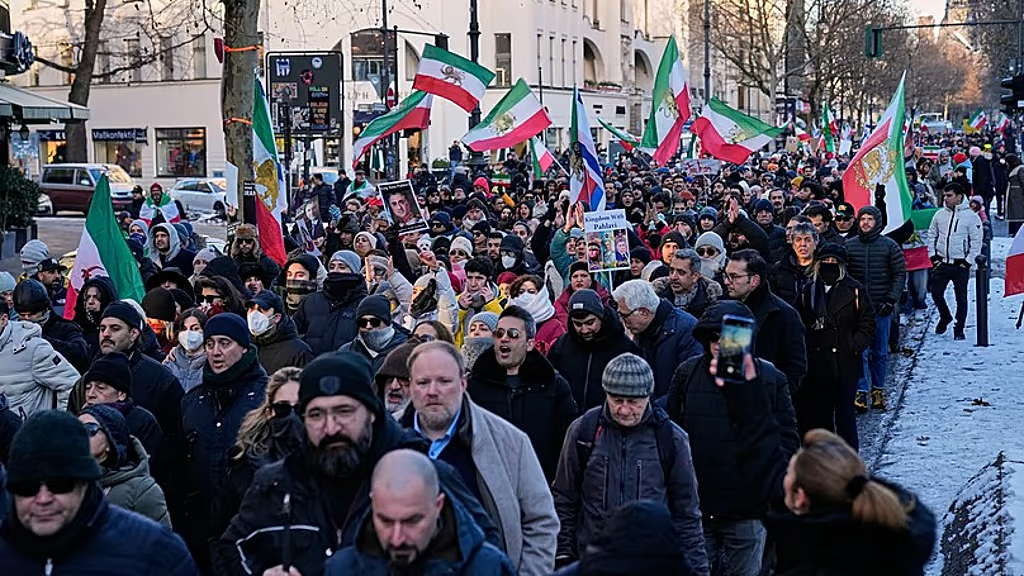
The protests that began in late December 2025 rapidly escalated into one of the most significant popular uprisings in Iran since 2019—and, according to some reports, even deadlier. Demonstrations spread across major cities and provinces, involving women, students, workers, teachers, artists, and ordinary citizens.
Unlike earlier protests driven primarily by economic grievances, the current movement openly challenges the legitimacy of the political system itself, demanding democracy, freedom, and an end to repression. The regime responded with:
- Live ammunition and excessive force against protesters
- Mass arrests and executions
- Severe internet and communication shutdowns
- Alleged use of foreign proxy forces against civilians
These actions prompted strong reactions across EU institutions.
Institutional EU Responses
Key EU Leaders and Their Actions
Condemned Iran’s “disproportionate and heavy-handed” use of force, declaring violence against peaceful demonstrators unacceptable. Emphasized that internet blackouts, combined with violent repression, expose “a regime afraid of its own people.”
Announced that the EU is prepared to propose “more severe” sanctions, targeting individuals and entities responsible for brutal repression.
Stated that “business as usual” is no longer possible while a dictatorship relies on torture and murder to remain in power. Took the unprecedented step of barring all Iranian diplomatic staff and representatives from European Parliament premises, signaling political isolation of the regime. Praised the “courageous Iranian people” and reaffirmed Europe’s continued support.
In a video statement, declared that Europe “stands fully behind” the Iranian protesters and strongly condemned the violent repression. The Commission expressed grave concern over rising deaths and injuries, calling for respect for freedom of expression, freedom of assembly, and open internet access.
On January 12, 2026, reiterated the EU’s readiness to adopt new and harsher sanctions, citing the scale and brutality of the crackdown.
EU’s Core Demands to the Iranian Government
The European Union has repeatedly called on Tehran to take immediate and concrete steps:
- Maximum Restraint Immediate cessation of physical force and use of weapons against nonviolent protesters.
- Restoration of Communications Lifting internet shutdowns and restoring access to communication channels used to conceal the scale of repression.
- Release of Detainees Immediate and unconditional release of all individuals detained for peacefully protesting.
Political Dynamics Within the EU
Center-right and liberal political groups have consistently shown solidarity with the Iranian population, particularly with Iranian women, since the 2022 killing of Mahsa Amini.
In recognition of this struggle, the EU awarded the Sakharov Prize 2024 to Mahsa Amini and the people of Iran, symbolizing institutional acknowledgment of their fight for freedom.
Far-left political groups, however, have been criticized for failing to condemn the Iranian regime or openly support Iranian women confronting what many describe as a misogynistic system.
Expert and Civil Society Perspectives
Kamil Alboshoka – Dialogue Institute (UK)
Alboshoka emphasized that the UK and European partners have consistently condemned Iran’s violent repression while prioritizing diplomacy and targeted sanctions rather than direct calls for regime change. This approach reflects a balancing act between supporting civil society and fundamental freedoms while managing concerns about regional stability.
However, he warned that with over 2,000 civilians reportedly killed, surpassing the 2019 crackdown, international judicial action is urgently needed.
Alboshoka urged:
- Reviewing diplomatic relations with Iran
- Raising the crisis at the UN Security Council
- Engaging with all opposition groups, including representatives of Iran’s non-Persian populations, who constitute roughly two-thirds of the country
He noted that while limited human-rights demands are often tolerated internationally, Iran’s youth and broader population are demanding systemic political change, requiring a firmer stance similar to that adopted by the United States. He observed, European and UK policy has so far prioritized diplomacy, human rights advocacy, and targeted sanctions over explicit calls for regime change. This caution reflects legitimate concerns about regional stability. However, caution must not become paralysis. When killings reach the thousands and repression becomes industrial in scale, the moral calculus changes. Alboshoka’s call for international judicial action, a reassessment of diplomatic relations, engagement at the UN Security Council, and dialogue with all opposition groups—including Iran’s non-Persian communities, who constitute a majority of the population—deserves serious consideration. The demands of Iran’s youth extend far beyond cultural freedoms. They seek a political system that guarantees dignity, democracy, and accountability—values Europe claims to champion.
Fahimeh ILGhami – Iranian-Belgian Activist, Prosperous Iran
“Massive internet shutdowns have left families unable to contact loved ones. Censorship has become a weapon of repression, not merely information control. The protests now represent a fundamental confrontation with a system viewed as illegitimate, corrupt, and violent.”
“Tens of millions are reportedly demonstrating nationwide. A revolution becomes inevitable when fear shifts sides and society refuses to submit. Silence from the international community is no longer neutrality—inaction empowers impunity.” She captured the human cost of Europe’s hesitation with stark clarity. Internet shutdowns have turned silence into a weapon, leaving families cut off from loved ones amid violence. What is unfolding, she argues, is not the maintenance of order but systematic repression—targeting women, students, workers, teachers, and artists for exercising universally recognized rights. Reports of foreign proxy forces deployed against civilians only deepen the regime’s moral isolation. Her warning is unambiguous: international silence is not neutrality. Inaction is not diplomacy. Every hour without a firm response emboldens those who believe they can kill with impunity. Alghami warned that without decisive international action, Iran risks descending into a prolonged humanitarian crisis with regional and global consequences. She described a country engulfed in fear, violence, and imposed silence where families are unable to contact loved ones due to communication blackouts.
Assessment: From Condemnation to Consequence
The EU’s evolving response reflects a critical transition:
2022–2024: Moral condemnation, symbolic gestures, and human rights advocacy
2025–2026: Active preparation for escalated sanctions and diplomatic isolation
The crackdown has tested the limits of EU diplomacy. While the bloc remains cautious about regime-change rhetoric, the scale of violence has pushed European leaders toward tougher measures and broader international coordination.
The unprecedented step of barring Iranian diplomatic staff from the European Parliament, combined with the preparation of severe new sanctions, signals that Europe’s patience with Tehran has reached a breaking point. This represents the most significant deterioration in EU-Iran relations since the 2015 nuclear deal.
Conclusion
The EU’s reaction to Iran’s violent suppression of protests underscores a sustained commitment to human rights and democratic principles. By standing publicly with the Iranian people and preparing harsher sanctions, the EU aims to increase pressure on Tehran to halt repression and respect fundamental freedoms.
However, achieving lasting change will require overcoming internal political divisions, navigating complex diplomacy, and coordinating closely with international partners. As protests persist and casualties mount, the EU’s role remains critical—not only in condemning abuses, but in ensuring accountability and amplifying global scrutiny.
The measures announced in January 2026 represent a potential turning point, moving Europe from a position of moral outrage to one of concrete action. Yet the gap between sanctions preparation and implementation, between diplomatic statements and meaningful support for Iranian civil society, remains a critical test of European resolve.
About The Author

Discover more from Faith & Freedom News - FFN
Subscribe to get the latest posts sent to your email.