Pakistan’s Seat at Gaza’s Peace Table: From Sidelines to Leadership
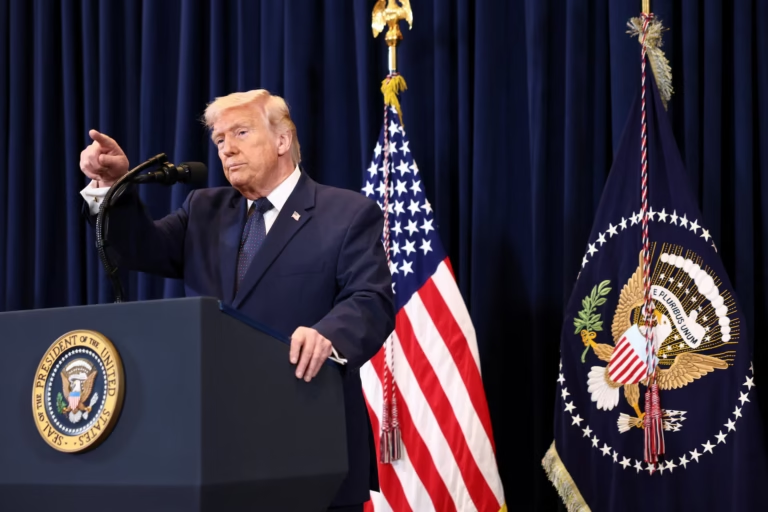
President Donald Trump’s call for various countries to join a proposed “Board of Peace” for post-war Gaza represents a notable shift from the usual cycle of ceasefires and crisis management. After more than two years of devastation, Washington is finally looking to tackle the tough, structural issues that have been pushed aside for too long: governance, security, demilitarization, and reconstruction.
For Pakistan, the reported invitation to Prime Minister Shehbaz Sharif is a significant opportunity to engage in one of the most ambitious peace efforts of this decade and to help shape the outcomes from within the process rather than just commenting from the sidelines.
With all the destruction in Gaza, Washington’s focus on governance, security, and reconstruction shows a recognition that without solid political and administrative foundations, no ceasefire can truly hold. In this context, Pakistan’s invitation to join the Board of Peace is meaningful—it’s a chance for Islamabad to take an active role in one of the most consequential peace initiatives of recent years.
The aim of Phase Two of the Gaza plan is straightforward: to move from fragile ceasefires to a system of technocratic governance, disarmament, and long-term rebuilding. This represents a fundamental departure from the reactive, crisis-management approaches that have characterized international engagement with Gaza for decades.
Phase Two, which was officially announced in January 2026, kicked off even while some issues from the first phase remain unresolved. The incomplete disarmament of Hamas and ongoing hostage situations highlight just how delicate the current state is. Still, the US perspective is clear—momentum is crucial.
This technocratic body will work under the strategic guidance of the Board of Peace, which will set policy directions and oversee international funding. The creation of an International Stabilisation Force, supported by regional cooperation, is meant to provide the necessary security framework for these initiatives to move forward.
Pakistan’s alignment with these objectives is neither sudden nor accidental. Islamabad has long argued that unresolved conflicts fuel extremism and instability far beyond their immediate geography. Stability in Gaza is therefore not only a humanitarian concern, but also a strategic one.
Pakistan’s support for the broader Gaza peace framework, including its backing of the relevant UN Security Council resolution in late 2025, reflects this understanding. The country has consistently maintained that lasting peace requires addressing root causes rather than merely managing symptoms.
Pakistan’s extensive experience in UN peacekeeping gives it a credibility few countries can match. Over six decades, Pakistani forces have served in some of the world’s most complex post-conflict environments—from Bosnia to Somalia, from Sierra Leone to Congo.
Pakistan’s Peacekeeping Legacy
- 60+ Years of Service: One of the largest and most consistent contributors to UN peacekeeping operations globally
- Complex Environments: Proven capability in challenging post-conflict settings requiring both military and civilian expertise
- Muslim World Perspective: Unique positioning to bridge different stakeholder perspectives in Muslim-majority contexts
- Governance Experience: Understanding of transitional administration and institution-building in fragile states
This history explains why Islamabad is viewed as a credible potential contributor to stabilization efforts and why its participation in governance-related mechanisms like the Board of Peace would be taken seriously. Statements from Pakistani leadership describing such involvement as a matter of national pride are rooted in this substantial legacy.
Importantly, a seat at Gaza’s peace table does not dilute Pakistan’s principled support for Palestinian rights. On the contrary, engagement from within allows Pakistan to advocate more effectively for Palestinian interests during critical decisions on governance models, reconstruction priorities, and security arrangements.
Being present ensures that perspectives from the Muslim world and the Global South are not peripheral, but integral to the process. This represents a more effective form of advocacy than external commentary—shaping outcomes through direct participation rather than reactive criticism.
At home, such engagement can be framed clearly and confidently. With transparency and parliamentary oversight, Pakistan’s role can be presented not as alignment with power politics, but as a reflection of national values—support for peace, justice, and the protection of civilians.
The key is ensuring that Pakistan’s participation remains consistent with its longstanding principles while allowing room for pragmatic contribution to conflict resolution. This balance between values and effectiveness is precisely what gives such engagement both domestic legitimacy and international credibility.
Pakistan’s potential role in the Board of Peace offers a chance to move from statements of concern to meaningful action. If Phase Two succeeds in translating political intent into governance, security, and reconstruction on the ground, it could mark a genuine turning point for Gaza.
The broader implications extend beyond Gaza itself. Success in this initiative could establish Pakistan as a model for how middle powers can contribute constructively to complex peace processes, balancing principled positions with practical problem-solving.
Pakistan’s seat at the peace table, if taken with clarity and purpose, can help ensure that this opportunity is not wasted. It represents a chance to demonstrate that effective diplomacy requires not just the articulation of positions, but the willingness to engage in the difficult work of implementation.
In an era when international institutions face questions about their effectiveness and relevance, Pakistan’s participation in this focused, results-oriented initiative could help chart a path forward—one that combines moral clarity with operational pragmatism, and transforms long-held principles into tangible outcomes for peace.
About The Author

Discover more from Faith & Freedom News - FFN
Subscribe to get the latest posts sent to your email.