Iran’s Crisis:
A Human Rights Emergency
Hiding in Plain Sight
Activist Manel Msalmi speaks with Eugene Gioni on women, minorities, nuclear threats, sleeper cells in Europe, and the media’s dangerous silence on crises beyond the headlines.
▶ Watch the full podcast — YouTube: Eugene Gioni × Manel Msalmi
The crisis in Iran is not simply a geopolitical conflict playing out on the world stage — it is, at its core, a human rights emergency that has been hiding in plain sight for decades. In a wide-ranging podcast conversation, human rights activist and MENA expert Manel Msalmi, founder of the European Association for the Defense of Minorities, sat down with host Eugene Gioni to unpack the layers of suffering, resistance, and global consequence that define the Iranian crisis today.
From the streets of Tehran to the corridors of European capitals, Msalmi’s account traces a conflict that is at once deeply internal and alarmingly global — one that implicates women’s bodies, minority identities, nuclear arsenals, and the world’s most vital maritime trade routes.
Protests, Persecution, and a Nation in Revolt
Since January, Msalmi reports, the streets of Tehran have witnessed a surge in protest activity accompanied by severe human rights violations targeting women and minority communities. But the roots of this unrest stretch back further. The death of Mahsa Amini in 2022, a young Kurdish woman killed by Iran’s so-called “morality police” for allegedly wearing her hijab incorrectly, became the catalyst for the Women, Life, Freedom movement — a grassroots uprising that has since become one of the most powerful symbols of resistance to authoritarian rule in the modern world.
Women are ready to die for their freedom. The question of forcing women to wear the veil is not superficial — it is a strategy to suppress autonomy and enforce obedience.
— Manel Msalmi, Human Rights Activist
Msalmi is unsparing in her assessment of how the West often misreads this issue. Framing enforced veiling as a mere cultural practice, she argues, fundamentally misunderstands what is at stake. For millions of women in Iran, Afghanistan, Pakistan, and Bangladesh, the veil is not a choice — it is a compulsion enforced by violence, and in some cases, by death.
The 40%: Minorities Under Double Oppression
One of the most underreported dimensions of Iran’s internal crisis is the scale of ethnic and religious minority persecution. Msalmi notes that nearly 40% of Iran’s population is of non-Persian descent — including Kurds, Baha’is, and other ethnic and religious communities — all subjected to what she describes as “double discrimination.”
These communities face persecution not only for their cultural and linguistic identities, but for their religious affiliations as well — since many are not Shia Muslims, the sect privileged by the regime. This layered oppression means their suffering is compounded: they are targeted as ethnic minorities and as religious dissenters simultaneously. For decades, this double discrimination has been met with systematic state violence, including torture and death penalties.
Nuclear Ambitions and the Urgency of Intervention
Beyond the internal human rights crisis, Msalmi raises the alarm over Iran’s nuclear program, stating plainly that the regime is alarmingly close to acquiring a nuclear weapon. This development, she argues, made international intervention not just justifiable but necessary — a timely response to a threat that could destabilize the entire region and beyond.
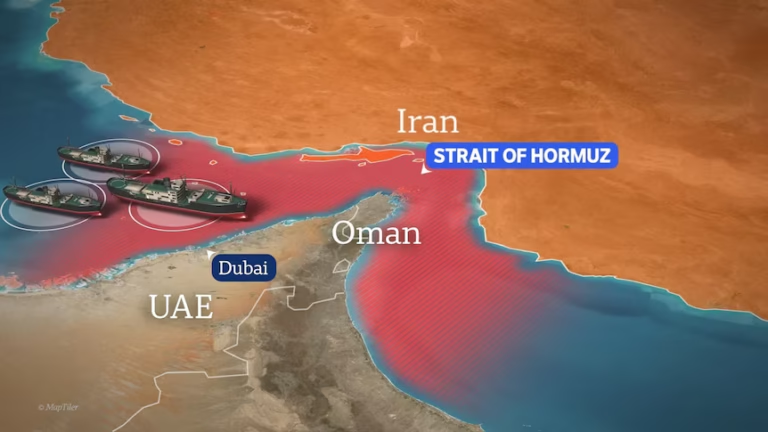
Under a new Supreme Leader, the Iranian regime has given no signals of willingness to negotiate or stand down. Msalmi argues that this leadership transition does not represent a moderation of Iran’s posture, but rather a reinforcement of its refusal to engage. Meanwhile, Iranian media continues to project a carefully constructed narrative of non-aggression toward Arab neighbors — a narrative contradicted, Msalmi says, by direct attacks on airports, hotels, and economic infrastructure across the Gulf.
A “Muslim War” — and Divided Muslim Voices
One of the most striking framings in the conversation is Gioni’s characterization of the conflict as a “Muslim war” — Iran targeting fellow Arab and Muslim-majority states including UAE, Saudi Arabia, Bahrain, Oman, and reportedly Turkey. Msalmi affirms the complexity this creates within the broader Muslim world’s intellectual and media landscape.
📻 Podcast Highlights — Key Moments
Iran’s protests and human rights violations — especially against women and minorities — are intensifying since January.
The Women, Life, Freedom movement began after Mahsa Amini’s death in 2022 — a symbol of courageous resistance.
Iran’s new Supreme Leader signals continued refusal to negotiate, with ongoing attacks on Arab countries’ infrastructure.
The conflict is framed as a complex “Muslim war,” exposing deep contradictions in regional narratives about Iran’s role.
Europe faces threats from over 400 Iranian-linked sleeper extremist cells, demanding heightened security vigilance.
Post-October 7th, a surge in antisemitism and anti-Zionism threatens Jewish communities and peace-building efforts.
Women’s rights across the Middle East are regressing — with enforced hijab laws and education bans as deliberate tools of oppression.
Mainstream media’s selective coverage of conflicts perpetuates dangerous double standards, leaving millions of victims voiceless.
Some Arab intellectuals and journalists recognize Iran plainly as the enemy of regional stability — an aggressor targeting the economic foundations of neighboring states. Others, particularly those aligned with Islamist movements, frame the conflict as a confrontation between the Muslim world and Western imperialism, casting Iran as a defender of Islamic causes. Msalmi dismisses the latter framing as both contradictory and dangerous: a regime that targets Muslim-majority Arab countries’ civilian infrastructure cannot credibly claim to be a champion of the Muslim world.
Sleeper Cells and the European Threat
The conversation takes a sharp turn toward Europe when Msalmi reveals what security experts tracking Iranian networks have warned: more than 400 Iranian-linked sleeper cells are believed to be present across the European continent. The reference point is the case of Assad in Belgium — a stark reminder that Tehran’s reach extends well beyond its borders.
The targets of these networks, Msalmi warns, are specific: opposition leaders in exile, Jewish communities and religious sites, and minority activists who have spoken out against the regime. The attack on a synagogue in Liège is cited as emblematic of a broader, coordinated pattern of intimidation and violence that European governments must take seriously.
October 7th, Antisemitism, and the Fragility of the Abraham Accords
The Hamas attacks of October 7th, 2023 introduced a new and troubling chapter in the region’s story — one that Msalmi sees as having severely damaged the fragile architecture of peace built through the Abraham Accords. The accords, which normalized relations between Israel and several Arab states, represented a historic breakthrough in Middle Eastern diplomacy. That progress, she argues, has since been threatened by a surge in antisemitism and anti-Zionism that has swept across both Europe and the Muslim world.
The dream of peace and dialogue between the Arab and Muslim world and Israel is now under threat. What happened after October 7th is alarming — and it is fueled by propaganda, not truth.
— Manel Msalmi
This antisemitism, Msalmi emphasizes, is not simply ideological — it has translated into physical attacks on Jewish communities and holy sites across Europe. And it is being actively amplified by Iranian propaganda, which frames the conflict in terms designed to stoke religious outrage rather than promote understanding.
The Media’s Silence: Sudan, Yemen, Bangladesh
Perhaps the most urgent challenge Msalmi raises is not military or political, but epistemological: the world simply does not know what is happening to millions of people in Sudan, Yemen, Syria, Pakistan, and Bangladesh, because the mainstream media has largely stopped telling their stories.
While the Israel-Palestine conflict has dominated global headlines and generated massive street protests across Europe and North America, equally devastating crises — mass displacement in Sudan, femicide and repression in Afghanistan, the targeting of minorities in Bangladesh — receive almost no coverage. Young people in universities, Msalmi observes, are often deeply engaged with social justice causes, yet remain entirely unaware of the scale of suffering unfolding beyond the conflicts that trend on social media.
If you ask young people about what is happening in Sudan — how many people were displaced, how many women were raped — nobody knows about it. This is a double standard we cannot afford.
— Manel Msalmi
This selective storytelling, both Msalmi and Gioni agree, is not neutral. It shapes public opinion, distorts solidarity, and leaves the victims of forgotten crises without a voice — or a witness. The responsibility of media, civil society, and ordinary citizens is to push back against this narrowing of the global moral imagination.
A Call to Action: Don’t Take Freedom for Granted
Msalmi closes with a message that is as personal as it is political. Those living in democratic societies — with freedom of speech, equal rights, and the rule of law — must not treat these as permanent or self-sustaining. They are achievements, hard won, and easily lost. The women of Iran who march knowing they may be arrested, tortured, or killed; the Kurdish activists who speak out knowing the cost; the Baha’i believers who practice their faith in defiance of a regime that would rather see them dead — these are the people whose stories demand to be told, and whose courage demands to be honored.
The podcast is not merely a conversation about Iran. It is a reminder that human rights are indivisible, that freedom anywhere is connected to freedom everywhere, and that silence — in the media, in civil society, in politics — is never neutral. It always has a cost, and it is always paid by those least able to afford it.
About The Author

Discover more from Faith & Freedom News - FFN
Subscribe to get the latest posts sent to your email.