
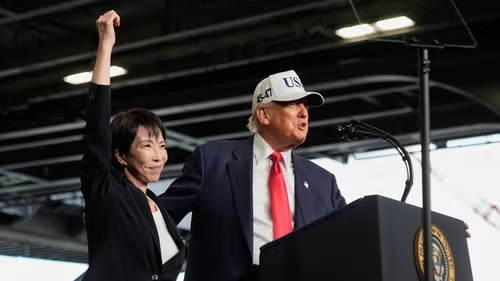
Make Japan Strong Again: Sanae Takaichi and Donald Trump Strengthen a Historic Alliance
From a golf putter that once belonged to Shinzo Abe to a March summit at the White House — two leaders are rewriting the script on what the world’s most consequential Pacific alliance looks like.
Japan has always been admired for its incredible journey from the ashes of war to becoming one of the globe’s most advanced economies and a leader in technology. Today, that same spirit of resilience seems to be at the heart of Sanae Takaichi’s leadership, as she steps in as Japan’s first female prime minister. She’s put forth an ambitious plan to boost the country’s economic strength, enhance its security, and elevate its role on the world stage. Her message to parliament was straightforward: Japan needs to regain its confidence, invest in its future, and ensure it plays a vital role in an increasingly unpredictable world.
There is something almost theatrical about the way Sanae Takaichi arrived on the world stage. Japan had seen cautious leaders before — skilled administrators who navigated complexity without ever quite commanding it. Takaichi is something different. She walked into the prime ministership with the kind of political confidence that tends to make other world leaders pay attention, and one of the first who did was U.S. President Donald Trump.
Long before she formally took office, Trump was watching. During Japan’s leadership election, he broke with the unwritten convention of American presidents staying quiet about foreign political contests and publicly praised her. He later called her “highly respected and very popular” — a description that, coming from Trump, carries real weight. It was not a throwaway compliment. People close to the president noted that he had been paying attention to Takaichi for some time, drawn by what one adviser described privately as her willingness to say what she actually means.
That quality, more than any policy detail, seems to be the foundation on which the Takaichi–Trump relationship has been built. Both leaders share a certain directness — an impatience with the slow-moving machinery of conventional diplomacy when a clear conversation between principals could move things faster. It is a style that sometimes unsettles foreign ministries, but it has a way of producing results.
Addressing the House of Representatives, Takaichi made it clear that her administration will focus on investment as a key element of national strength. For years, Japan’s economic policies have been held back by cautious fiscal management and a lack of long-term investment in emerging sectors. Takaichi is signaling a shift from that mindset, arguing that being overly frugal has often robbed the country of chances to invest in growth and innovation. Her plan to introduce multi-year budgets aimed at crisis management and the development of cutting-edge technology shows her commitment to breaking this cycle and reviving economic vitality.
Tokyo, October 2025: More Than a Courtesy Call
Trump’s visit to Tokyo last October was telling. On the surface, it had all the ceremony you would expect — the formal statements, the motorcades, the choreography of allied leaders standing shoulder to shoulder. But the substance of what was discussed mattered far more than the pageantry.

The two sides moved quickly into the kind of conversation that Washington has been wanting to have with Tokyo for years — specifically, rare earth minerals. China’s near-total dominance of rare earth supply chains has been a quiet anxiety running through American defense and technology planning for over a decade. Japan, with its advanced processing capabilities and established ties in the region, is one of the few countries positioned to meaningfully help shift that calculus. In Tokyo, Takaichi’s government made clear it was prepared to do exactly that, and Japan pledged substantial investment into the United States as a signal of genuine partnership rather than passive alliance maintenance.
It was serious, consequential diplomacy. But the moment that caught the world’s attention was smaller and more human than any policy document.
She presented him with a putter that had belonged to Shinzo Abe — the man Trump had played golf with, laughed with, and publicly mourned when he was assassinated in 2022. It was the kind of gesture that lands differently than any joint communiqué ever could.
Takaichi has been open about the debt she owes to Abe’s political vision. She carries forward his conviction that Japan must be a confident, capable nation — not a country that simply defers to others but one that earns its place at the table through strength and clarity of purpose. Handing Trump that putter was her way of saying: the relationship we built with you will continue, and the values behind it are unchanged. Trump, by all accounts, understood exactly what the gesture meant.
The Woman Behind the Slogan

Takaichi’s critics at home have occasionally struggled to pin her down. She is economically bold — convinced that years of excessive austerity have stunted Japan’s potential and that the country needs to bet on itself rather than manage decline. Her administration has laid out multi-year investment plans in artificial intelligence, semiconductors and advanced manufacturing, with an explicit goal of keeping Japan at the frontier of global technological competition rather than watching from a distance as others race ahead.
But she is not reckless. In the same breath that she calls for fiscal ambition, she insists on strategic discipline. Japan’s security environment has changed dramatically. China’s military expansion, North Korea’s persistent provocations and Russia’s destabilizing behavior across multiple theaters have combined to produce what Takaichi herself has described as the most complex security landscape Japan has faced since the end of World War II. Her response is not panic or bluster — it is preparation.
Her government has been quietly accelerating defense capability reviews and has put constitutional revision — long a political third rail in Japan — back into serious public conversation. The pacifist provisions of Japan’s postwar constitution were written for a different world. Takaichi believes the country needs to be honest about that, even if the political path toward change remains difficult.
She is, in the estimation of people who have watched Japanese politics for decades, a genuinely unusual figure. The comparisons to Margaret Thatcher are not accidental — both women rose through political environments that were not built with them in mind, and both chose conviction over comfort when it mattered. Whether Takaichi’s reforms ultimately succeed at the scale she envisions remains to be seen. But the direction is unmistakable.
March at the White House — and the Road Ahead
Takaichi is expected in Washington in March 2026 for a full White House summit. The agenda will be substantive: economic security cooperation, technology sharing, defense spending expectations, and the broader strategic architecture of the Free and Open Indo-Pacific concept that Abe first championed and that Takaichi has adopted as central to her foreign policy vision.
There will also be harder conversations. Trade tariffs remain a genuine point of tension, and Trump’s America-first instincts mean that no ally, however close, is entirely exempt from economic pressure. Takaichi knows this. Her approach has been to frame Japan not as a country asking for American protection but as a country contributing meaningfully to shared security — a distinction that matters enormously to this particular White House.
Many analysts believe she is well-positioned to make that case. Trump responds to strength and to leaders who speak plainly about what they want and what they can offer. Takaichi, who has spent her career doing precisely that, fits the profile in ways that go beyond diplomatic calculation. There is a genuine ideological affinity here — a shared belief that nations must be willing to defend their sovereignty and their values, and that the free world holds together only when its leading members take their responsibilities seriously.
That is, ultimately, what “Make Japan Strong Again” means in practice. It is not nostalgia for a past that cannot be recovered. It is a bet on the future — that a more capable, more confident Japan, standing firmly alongside a committed United States, is better for the Indo-Pacific and better for the free world than the alternative. As the March summit approaches, both leaders appear ready to make that case together.
The alliance has weathered a great deal over eight decades. Under Takaichi and Trump, it may be about to enter one of its more consequential chapters yet.
About The Author

Discover more from Faith & Freedom News - FFN
Subscribe to get the latest posts sent to your email.


