Leavitt Declares Iran Ceasefire a “Victory for the United States” — Vance to Lead Peace Talks in Islamabad
Press Secretary Karoline Leavitt details Operation Epic Fury’s sweeping military achievements, announces high-level negotiations in Pakistan, and defends Trump’s “peace through strength” doctrine.
Key takeaways from the briefing
- Leavitt: ceasefire is a “victory” achieved through Trump’s maximum pressure and U.S. military dominance
- VP Vance to lead U.S. delegation in Islamabad; joined by Jared Kushner and Steve Witkoff; talks begin Saturday
- Iran must reopen Strait of Hormuz “completely, immediately, freely” — tolls are “completely unacceptable”
- Iran’s first 10-point proposal was “thrown in the garbage”; revised plan deemed a “workable basis”
- Iran to hand over enriched uranium — a “red line the president will not back away from”
- NATO “was tested and they failed” — Trump mulling reduced commitment or withdrawal
- First conviction secured under Melania Trump’s Take It Down Act
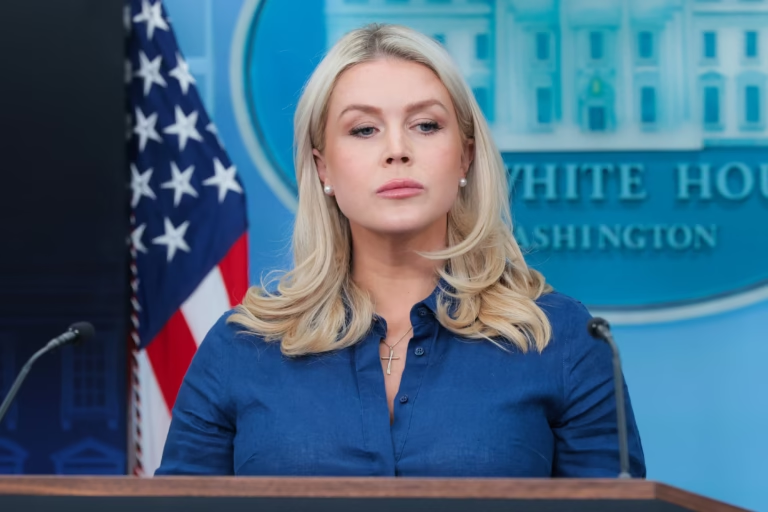
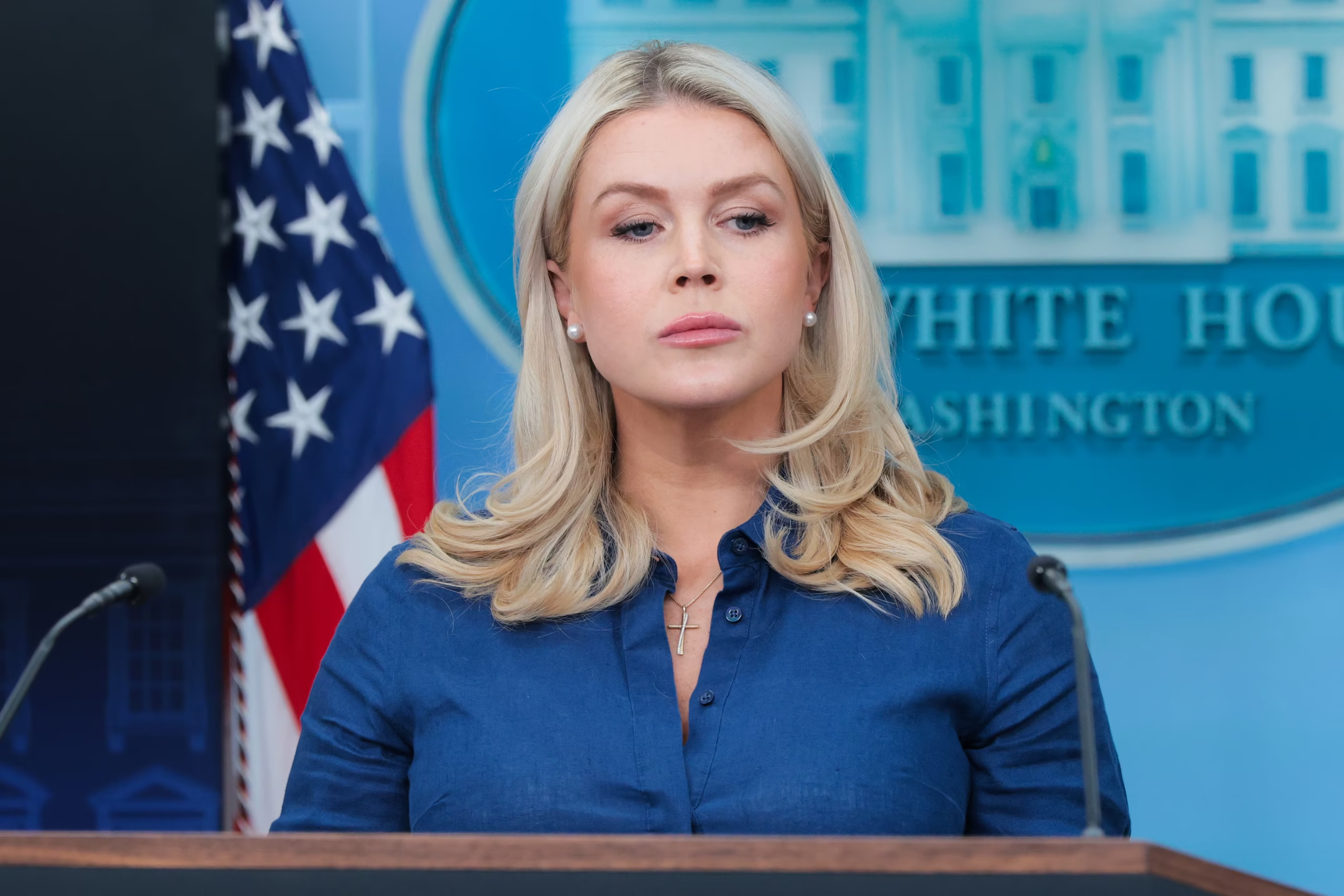
White House Press Secretary Karoline Leavitt held a 29-minute briefing Wednesday — the day after President Donald Trump announced a two-week ceasefire with Iran — framing the agreement not as a compromise, but as a decisive triumph born of overwhelming military force.
“This is a victory for the United States of America that the president and our incredible military made happen,” Leavitt told reporters in the James Brady Briefing Room, adding that U.S. military objectives were not only met but “exceeded” over the 38-day Operation Epic Fury.
Leavitt delivered an extensive rundown of U.S. and allied military achievements over the 38-day operation. The figures she cited were striking: over 13,000 targets struck across Iran; more than 450 ballistic missile sites destroyed; 800 drone facilities neutralized; and Iran’s navy — once comprising over 150 vessels across 16 warship classes — completely annihilated, with zero submarines remaining and 97 percent of Iran’s naval mines eliminated.
⚓ Navy: Completely annihilated — 150+ vessels destroyed, zero submarines remaining
✈ Air Force: Irrelevant — reduced from 30–100 daily flights to zero
💣 Ability to fund terrorism: Greatly reduced
🎯 13,000+ total targets struck in 38 days
Iran’s air force had been flying 30 to 100 sorties daily before the operation. U.S. forces struck Iranian command-and-control structures more than 2,000 times. Leavitt paused to honor 13 American service members killed during Operation Epic Fury, stating the nation would “never forget them.”
The ceasefire’s survival hinges entirely on Iran’s complete, immediate, and unrestricted reopening of the Strait of Hormuz. Leavitt disputed Iranian state media reports that the waterway remained closed, telling reporters the U.S. had observed an “uptick in traffic.”
“The president was made aware of those reports. That is completely unacceptable. What they are saying publicly is different from what they are telling us privately.”
The U.S. has observed an uptick in maritime traffic in the Strait.
Leavitt addressed widespread media coverage of an Iranian 10-point ceasefire proposal, clarifying that Tehran had initially submitted a plan the administration deemed “fundamentally unserious and unacceptable” — one that President Trump promptly discarded. Iran then returned with a revised, condensed proposal that Trump found to be a “workable basis” aligning with the administration’s own 15-point framework.
Iran then delivered a more reasonable, entirely different, and condensed plan — which the President determined was a workable basis to negotiate.
In one of the briefing’s major announcements, Leavitt confirmed that President Trump is dispatching a high-level U.S. negotiating team to Islamabad, Pakistan, for closed-door peace talks. VP Vance will head the delegation, joined by special envoy Steve Witkoff and presidential advisor Jared Kushner, with the first round of talks set for Saturday morning local time.
Envoys Jared Kushner and Steve Witkoff will also participate.
The first round of talks will take place this Saturday. Talks will be held behind closed doors.
Reporters pressed Leavitt repeatedly on Trump’s pre-ceasefire warning that failure to reopen the Strait of Hormuz would result in “a whole civilization will die tonight, never to be brought back again.” She defended the remark without reservation.
“It was a very, very strong threat from the president of the United States that led the Iranian regime to cave to their knees and ask for a ceasefire and agree to reopening the Strait of Hormuz. So it was a very strong threat that led to results.”
— Press Secretary Karoline Leavitt, April 8, 2026“It was a very, very strong threat from the president of the United States that led the Iranian regime to cave to their knees and ask for a ceasefire and agree to re-opening the Strait of Hormuz… it was a very strong threat that led to results.”
When a reporter suggested Trump may have lost the “moral high ground,” Leavitt fired back: “The insinuation by anyone in this room that Iran somehow has the moral high ground is insulting considering the atrocities they have committed against our people and our military over the past five decades.”
LEAVITT: “The president absolutely has the moral high ground over the Iranian terrorist regime — and for you to even suggest otherwise is insulting.”
“They have been chanting ‘Death to America’ for 47 years.”
Turning to the transatlantic alliance, Leavitt said Trump believes NATO “was tested and they failed” by not adequately supporting the U.S.–Israel operation or meeting long-standing defense spending commitments. Trump is expected to have a “frank and candid conversation” with NATO Secretary-General Mark Rutte and is actively considering reduced U.S. support or withdrawal from the alliance.
On Trump’s remark that “Cuba is next,” Leavitt clarified it refers to the communist regime’s anticipated collapse from within — driven by economic weakness and domestic discontent — not imminent military action. On the domestic front, she highlighted the Working Families Tax Cut and celebrated the first conviction under the Take It Down Act, landmark legislation championed by First Lady Melania Trump to combat nonconsensual AI-generated explicit images.
About The Author

Discover more from Faith & Freedom News - FFN
Subscribe to get the latest posts sent to your email.