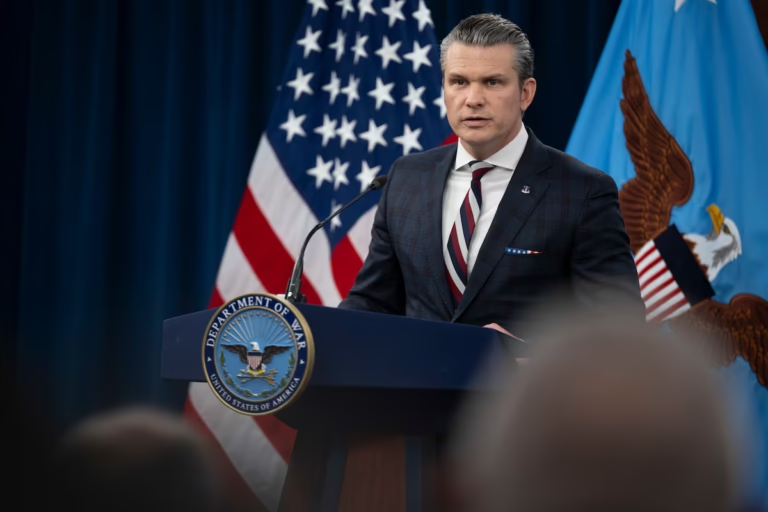
“Just Getting Started” — Hegseth Declares War Accelerating, Not Decelerating as Conflict Spreads from Turkey to Sri Lanka
Hegseth confirms a U.S. torpedo sank Iranian frigate IRIS Dena in the Indian Ocean. Six KIA identified — Trump to stand in grief at Dover. Senate defeats war powers resolution 53–47. An ayatollah calls for Trump’s blood on state TV. Iraq’s entire power grid collapses. And Iran’s funeral for Khamenei is postponed. The war is widening on every axis.
Hegseth: U.S. “Accelerating, Not Decelerating” — “Just Getting Started” in Iran War
In his most forward-leaning declaration since the conflict began, Defense Secretary Pete Hegseth signaled Thursday that the opening six days of Operation Epic Fury represent a prelude — not a peak — with additional military assets and capabilities heading to the region.
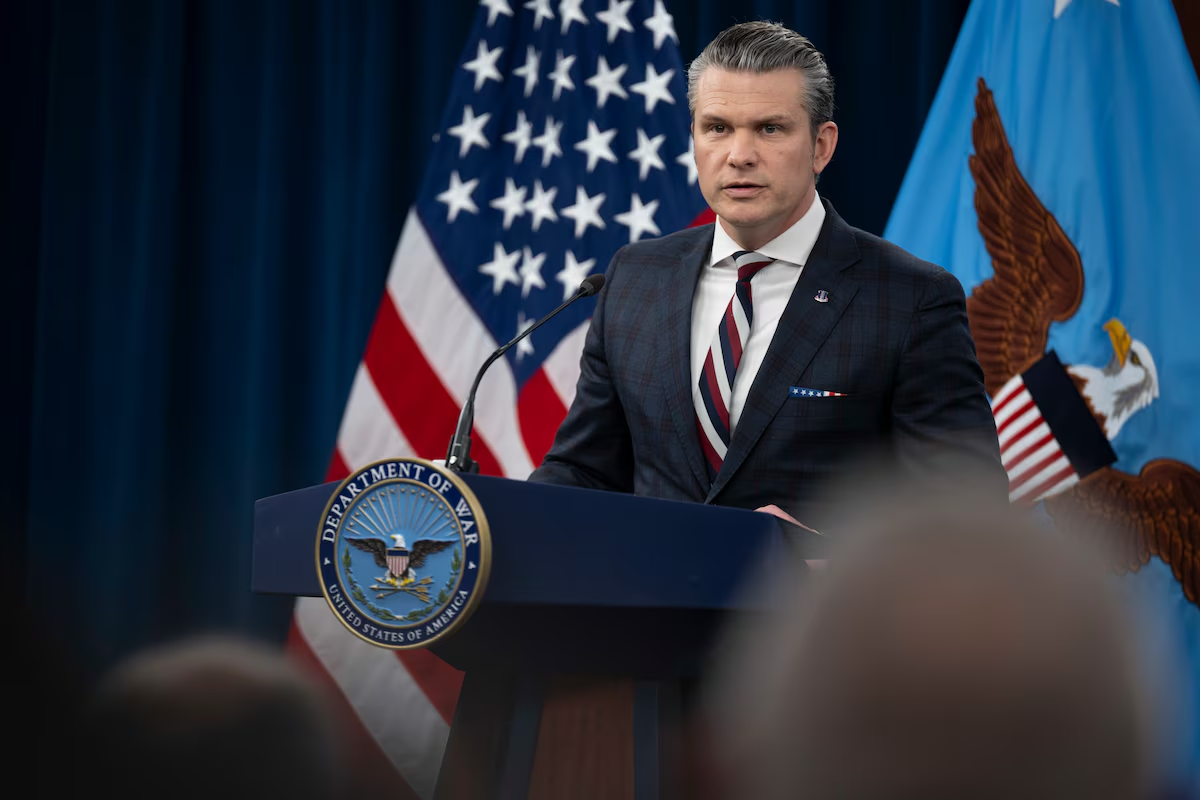
Defense Secretary Pete Hegseth delivered what may be the most significant strategic signal of the conflict on Thursday, declaring that the United States is “accelerating, not decelerating” its military campaign against Iran — and that the nation is “just getting started.” The statement came on the sixth day of Operation Epic Fury and was accompanied by the confirmation that additional U.S. military assets are heading to the region.
The declaration stands in deliberate contrast to the rhythms of prior American military campaigns, in which the opening phase of maximum shock has typically been followed by a gradual reduction in tempo as objectives are declared achieved. Hegseth’s framing inverts that expectation entirely: the shock of the opening six days — 2,000+ targets struck, Iran’s navy annihilated, its supreme leader killed, its nuclear infrastructure shattered — is being described not as a culmination but as an opening act.
It’s really a nation that was out of control. And they would have used it on us if we let them — if we waited any longer.
— President Donald J. Trump, White House, March 4, 2026President Trump reinforced Hegseth’s assessment from the White House on Wednesday, declaring that the U.S. is doing “very well” and making “tremendous progress” — rating the campaign’s success at “15 out of 10.” White House Press Secretary Karoline Leavitt added that the Trump administration “will not rest until every American is home safely and until the terrorist threat from Iran has been completely destroyed” — framing both the evacuation of American citizens and the military campaign as inseparable missions.
Leavitt also shed new light on the timeline of Trump’s decision to authorize the campaign, saying the president had a “good feeling” that Iran was going to strike U.S. assets and personnel in the region even before a key phone call with Israeli Prime Minister Netanyahu regarding the late Iranian leader’s location. When asked how that Netanyahu conversation played into the president’s thinking, Leavitt said: “I think it was important with respect to the timeline. But I think the president, prior to that phone call, had a good feeling that the Iranian regime was going to strike United States assets and our personnel in the region.” That pre-existing threat assessment, she suggested, formed the foundation of Trump’s decision to move first.
Even as the war dominates the White House’s attention, Leavitt announced Thursday that Trump will host leaders from 12 Latin American nations this weekend in Miami — with Argentina, Bolivia, Chile, Costa Rica, the Dominican Republic, Ecuador, El Salvador, Honduras, Panama, Paraguay, Trinidad and Tobago, and potentially others among the attendees. The summit will address criminal gangs and illegal immigration. The dual-track approach — managing a major military campaign while convening a hemispheric security summit — reflects an administration projecting a posture of simultaneous strength on multiple fronts.
Israeli officials separately confirmed Thursday that intelligence indicated Iran could have enriched uranium to 90% — weapons grade — within two weeks if it had decided to rush to the bomb before U.S. and Israeli strikes began. They assessed, however, that Iran’s weaponization group was “still far from producing a classic nuclear bomb” — a qualification that highlights the gap between enrichment capacity and actual weapons assembly, and that formed part of the justification for acting when they did.
U.S. Torpedo Sinks Iranian Frigate IRIS Dena Off Sri Lanka — Iran Vows America “Will Bitterly Regret” It
In a dramatic expansion of the conflict’s geographic footprint, a U.S. submarine torpedoed an Iranian warship 2,000 miles from Iran’s shores — in the Indian Ocean, near the Indian Navy’s area of operations — marking the war’s first confirmed naval engagement outside the Persian Gulf.
Hegseth confirmed Thursday that a U.S. torpedo sank an Iranian warship in the Indian Ocean — a development that dramatically extends the operational geography of Operation Epic Fury and signals Washington’s willingness to pursue Iranian naval assets far beyond the immediate conflict zone. The vessel has been identified by Iran’s Foreign Minister as the IRIS Dena, a frigate that was reportedly serving as a guest of India’s Navy with approximately 130 sailors aboard.
The U.S. has perpetrated an atrocity at sea, 2,000 miles away from Iran’s shores. Mark my words: The U.S. will come to bitterly regret the precedent it has set.
— Iranian Foreign Minister Abbas Araghchi, via social media, March 5, 2026Iranian Foreign Minister Abbas Araghchi acknowledged the sinking in a social media statement — the first official Iranian confirmation — calling it an attack in “international waters without warning” while the Dena was “a guest of India’s Navy.” His warning that America “will come to bitterly regret the precedent it has set” marks an escalatory signal from Tehran, though the nature and timeline of any Iranian response remains unclear given the severe degradation of its conventional naval forces.
⚠ IRIS Dena — Key Facts
The IRIS Dena is an Iranian Navy frigate operating in the Indian Ocean at the time of the strike. Iranian Foreign Minister Araghchi stated the vessel carried approximately 130 sailors and was operating as a guest of India’s Navy in international waters. The sinking marks the first confirmed U.S. submarine torpedo strike of the campaign and the conflict’s first major naval engagement in the Indian Ocean theater. India has not publicly commented on the incident as of press time.
The sinking of the Dena extends the conflict’s naval dimension far beyond the Persian Gulf, Strait of Hormuz, and Gulf of Oman — where CENTCOM had previously confirmed the destruction of Iran’s entire operational naval presence. The Indian Ocean engagement suggests U.S. naval forces are pursuing a strategy of total Iranian naval denial across all theaters, consistent with Hegseth’s declaration that the campaign is “accelerating, not decelerating.”
The proximity to India’s naval operations and the presence of Indian Navy context raises potential diplomatic sensitivities with New Delhi, which has thus far maintained a careful neutrality in the conflict. Indian officials have not publicly commented on the incident.
Six American Heroes Killed in Kuwait Drone Attack — Trump to Receive Their Remains at Dover
The Army Reserve has identified all six service members killed in an Iranian drone strike in Port Shuaiba, Kuwait. All were assigned to the 103rd Sustainment Command based in Des Moines, Iowa. President Trump will attend their dignified transfer at Dover Air Force Base.
The Army Reserve on Wednesday released the identities of all six service members killed in a single Iranian unmanned aircraft system attack in Port Shuaiba, Kuwait. The final identification — Major Jeffrey R. O’Brien, 45, of Indianola, Iowa — was released Wednesday, and the Pentagon confirmed that Chief Warrant Officer 3 Robert M. Marzan, 54, of Sacramento, California is believed to be the sixth soldier who perished at the scene, pending final identification by medical examiner.
All six were assigned to the 103rd Sustainment Command, an Army Reserve unit based in Des Moines, Iowa. They were logistics and sustainment troops — the vital support force that keeps a military campaign supplied, fueled, and functional. Their deaths underscore that in modern warfare, the distinction between “combat” and “support” roles has been erased by drone warfare that can reach any target, anywhere in a theater.
President Trump intends to attend the dignified transfer of these American heroes — to stand in grief alongside their families.
— White House Press Secretary Karoline Leavitt, March 4, 2026White House Press Secretary Leavitt confirmed Wednesday that President Trump intends to attend the dignified transfer at Dover Air Force Base in Delaware — the solemn ceremony at which the remains of fallen service members are received from military aircraft and transferred into the care of their families. Dignified transfers are not public ceremonies; they are private moments of national acknowledgment, attended by the president as a personal act of honor.
Senate Defeats War Powers Resolution 53–47, Clearing Trump to Continue Iran Campaign
A Democratic push to rebuke the president and rein in his authority to wage war on Iran was voted down Wednesday afternoon, leaving the administration’s legal foundation for the campaign intact — for now.
War Powers Resolution — Senate Vote, March 4, 2026
The Senate defeated a Democratic war powers resolution seeking to block President Trump from using further military force against Iran. The measure failed 47–53, leaving the administration’s campaign authorization intact. Democrats cited shifting justifications for the war and the certainty of more American casualties. Republicans largely rallied behind the president.
The 53–47 vote against the resolution represents a significant political validation for the Trump administration, but it does not foreclose further congressional action. The debate was framed by Democrats around two concerns: the administration’s shifting justifications for the war, and explicit warnings of more American casualties to come. According to CBS News reporting, private intelligence briefings told congressional staff that U.S. intelligence did not indicate Iran was planning an imminent preemptive strike on the United States — an apparent tension with the White House’s public “imminent threat” framing. Israeli President Herzog offered CBS News a different justification entirely: Iran’s “new secret plan to rush to the bomb” — a plan neither the U.S. nor Israel has publicly documented. The divergence between these rationales is expected to fuel continued congressional scrutiny as the campaign extends.
6,500 Americans Evacuated — Number “Expected to Grow Significantly” as 14-Country Advisory Expands
The State Department says it has helped approximately 6,500 Americans depart the Middle East, with a charter flight departing Wednesday night and officials saying the total is expected to rise significantly as the government secures more transportation options.
The State Department confirmed Wednesday that approximately 6,500 Americans have departed the Middle East with U.S. government assistance since the conflict began — and that a State Department official told CBS News the number is “expected to grow significantly later today and tomorrow.” A charter flight of American citizens departed the region Wednesday night, with the department citing “operational security purposes” in declining to provide details on passenger numbers or departure location.
The department has issued evacuation advisories for 14 countries across the Middle East — an extraordinarily broad advisory footprint that reflects the conflict’s regional spillover through Iranian proxy strikes in Lebanon, Iraq, Yemen, Bahrain, Qatar, Kuwait, Saudi Arabia, and the UAE. Officials said they are working on “a series of options” including commercial flights where available, charter flights, and ground transportation to connect Americans to viable departure points.
The Trump administration will not rest until every American is home safely and until the terrorist threat from Iran has been completely destroyed.
— White House Press Secretary Karoline Leavitt, March 4, 2026The evacuation effort has drawn some criticism from Americans who feel the government has not moved fast enough. Officials acknowledged “complex family situations” involving U.S. citizens with non-American dependents or family members, and said they are working to accommodate those circumstances. The State Department previously closed embassies in Saudi Arabia, Kuwait, and Lebanon following Iranian retaliatory strikes in those countries.
CENTCOM Posts Video of Mobile Missile Launchers Destroyed — Israel Hits “Armed and Ready” Launcher Near Qom
Overnight footage confirmed the ongoing hunt for Iran’s last mobile ballistic-missile platforms, with video released by both U.S. Central Command and the IDF showing real-time launcher destruction across multiple Iranian cities.
U.S. Central Command posted unclassified video late Wednesday showing Iranian mobile missile launchers being destroyed in U.S. strikes, accompanied by a statement declaring: “The effort to eliminate the Iranian regime’s mobile missile launch capabilities continues. We are finding and destroying these threats with lethal precision.”
The Israel Defense Forces simultaneously released footage of two separate strikes: one destroying an Iranian ballistic missile launcher near Qom — approximately 80 miles south of Tehran — which the IDF described as “armed and ready” to launch toward Israel at the moment of the strike; and another hitting an Iranian defense system in Isfahan, located roughly 270 miles south of Tehran.
The effort to eliminate the Iranian regime’s mobile missile launch capabilities continues. We are finding and destroying these threats with lethal precision.
— U.S. Central Command (@CENTCOM), social media post, March 4–5, 2026The release of unclassified strike footage serves a dual purpose: it provides the American public with documentary evidence of the campaign’s precision and effectiveness, and it signals to Iran that no mobile launcher — regardless of how frequently it repositions — remains safe from U.S. and Israeli targeting. The ongoing hunt for mobile ballistic-missile launchers represents one of the campaign’s most operationally demanding objectives, requiring continuous ISR coverage and rapid decision-to-strike timelines that previous generations of military technology could not have supported.
The strike on an “armed and ready” launcher near Qom — the same city where Israel struck the Assembly of Experts building during the succession vote — underscores the multi-domain pressure the joint campaign is maintaining simultaneously: leadership decapitation, governance disruption, nuclear infrastructure targeting, and missile capability elimination, all occurring in the same city on the same days.
Canada, Australia Call for De-Escalation — Iraq Power Grid Collapses — Israel Kills Hamas Official in Lebanon
As the conflict’s ripple effects spread from Turkey to Sri Lanka and from Baghdad to Beirut, international leaders are calling for restraint while acknowledging the necessity of preventing Iranian nuclear capability.
⚡ Iraq: National Power Grid “Completely Shut Down Across All Provinces”
Iraq’s electricity ministry confirmed the national power grid suffered a complete shutdown across all provinces following a “sudden drop in gas supplies” to a key power plant. AFP reported the outage already hit Iraq’s semi-autonomous Kurdish region. Iraq’s oil ministry said it stopped production at a major field near Basra, citing a tanker shortage in the Persian Gulf directly linked to the Hormuz crisis. Engineers were working to restore transmission lines and generation capacity. The blackout underscores the expanding economic collateral damage of the conflict across the entire region — Iraq, which is not a direct party to the war, now faces energy collapse tied to the tanker shortage and supply chain disruptions caused by the Hormuz standoff.
Canadian Prime Minister Mark Carney and Australian Prime Minister Anthony Albanese spoke in Canberra Thursday local time, on the margins of a bilateral trade summit, calling jointly for de-escalation while insisting that any resolution must end Iran’s capacity to acquire, develop, or export nuclear weapons and terrorism. Carney’s remarks drew attention when a reporter pressed him directly on whether Canada could ever be drawn militarily into the conflict. Rather than a flat denial, Carney offered a carefully hedged response: “You’ve asked a fundamental hypothetical in a conflict that can spread very broadly. One can never categorically rule out participation. We will stand by our allies when it makes sense.”
Israeli President Herzog, in his CBS Evening News interview with anchor Tony Dokoupil, was explicit that there was “not much of a choice” but to act, while separately ruling out any ground invasion. He cited intelligence about a new Iranian plan to rush toward a nuclear weapon — though the U.S. intelligence community publicly assessed last year that Iran was not building a nuclear weapon, and neither Washington nor Jerusalem has publicly released evidence of the new secret plan Herzog referenced. It is worth noting that the gap between these assessments — and between enrichment capacity and actual weaponization — is likely to remain a central point of political contention in the weeks ahead.
In Lebanon, a pre-dawn Israeli drone strike killed Wassim Atallah al-Ali and his wife at the Beddawi Palestinian refugee camp near Tripoli — Lebanon’s National News Agency reported that an “enemy drone targeted their home,” describing al-Ali as a senior Hamas official. It is the first reported targeted killing of a Hamas member since U.S.-Israeli strikes on Iran set off the broader regional war, and signals Israel’s intent to use the current operational window to simultaneously degrade Hamas leadership wherever it is located.
Iran’s Islamic Republic has announced that the three-day state funeral for Supreme Leader Khamenei is being postponed amid the continuing escalation of the war. That a regime normally steeped in ceremonial observance cannot hold its own supreme leader’s funeral without disruption from an ongoing military campaign is a vivid illustration of the degree to which Operation Epic Fury has destabilized the Islamic Republic’s most basic governmental functions.
Iranian Ayatollah Calls for “Shedding” of Trump’s Blood — Civilian Death Toll Exceeds 1,000
As Iran’s conventional military crumbles, the regime turns to inflammatory clerical rhetoric — while a U.S.-based organization reports more than 1,000 Iranian civilians killed, including over 180 children, since operations began.
Iranian state television broadcast a message Thursday from Ayatollah Abdollah Javadi Amoli — one of the few clerical statements to emerge from Iran’s battered religious establishment since the conflict began. In the broadcast, Javadi Amoli called for unity and resistance: “We are now on the verge of a great test and we must be careful to fully preserve this unity, to fully preserve this alliance.” He then escalated: “The shedding of Zionist blood, the shedding of Trump’s blood.” He added: “The Imam of the time says, ‘Fight the oppressive America, his blood is on my shoulders.'”
The message is notable for its incendiary language and for what it reveals about Iran’s current posture: with its conventional military largely destroyed, the regime is falling back on clerical mobilization rhetoric. Whether the call resonates with an Iranian public enduring air strikes, power outages, and the sudden death of its supreme leader remains to be seen.
⚠ Civilian Casualties — Iran (U.S.-Based Organization Report)
A U.S.-based organization monitoring the conflict reports more than 1,000 civilians killed in Iran since operations began on February 28, including more than 180 children. These figures have not been independently verified by FFN. The Iranian Red Crescent Society had previously reported 787 deaths at the five-day mark. The divergence between official and organizational figures reflects the difficulty of independent reporting inside Iran during active military operations. FFN will continue to monitor and report all available figures.
Iran’s Foreign Minister Araghchi separately warned the U.S. over the sinking of the Dena, while the regime announced Khamenei’s three-day funeral would be postponed. The combination of a delayed state funeral, a fractured succession process in Qom, the loss of top military commanders, and the near-total elimination of conventional military capability paints a picture of a regime under existential pressure — fighting rhetorically while its physical capacity for organized resistance is systematically dismantled.
Full Day 6 Live Update Record — March 4–5, 2026
A complete chronological record of major developments from Day 6 of Operation Epic Fury, in reverse chronological order.
About The Author

Discover more from Faith & Freedom News - FFN
Subscribe to get the latest posts sent to your email.