Israel Launches Lebanon Ground Operation and Claims Killing of Iran’s De Facto Leader Ali Larijani
In a single devastating Tuesday, Israel’s military moved on two fronts simultaneously: Division 91 entered southern Lebanon to dismantle Hezbollah infrastructure, while an overnight airstrike near Tehran reportedly killed Ali Larijani — Iran’s most senior surviving leader — and the Basij commander. Iran has not denied it.
Tuesday, March 17 delivered a one-two punch that may represent the most consequential single day of the three-week conflict. On the western front, Israel’s Division 91 entered southern Lebanon in a limited ground operation designed to dismantle Hezbollah’s border infrastructure and permanently expand Israel’s security buffer. On the eastern front, an Israeli airstrike overnight near Tehran reportedly killed Ali Larijani — the most senior surviving official in the Iranian regime — along with Gholamreza Soleimani, commander of the Basij paramilitary force.
Iran has issued no official confirmation or denial of Larijani’s death. State media published an undated handwritten note attributed to him praising fallen sailors — a message widely interpreted as a pre-strike document released as circumstantial evidence of life. Anonymous Iranian officials, however, privately acknowledged both deaths to journalists. If confirmed, Larijani’s killing marks the single most significant leadership decapitation since Supreme Leader Ali Khamenei was killed on the campaign’s opening day, February 28.
Who Was Ali Larijani?
Age 67 at time of strike
Defended enrichment rights
Oversaw JCPOA era
Nuclear, alliances, security
Led temporary leadership council from Feb 28
Quds Day rally, Tehran. Posted on X taunting Trump on March 12.
Larijani was no ordinary official. A philosopher by academic training and a Revolutionary Guards alumnus by career origin, he had navigated four decades of Iranian politics with rare longevity — surviving the reformist era, the Ahmadinejad years, the JCPOA negotiations, and multiple rounds of internal factional combat. When Khamenei was killed on February 28, Larijani stepped into the vacuum as head of a temporary leadership council, becoming the regime’s primary coordinator for military operations, nuclear policy, and diplomatic outreach to China and Russia.
He was sanctioned by the United States in January 2026 for directing a deadly crackdown on nationwide protests. As recently as March 12 — five days before his reported death — he was posting on X (formerly Twitter), taunting President Trump. His last confirmed public appearance was at Quds Day rallies in Tehran on March 13.
“Larijani was the effective leader of the regime after Khamenei — responsible for coordinating Iran’s war effort, nuclear policy, and internal repression. He has been eliminated.”
Defense Minister Katz confirmed the strike, describing Larijani as the “effective leader” of post-Khamenei Iran and stating that he and Prime Minister Benjamin Netanyahu had ordered the continued “hunting” of Iranian leadership. The IDF described the strike as part of a broader campaign to dismantle the regime’s “repression mechanism” — linking Larijani’s role not just to military operations but to the internal crackdowns that have suppressed Iranian civil society for decades.
Simultaneously, the strike reportedly killed Gholamreza Soleimani, who has commanded the Basij paramilitary force since 2019. The Basij — which operates separately from the regular army and the IRGC — has been Iran’s principal instrument for domestic political repression, mobilizing tens of thousands of paramilitaries to crush protest movements. Removing its commander alongside the regime’s de facto head constitutes a simultaneous decapitation of Iran’s external war coordination and its internal security architecture.
The Decapitation Timeline: Iran’s Vanishing Leadership
Lebanon: Division 91 Enters the Border Zone
On the western front, the Israel Defense Forces confirmed Monday that troops from Division 91 have begun limited ground maneuvers in southern Lebanon — a tactical escalation that marks the first formal IDF ground entry into Lebanese territory since the current campaign against Hezbollah intensified. The operation aims to expand the security buffer zone, destroy terror infrastructure embedded in border villages, and eliminate Hezbollah militants operating within striking distance of northern Israeli communities.
eliminated since campaign
and infrastructure struck
Div. 91 ground + Div. 146 defense
Before ground forces entered the area, the Israeli Air Force and artillery units conducted extensive preparatory strikes to neutralize threats and clear the operational environment. Division 91 is operating alongside Division 146, an IDF reserve formation tasked with defending Galilee communities since Hezbollah entered the broader regional conflict. Israeli officials said the two divisions represent a coordinated approach: one pushing into Lebanon, one holding the northern defensive line.
Katz drew an explicit strategic analogy to Israel’s operations in Gaza, comparing the planned dismantling of Hezbollah infrastructure in border villages to IDF operations against Hamas strongholds in Rafah and Beit Hanoun. He stated that Israel will not permit displaced Shiite residents from southern Lebanon and parts of Beirut to return south of the Litani River until Israeli security authorities determine that northern Israeli communities are safe — a condition that could keep the buffer zone in place indefinitely.
The defense minister accused Hezbollah leader Naim Qassem and the group’s leadership of deliberately endangering civilians by embedding military infrastructure in populated areas — a charge Hezbollah has faced consistently across multiple conflicts. “Hezbollah will pay a heavy price for its aggression and its role in the Iranian axis seeking to destroy Israel,” Katz said.
Trump: Hezbollah “Rapidly Being Eliminated”
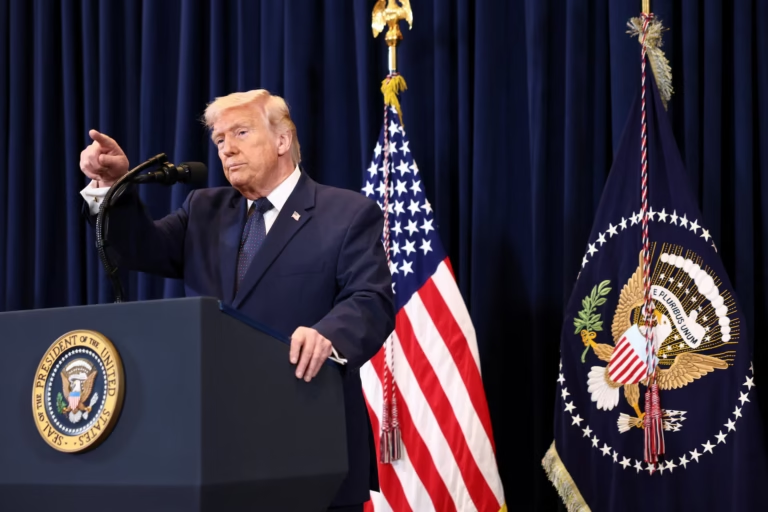
President Trump voiced support for Israel’s Lebanon ground operation during remarks at a White House event Monday, calling Hezbollah “a big problem” and describing the group as “rapidly being eliminated.” He confirmed direct conversations with Israeli leadership about the campaign — a level of U.S.-Israel coordination that has characterized the entire three-week operation.
The convergence of the Lebanon ground operation and the Larijani strike on the same day reflects an Israeli military doctrine of simultaneous pressure across multiple fronts — preventing Iran and its proxy network from concentrating resources on any single theater. With Larijani gone, Iran loses not only its most experienced remaining diplomat and security coordinator but also one of the few figures capable of navigating a path toward negotiation. Analysts warn that his elimination may shift power further toward hardline IRGC elements with less interest in any political settlement — potentially prolonging the conflict even as Iran’s conventional military capacity continues to collapse.
Whether Iran publicly acknowledges Larijani’s death — and who, if anyone, steps forward to replace him — will tell us more about the regime’s remaining capacity for coherent governance than any missile launch count. For now, Tehran is silent. And silence, in this war, has begun to speak for itself.
- Israel Defense Forces (IDF) — Official statements on Lebanon ground operation, March 17, 2026
- Israeli Defense Ministry — Minister Katz statement on Larijani and Lebanon, March 17, 2026
- The New York Times, BBC, CNN, The Guardian — Larijani strike reports, March 17, 2026
- South China Morning Post / France24 — Larijani background and strike coverage
- White House — President Trump remarks on Hezbollah, March 17, 2026
- Iranian State Media (Tasnim, Mehr) — Undated Larijani handwritten note, March 17, 2026
- Faith & Freedom News — Full Operation Epic Fury Coverage
- FFN: War or Peace — U.S.-Iran Standoff Reaches Breaking Point
About The Author

Discover more from Faith & Freedom News - FFN
Subscribe to get the latest posts sent to your email.