Freedom, Family & Faith:
Inside the 2026 International Religious Freedom Summit
Advocates, diplomats, and faith leaders from across the globe gathered in Washington to defend the most fundamental of human rights — and to grapple with a world where more people than ever live under religious repression.
Adopted
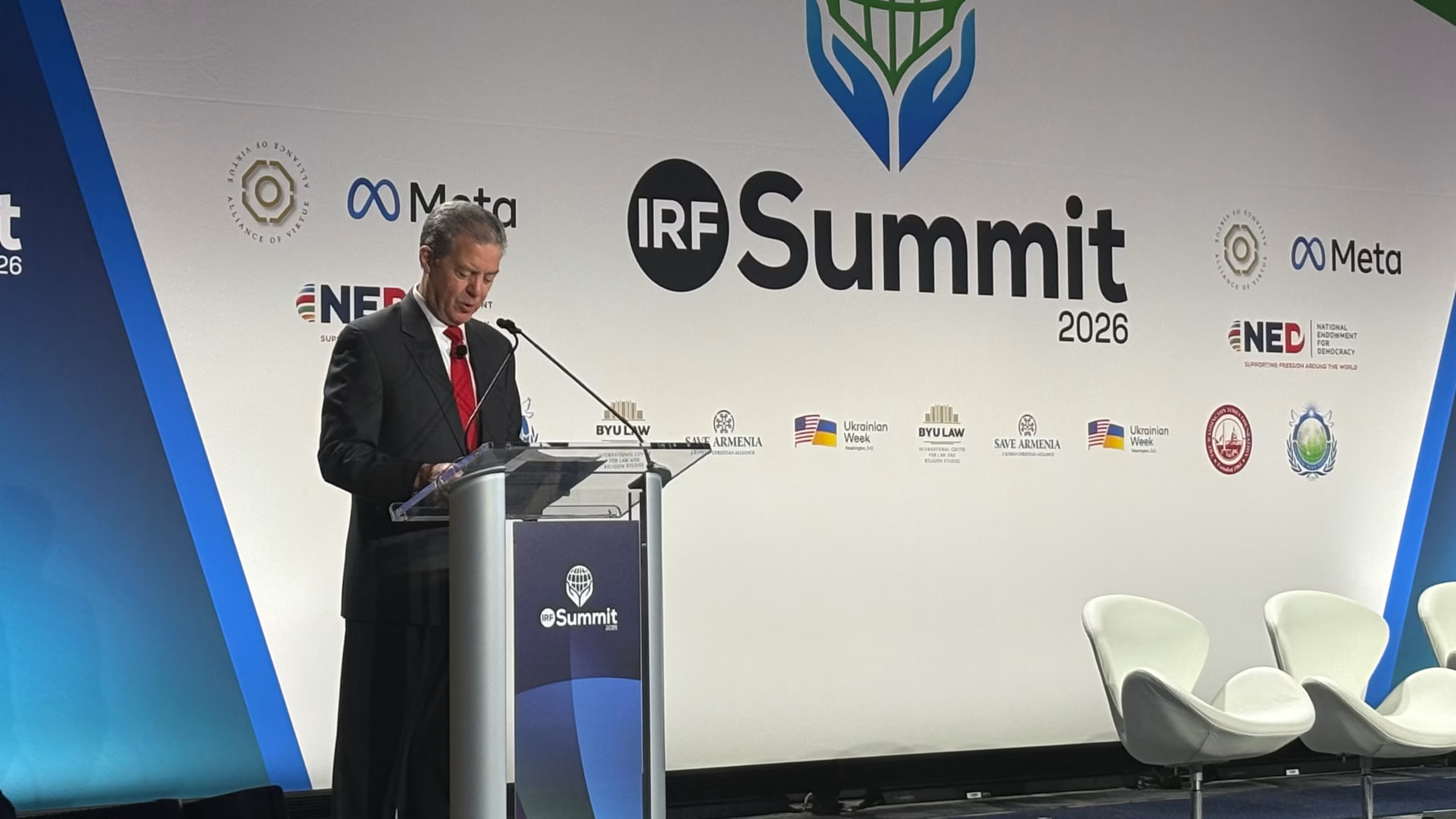
On Monday, February 2nd, the International Religious Freedom (IRF) Summit kicked off in Washington, D.C., bringing together many of the world’s foremost religious freedom experts and advocates. The G20 Interfaith Forum attended the summit, sponsoring a booth and a side session on G20 priorities. This report covers the first day of the conference.
Katrina Lantos Swett opened the 2026 IRF Summit by welcoming participants and highlighting the significance of the global coalition gathered to defend freedom of religion or belief. She announced the upcoming IRF dinner themed “Religious Freedom: Democracy at Risk,” featuring speakers including former U.S. House Speaker Newt Gingrich, Paula White‑Cain, former EU Special Envoy Ján Figeľ, and Moriko Hori of the Women’s Federation for World Peace International.
Reflecting on the origins of the IRF Summit — conceived by Ambassador Sam Brownback — Swett noted that what began as an ambitious idea has quickly become what she called “the most important and consequential gathering of religious freedom leaders, advocates, and experts from around the globe.” She described the current moment as both “the best of times” and “the worst of times”: while the movement for global religious freedom has unprecedented momentum, more people than ever live under regimes that restrict or repress their most basic rights of conscience.
She highlighted two prisoners of conscience adopted by the summit — Pastor Jin of China and Faizullah Asimov of Uzbekistan — and affirmed that the IRF community answers the question “Am I my brother’s keeper?” with a resounding yes.
Ambassador Sam Brownback followed by emphasizing the global nature of the movement and the profound threat it poses to authoritarian regimes. He argued that dictators fear religious freedom because it represents, in his words, “the heart of freedom — a soul choosing its own course for this life and beyond.”
He argued that communist, authoritarian, and totalitarian governments attack this right because they know that people of faith often stand up to oppression with courage rooted in spiritual conviction. Brownback described these individuals as living “behind enemy lines,” carrying within them the spirit of conviction and testifying through their lives of a different, freer way.
“God answers prayer” — and the IRF Summit itself is evidence of that.— Ambassador Sam Brownback
Brownback shared that the idea for the annual IRF Summit came to him during prayer in November 2020, affirming his hope that the summit would continue to be guided by faith as participants work to advance freedom for all. He characterized the struggle for religious freedom as a defining conflict of the age, asserting that oppressive regimes fear the moral power of faith more than military might.
Pastor Paula White‑Cain expressed gratitude for the IRF Summit and described her lifelong commitment to defending freedom of belief. Having traveled to nearly 140 countries, she has witnessed both the beauty of worship and the suffering of those persecuted for their faith. In her current role as Senior Adviser to the White House Faith Office, she noted that religious liberty remains the top priority.
She praised the summit’s nonpartisan spirit and grounded its mission in Article 18 of the Universal Declaration of Human Rights, emphasizing that freedom of thought, conscience, and religion is a fundamental human right — not a privilege granted by governments.
White‑Cain highlighted severe violations of religious freedom worldwide, including repression of Uyghurs and Tibetans in China, attacks on Christians in Nigeria, persecution of Bahá’ís and other minorities in Iran and Yemen, and rising hostility toward Jewish communities. Drawing on her direct work in Nigeria and the Democratic Republic of the Congo, she described staggering death tolls and ongoing violence, stressing that behind every statistic is a family, a community, and a life forever changed.
-
Challenge governments that restrict worship, criminalize conversion, or weaponize blasphemy laws against their own citizens.
-
Defend religious freedom universally — not only for one’s own community, but for every person of every faith and none.
-
Remind the world that societies flourish when freedom of belief is protected for all, drawing on examples like the Abraham Accords.
Religious liberty is the cornerstone of human dignity — and defending it is personal, urgent, and within our power.— Pastor Paula White‑Cain
Melissa Rogers emphasized that the most effective advocacy for freedom of religion or belief comes from broad, diverse coalitions. While smaller or single‑issue groups have value, she encouraged advocates to continually seek the widest possible partnerships across faiths and beliefs — because broad coalitions are both louder and more influential.
She stressed the importance of what she called “pleasant persistence.” One meeting with government officials is never enough; progress requires repeated engagement, ongoing communication, and patience with the realities of government schedules. Rogers also highlighted the need to balance big‑picture goals with incremental steps — articulating overarching principles while identifying smaller, achievable actions that demonstrate progress and build momentum.
Rogers argued that policymakers must hear from religious groups because religion shapes every dimension of human life and is central to understanding global events. She stressed the importance of having officials in senior government roles who understand faith dynamics and religious‑freedom issues, both domestically and internationally.
Democracies must lead by example. Credibility requires integrity — defending religious liberty at home is inseparable from promoting it abroad.— Melissa Rogers
Rogers noted that protecting religious freedom for all — equally and consistently — strengthens democratic institutions, reinforces the rule of law, and supports programs such as refugee resettlement.
Jordan of the American Center for Law & Justice (ACLJ) emphasized that countries protecting religious liberty — where individuals can choose, change, or reject a faith without fear — tend to be strong allies of the United States. Such nations share human‑rights values, cooperate at the United Nations, and contribute to global security. The ACLJ has worked with UN partners, including Ahmed Shaheed and Bill’s office, to save Christian pastors from execution in restrictive environments.
Jordan explained that personal stories are essential for engaging the American public. Graphic documentation of ISIS atrocities awakened many to the scale of global persecution, far beyond the minor discrimination some experience domestically. When advocates highlight individual families, spouses, or survivors, people begin to care about countries they previously ignored.
We helped a Palestinian Christian widow escape Gaza the day before a major conflict. Advocacy can save lives — not just win legal arguments.— Jordan, ACLJ
Jordan stressed that the ACLJ defends religious freedom for all — not only Christians or Jews — and that storytelling remains one of the most powerful tools for mobilizing support. He argued that robust religious liberty strengthens a nation’s global reputation and aligns with the moral obligations of many faith traditions.
Marianna Richardson is the Director of Communications for the G20 Interfaith Forum and an adjunct professor at the Marriott School of Business at Brigham Young University.
Original summaries: Part 1 (Feb. 13, 2026) · Part 2 (Feb. 16, 2026)
About The Author

Discover more from Faith & Freedom News - FFN
Subscribe to get the latest posts sent to your email.