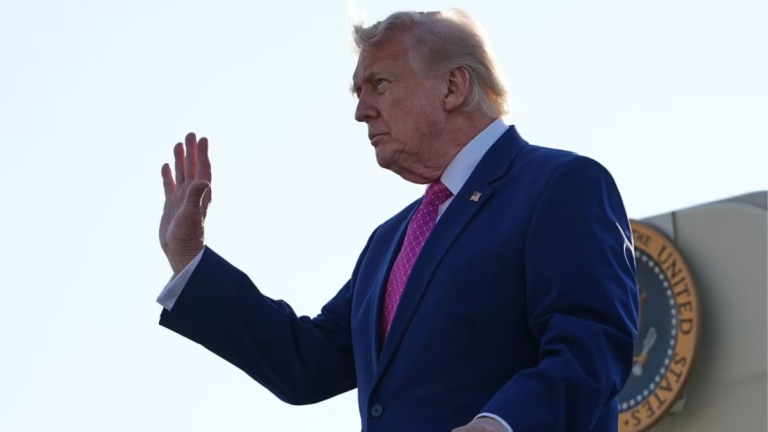
President Donald J. Trump addresses the audience during an historic ceremony in Davos, Switzerland, joined by Founding Members who have committed to building a secure and prosperous future for Gaza. Picture source The White House.
First Meeting,
First Steps Toward
Gaza’s Renewal
The inaugural Board of Peace convenes in Washington under President Trump, gathering representatives of more than 45 nations to convert a fragile ceasefire into a concrete plan for Gaza’s reconstruction, security, and governance.
Today, Washington is set to host what could be a pivotal moment in shaping Gaza’s future. The inaugural meeting of the Board of Peace is taking place under President Donald Trump’s leadership, gathering representatives from over 45 nations to work on turning a fragile ceasefire into a solid plan for recovery and stability.
The scale of participation itself signals the seriousness of this initiative. Countries from Europe, the Middle East, Asia, and beyond — including Pakistan, Turkey, Saudi Arabia, the United Kingdom, Japan, and Indonesia — are sitting down together to tackle issues of reconstruction, security, and governance in Gaza. This wide-ranging involvement underscores that the responsibility for peace is a shared one, not resting on a single capital alone.
Three Vital Priorities
“If momentum is maintained beyond today’s proceedings, this inaugural session will not simply mark the start of another international forum. It will stand as the moment when the world chose to move from ceasefire to renewal.”— Junaid Qaiser, Author & Peace Activist
Key Speakers and Leaders
- 🇺🇸President Donald J. Trump — Host and convener of the inaugural Board of Peace session.
- 🇺🇸Marco Rubio — U.S. Secretary of State, expected to address diplomatic frameworks.
- 🌐Jared Kushner — Key architect of regional peace diplomacy and the Abraham Accords.
- 🇬🇧Tony Blair — Former UK Prime Minister, representing international institutional experience.
- 🇺🇸Steve Witkoff — U.S. Special Envoy; expected to outline the operational roadmap.
- 🇺🇳Mike Waltz — U.S. Ambassador to the United Nations; focusing on multilateral coordination and UN reform.
- 🌐Nickolay Mladenov — Board of Peace Director-General; to outline the way forward for the initiative.
Nations at the Table
Hungary, Kosovo, Pakistan & Israel
Hungary is making its stance clear, with Foreign Minister Péter Szijjártó confirming the country’s full support for Trump’s peace initiatives. Since security in Central Europe is so closely tied to global stability, Szijjártó noted that Hungary did not hesitate to join the initiative. Prime Minister Viktor Orbán is expected to frame these diplomatic efforts as a much-needed glimmer of hope in an increasingly volatile landscape.
Kosovo’s President Vjosa Osmani has arrived in Washington as one of the initiative’s co-founders, focused on strengthening ties with global leaders to drive regional stability and shared prosperity — signaling Kosovo’s commitment to a proactive role in international peace-building.
For Pakistan, participation carries both moral and strategic weight. Prime Minister Muhammad Shehbaz Sharif has arrived in Washington accompanied by Deputy PM and Foreign Minister Ishaq Dar, Finance Minister Muhammad Aurangzeb, Information Minister Attaullah Tarar, and Special Assistant Tariq Fatemi — reflecting Pakistan’s growing diplomatic reach on the international stage.
Israeli Foreign Minister Gideon Sa’ar met with U.S. Ambassador Mike Waltz in New York ahead of today’s session to coordinate on regional strategy, emphasizing that the diplomatic bond between the two nations has reached a new level of strength. Sa’ar is representing Israel at the summit, signaling a unified front on security and institutional reform.
“Diplomacy often kicks off with a single, intentional step. As the Board of Peace meets for the first time, it carries the potential that multilateral cooperation — backed by resources, security assurances, and political will — can redefine Gaza’s future.”— Junaid Qaiser
Direction Over Announcements
The significance of this first meeting lies not merely in the announcements made, but in the direction set. If funding mechanisms are structured transparently, if stabilisation forces are anchored in a clear chain of command, and if humanitarian corridors are safeguarded, today’s summit will set in motion a coordinated recovery process unlike anything attempted for Gaza before.
The road ahead is bound to be challenging, and expectations must be tempered with realism. Nevertheless, this inaugural session carries the weight of possibility — that multilateral cooperation, properly resourced and politically backed, can be the turning point from ceasefire to genuine renewal.
About The Author

Discover more from Faith & Freedom News - FFN
Subscribe to get the latest posts sent to your email.