The Great Hospital Con: MSF Withdrawal from Nasser Hospital Vindicates Two Years of Israeli Warnings
Doctors Without Borders’ suspension of operations at Gaza’s largest functioning hospital — citing armed men, weapons movement, and security breaches — has confirmed what Israel’s military has long asserted and what Palestinian civilians in Khan Yunis already knew: Hamas has turned Gaza’s hospitals into command and security headquarters.
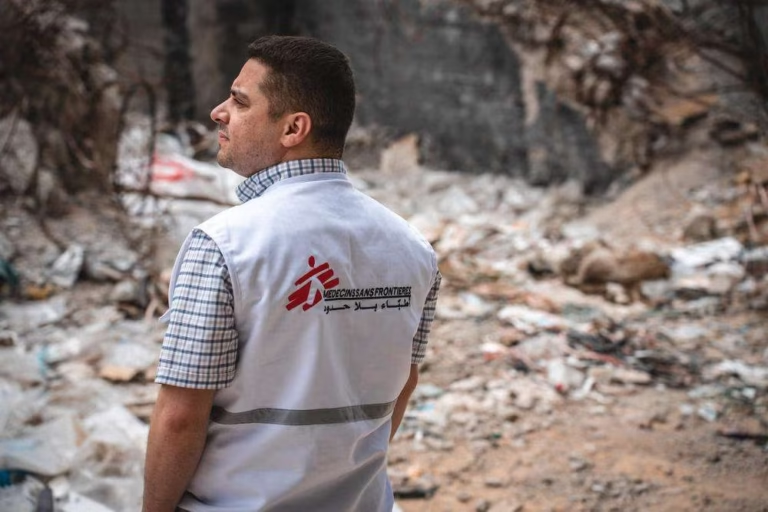
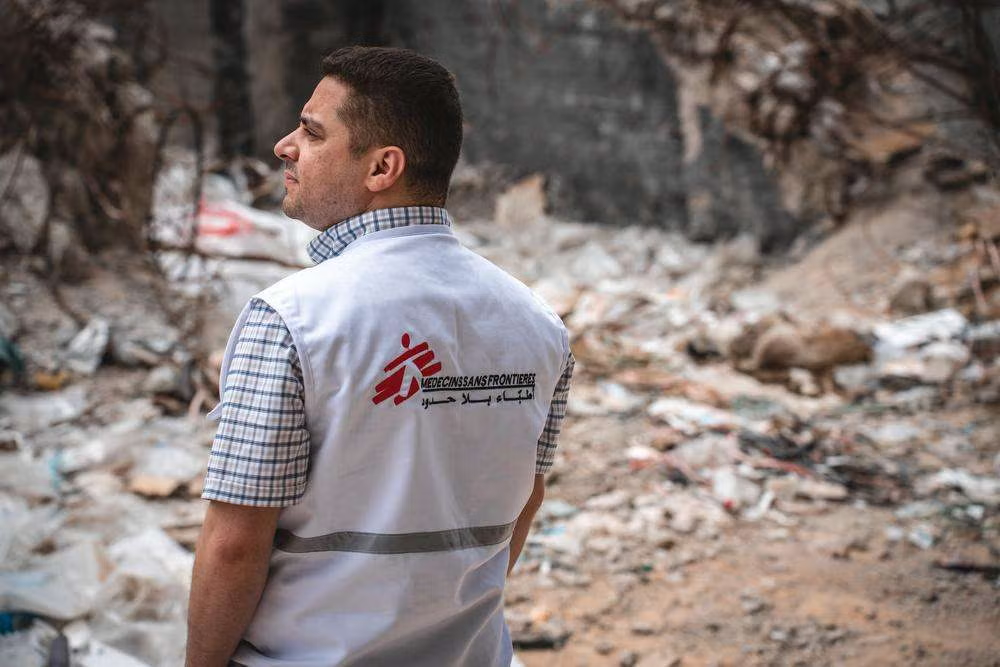
The decision by Doctors Without Borders — known internationally as Médecins Sans Frontières (MSF) — to suspend operations at Nasser Hospital in Khan Yunis has set off a cascade of official responses from Israel and provoked searing analysis from Palestinian voices who say the world’s most prominent humanitarian organizations spent two years ignoring what ordinary Gazans already knew. The IDF and Israeli Foreign Ministry called the NGO’s belated disclosure a vindication. Palestinian analysts called it a historic indictment — not just of Hamas, but of a global media and NGO ecosystem that chose narrative over truth.
🏥 What MSF Said — And What It Means
MSF confirmed it suspended its operations at Gaza’s largest functioning hospital on January 20, 2026, citing concerns about “the management of the structure, the safeguarding of its neutrality, and security breaches.” The organization formally expressed its concerns to “the relevant authorities” — meaning Hamas — after its staff and patients observed “armed men, some masked” operating inside the hospital compound.
In a February 11 statement that the Israeli Foreign Ministry subsequently shared, MSF described a documented “pattern of unacceptable acts” since the ceasefire took effect on October 10, 2025. These included the presence of armed men, intimidation of patients, arbitrary arrests, and — critically — what MSF described as a “recent situation of suspicion of movement of weapons” inside the facility.
“For over two years, the IDF and the defense establishment has warned about the cynical use by terrorist organizations in Gaza of hospitals and humanitarian shelters as human shields to conceal terrorist activity.”
“The IDF indeed possesses intelligence indicating that Nasser Hospital is being used as a headquarters and military post for senior Hamas commanders and operatives in southern Gaza.”
The IDF stressed that MSF’s decision “comes too late,” and constitutes further proof that Hamas must be fully disarmed. The Israeli Foreign Ministry was more pointed still. Sharing MSF’s February 11 statement on X, the ministry added: “In Gaza, armed men inside hospitals are Hamas terrorists. … Better late than never.”
“In Gaza, armed men inside hospitals are Hamas terrorists. Better late than never.”— Israeli Foreign Ministry, February 2026
🔍 The Cover-Up That Wasn’t Hidden
For Ahmed Fouad Alkhatib, the head of Realign for Palestine — an Atlantic Council project that challenges entrenched narratives in the Israel-Palestine discourse — MSF’s disclosure is the end of a story that was never properly told, despite being entirely visible to anyone who looked. In posts on X, Alkhatib laid out the full scope of the deception with barely concealed fury.
Hamas’s response to the MSF scandal is a textbook example of institutional capture: using an international outcry over its armed presence in hospitals to legitimize and consolidate that very presence under the guise of policing it. The organization accused of militarizing hospitals is now deploying armed units to hospitals — and presenting this as a humanitarian measure.
📢 “Two Years Late” — A Palestinian Verdict
In a second post, Alkhatib was even more direct — and more damning — about the global failure to report what Gazans themselves experienced throughout the war. His words are worth reading in full, because they come not from an Israeli spokesperson but from someone with family and friends who lived through Hamas’s security apparatus operating from inside hospital walls.
⚖️ International Humanitarian Law and the Cynical Calculation
The use of hospitals for military purposes constitutes a war crime under international humanitarian law. The Geneva Conventions grant special protected status to medical facilities precisely because of their vulnerability and their essential civilian function. Hamas’s documented use of Nasser Hospital — and, according to Alkhatib, Gaza’s three main hospitals — as security, intelligence, and administrative command centers represents one of the most egregious violations of that protected status recorded during the conflict.
Under the Fourth Geneva Convention and Additional Protocol I, hospitals and medical facilities enjoy special protection from attack — but that protection is forfeited when they are used “to commit acts harmful to the enemy.” The deliberate use of a hospital as a military headquarters, intelligence center, or weapons depot constitutes a war crime by the party exploiting the facility, not the party that subsequently targets it.
The IDF’s long-standing intelligence assessments — now corroborated by MSF’s own staff observations and formal public statement — point to a deliberate, sustained strategy by Hamas to embed its command structure inside protected civilian infrastructure. The military and political advantage of such a strategy is clear: it forces adversaries to either accept the sanctuary it provides, or absorb the reputational cost of striking a hospital. For two years, the reputational cost fell almost entirely on Israel, while Hamas’s exploitation of medical facilities went largely unreported and uncontested in international media.
“MSF is two years late to this recognition — but it is confirming what even a child in southern Gaza could have told them, had they bothered to ask.”— Ahmed Fouad Alkhatib, Realign for Palestine / Atlantic Council
🚨 Hamas’s Response: Formalize What You Denied
Perhaps the most revealing development in the entire episode is Hamas’s response to the MSF disclosures. Rather than denying that armed men were present — the previous line — Hamas’s Ministry of Interior announced the deployment of its own heavily armed police units to Gaza’s hospitals, framing this as a measure to prevent unauthorized armed presence in medical facilities.
The logic is breathtaking in its cynicism: the organization caught militarizing hospitals is now deploying armed forces to hospitals as a solution to the problem of armed forces in hospitals. What began as a covert strategy has been laundered, under international pressure, into official policy — presented to the world with the language of humanitarian protection.
For Alkhatib, this is the defining illustration of the entire dynamic: Hamas uses international outrage as cover to deepen its institutional control, while its critics in the West either applaud the stated intention or remain silent. The withdrawal of MSF — an organization whose credibility and moral authority is beyond question in international humanitarian circles — has stripped away that cover. What remains is the machinery of a terrorist organization that has weaponized the suffering of Palestinian civilians for two years, including the very hospitals meant to save their lives.
About The Author

Discover more from Faith & Freedom News - FFN
Subscribe to get the latest posts sent to your email.