7,000 Targets. 100 Ships. Zero Missile Production. CENTCOM Reports “Unstoppable Momentum” as Iran’s Military Collapses
Admiral Brad Cooper’s Day 16 update laid out the most comprehensive picture yet of Iran’s military annihilation: the navy is gone, missile production is at zero, air defenses are shattered, and the regime is firing fewer and fewer missiles every day.
struck total
destroyed
production remaining
— down 26% in one day
For sixteen consecutive days, American forces have struck Iran with what CENTCOM Commander Admiral Brad Cooper described Monday as “overwhelming firepower delivered deep into Iran” — and the Day 16 operational update made the cumulative toll undeniable. More than 7,000 targets have now been struck inside the Islamic Republic. Over 100 Iranian naval vessels have been destroyed across four bodies of water. Iran’s ballistic missile production has been reduced to zero. Its air defense network — 120 radar systems and more than 100 anti-aircraft batteries — has been effectively eliminated.
“For 16 days, we’ve delivered overwhelming firepower deep into Iran,” Cooper said in a video update Monday, going on to describe the execution of “a large-scale precision strike on Kharg Island, destroying more than 90 Iranian assets” and calling the campaign’s pace “precise, overwhelming, and relentless.” He honored fallen service members before laying out the mounting evidence of a military machine in irreversible collapse.
“We have crushed Iran’s navy — over 100 vessels destroyed. Their defense industrial base is shown here in ruins. U.S. and partner forces continue to execute precise, overwhelming, and relentless strikes.”
Cooper showed imagery of the destroyed defense industrial base — a visible record of facilities that once built Iran’s missiles, drones, and naval hardware reduced to rubble. Officials described the overall campaign as having “unstoppable momentum” and noted that operations have been running “ahead of schedule” by the Pentagon’s own assessment.
The Navy Is Gone
The destruction of Iran’s naval fleet is now effectively complete. More than 100 vessels — surface combatants, fast attack craft, submarines, and support ships — have been sunk across the Persian Gulf, the Strait of Hormuz, the Gulf of Oman, and the Arabian Sea. Earlier figures in the campaign confirmed 17 or more warships and at least one submarine; those totals have since escalated significantly as the campaign expanded to every body of water where Iranian naval assets operated.
The significance extends beyond a body count of hulls. Iran’s navy was its primary tool for threatening commercial shipping, deploying mines, harassing tankers, and projecting asymmetric pressure through the Strait of Hormuz. With more than 100 vessels destroyed, the operational doctrine that made the Strait a credible threat has been stripped of its principal instrument. What Iran retains are small boats, drones launched from shore, and a shoreline — none of which constitute a navy.
Kharg Island and the Tehran Strikes
Among the most consequential operations of the March 15–16 window was a large-scale precision strike on Kharg Island — Iran’s dominant oil export terminal and a node of missile, naval, and intelligence infrastructure. U.S. forces destroyed more than 90 Iranian military assets in the operation while deliberately avoiding civilian oil infrastructure, a distinction officials have consistently emphasized to minimize the conflict’s impact on global energy markets.
| Strike Location / Target | Category | Outcome |
|---|---|---|
| Kharg Island | Naval / Missile / Intelligence | 90+ military assets destroyed in single precision operation |
| Mehrabad Airport, Tehran | Symbol / Regime | Former Supreme Leader Ali Khamenei’s personal aircraft obliterated |
| Government Space Facility, Tehran | Dual-Use / Defense Industrial | Destroyed; part of missile and space-launch infrastructure |
| Tehran, Shiraz, Tabriz | Command / IRGC / Manufacturing | Extensive strikes on command/control, IRGC HQ, missile facilities |
| Air Bases / Maritime Bases | Air Force / Navy | Multiple installations struck; remaining air and naval capacity suppressed |
| Hezbollah — Lebanon / Syria | Proxy Networks | 90% weapons supply reduction in related operations; command targets hit |
Notably, strikes in the March 15–16 window also included the obliteration of the late Supreme Leader Ali Khamenei’s personal aircraft at Mehrabad Airport in Tehran and the destruction of a government space facility — a target category that U.S. officials have consistently linked to Iran’s ballistic missile and satellite launch programs. These are not purely military strikes; they are symbolic ones, communicating to Tehran’s leadership structure that nothing within the regime’s infrastructure is beyond reach.
Missiles in Freefall: The Numbers Tell the Story
Peak Day
−42%
Continued
−26% / Day
Iran’s missile launches tell the story of a campaign working exactly as designed. Thirty-two missiles on March 12 — the operation’s peak day for Iranian retaliation. Nineteen on March 13. Nineteen again on March 15. Fourteen on March 16 — a 26% single-day decline. The cumulative total since the campaign began stands at approximately 1,265 ballistic missiles: a figure that, in ordinary circumstances, would represent an almost unimaginable act of aggression, but in the context of Operation Epic Fury represents the shrinking remnant of a once-formidable arsenal.
Drone activity did tick upward to 93 launches on March 16 — a reminder that asymmetric capabilities remain and that Iran is not fully disarmed. But drone intercept rates have been consistently high throughout the campaign, and officials note that drones represent a fundamentally different threat category than ballistic missiles: slower, lower-yield, and more manageable for the layered air defense networks now protecting Gulf states and American assets.
Officials Speak: Three Voices, One Message
Trump: “Peace Through Strength” — and a Warning for China
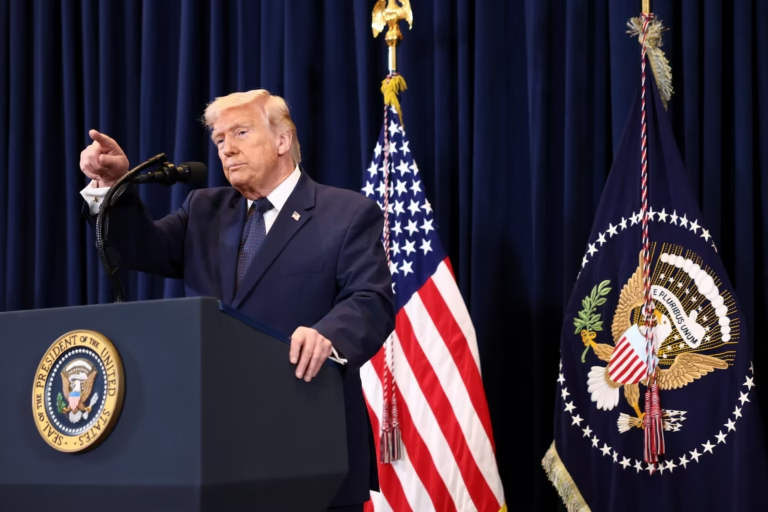
President Trump has consistently framed Operation Epic Fury under the doctrine of “peace through strength” — personally selecting the operation’s name and emphasizing that decisive military action now prevents far greater conflicts later. He has pointed to the campaign as having already prevented a potential nuclear escalation and remains the public face of what the administration calls the most successful American military operation in a generation.
On the diplomatic front, Trump’s attention has been fixed on the Strait of Hormuz coalition — pressing approximately seven nations to contribute naval assets to a reopening effort, warning NATO that its future could depend on the response, and suggesting that a summit with Chinese President Xi Jinping may be delayed if Beijing continues to refuse participation. He has also made direct appeals to ordinary Iranians, calling on “Iranian patriots” to “seize this moment” and take back their country from the regime.
As the campaign enters its eighteenth day, the military picture is one of overwhelming American dominance — Iran’s navy destroyed, its missile production zeroed out, its air defenses shattered, its fires declining by the day. The question that now governs everything is not whether the United States has won militarily. It is whether winning militarily is sufficient to end the war.
- U.S. Central Command (CENTCOM) — Adm. Brad Cooper video update, March 16, 2026
- Pentagon — Secretary Hegseth press briefings, March 10–16, 2026
- Joint Chiefs of Staff — Gen. Dan Caine statements, March 2026
- White House — Presidential statements on Operation Epic Fury, March 2026
- Press Secretary Karoline Leavitt — Briefings, March 2026
- Faith & Freedom News — Full Operation Epic Fury Coverage
- FFN: War or Peace — U.S.-Iran Standoff Reaches Breaking Point
About The Author

Discover more from Faith & Freedom News - FFN
Subscribe to get the latest posts sent to your email.