48-Hour Ultimatum: Trump Threatens to “Obliterate” Iran’s Power Plants Unless Hormuz Is Fully Opened — The Clock Is Running
Posted Saturday night at 23:44 GMT, Trump’s Truth Social message gives Iran until approximately March 23–24 to fully reopen the Strait of Hormuz — or face the destruction of its power grid, starting with the largest plant first. Twenty-two nations back him. Iran is threatening all-out energy infrastructure war across the Middle East.
Strait or face strikes
(100+ ships to 5–6/day)
joint condemnation
per barrel
At 23:44 GMT on Saturday, March 21, President Trump posted an ultimatum that may stand as the single most consequential message of the four-week conflict: a direct, named threat to destroy Iran’s power plants — largest first — unless the Strait of Hormuz is fully reopened to commercial shipping, without threat, within 48 hours. The clock began ticking at that moment. The deadline falls approximately March 23–24, 2026.
The ultimatum is not a diplomatic signal or a rhetorical flourish. It is a specific, time-bound, target-identified threat issued by the Commander-in-Chief of the most powerful military on earth. Iran has no meaningful air force left to intercept what would come. It has no functioning air defense network. What it does have are power plants — civilian and industrial infrastructure on which 90 million Iranians depend — and those are now the stated next target if the Strait remains closed.
“The United States of America will hit and obliterate their various power plants, starting with the biggest one first.”
Why the Strait: The Chokepoint at the Center of Everything
narrowest point
under normal conditions
currently (down from 100+)
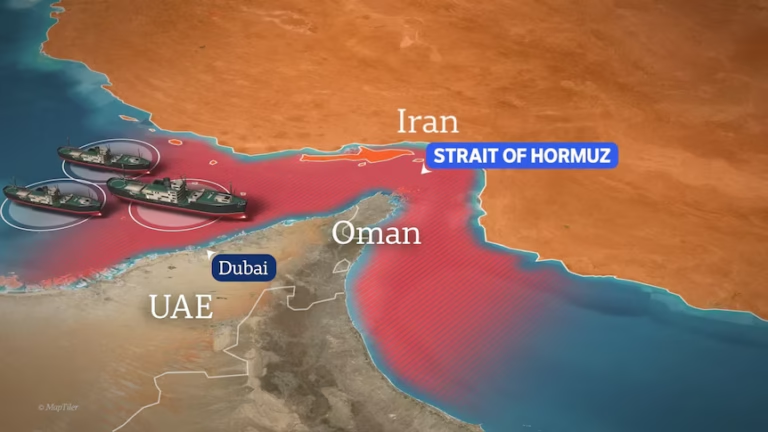
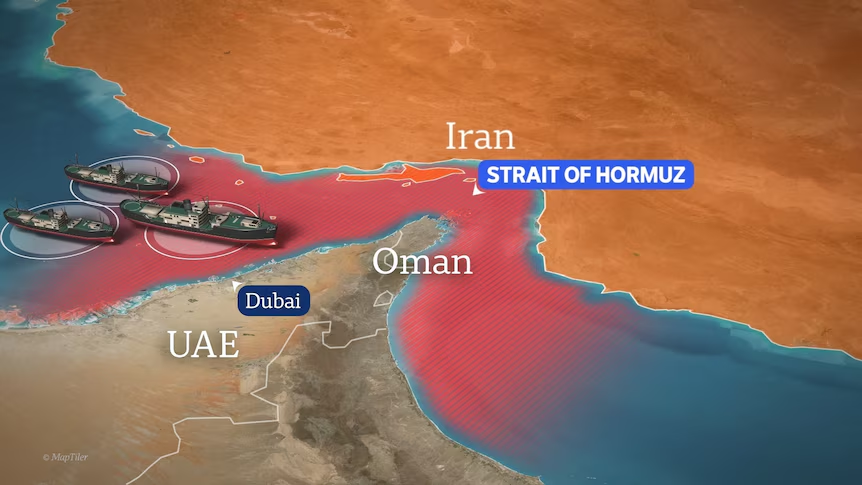
The Strait of Hormuz is roughly 21 to 33 miles wide at its narrowest point, connecting the Persian Gulf to the Gulf of Oman and the Arabian Sea. Under normal conditions, more than 100 commercial vessels pass through it every day, carrying approximately 20–25% of the world’s seaborne oil trade — the bulk of energy exports from Saudi Arabia, the UAE, Iraq, Qatar, and Kuwait. Since Iran began its de facto blockade through mines, drone and missile attacks on vessels, and direct threats to commercial shipping, that traffic has collapsed to five or six ships per day — a reduction of 95%.
The economic consequences are already severe: Brent crude has surpassed $120 per barrel, global energy markets are in crisis, and the International Energy Agency has authorized a coordinated release from strategic petroleum reserves in an attempt to prevent worse. Saudi Arabia has partially rerouted exports through its East-West pipeline to Yanbu on the Red Sea; the UAE has diverted some shipments through its Fujairah pipeline. But there is no full substitute for the Strait. No pipeline can carry what passes through it in a normal week. The world’s energy system runs through this 33-mile chokepoint — and Iran has its hand on the valve.
Iran’s Response: A Threat to Every Energy Installation in the Region
Iran’s counter-threat is calibrated to maximize fear without specifying targets — a classic deterrence posture designed to make the cost of action appear prohibitively high. The problem with that posture is that it has been tried before in this conflict. Iran threatened the Gulf states. Iran threatened shipping. Iran threatened Israel. Each threat was followed by American or Israeli military action that degraded Iran further. The regime is now threatening retaliation with an air force it no longer has, a navy that is on the ocean floor, and a missile production industry at zero capacity.
What Iran does retain is the ability to inspire or direct proxy attacks on Gulf infrastructure — and that threat is real. The drone strike on Saudi Arabia’s Red Sea refinery last week demonstrated it. The attack on Qatar’s section of the South Pars gas field demonstrated it. These are not the actions of a conventional military; they are the actions of an asymmetric threat actor that has been stripped of its conventional tools and is now wielding whatever remains. The 48-hour ultimatum is designed to force a choice: open the Strait, or watch the power grid go dark.
The Coalition: 22 Nations Demand Iran Stand Down
The 22-nation joint statement — which grew from a G7 initiative on March 19 and rapidly expanded to include Gulf partners — represents the broadest formal international coalition against Iran assembled in the conflict. Its language is notably specific: it explicitly references UN Security Council Resolution 2817, calls the Strait’s closure a “threat to international peace and security,” and welcomes “preparatory planning” for coalition efforts to ensure safe passage. That last phrase is diplomatic code for naval escorts and minesweeping operations now in preparation.
The G7 foreign ministers separately issued their own statement affirming readiness to “take necessary measures to support global energy supplies” and condemning Iran’s “reckless attacks against civilians and civilian infrastructure, including energy infrastructure.” The International Maritime Organization’s Council adopted a parallel resolution — supported by more than 100 nations — condemning Iran’s “purported closure” of the Strait and demanding restoration of free navigation.
The Gulf States: UAE Signs On, Saudi Arabia Expels Iranian Diplomats
The 48-Hour Timeline: What Happens Next
~23:44 GMT
Current
Window
~23:44 GMT
The 48-hour ultimatum marks the sharpest escalation since the conflict began on February 28. Every prior American threat in this war has been followed by action. The strikes on Kharg Island were threatened and delivered. The targeting of Iranian naval vessels was promised and executed. The hunting of the regime’s leadership was declared and confirmed. There is no reason to believe this ultimatum will be treated differently — by Washington or by the watching world.
The question is not whether Trump means it. The question is whether Iran will blink — and whether opening the Strait at the point of a gun, with its military already obliterated and its leaders dead or in hiding, constitutes the kind of compliance that halts the escalation or merely postpones the next one. The next 48 hours may answer that question. Or they may only deepen it.
- President Trump — Truth Social ultimatum post, March 21, 2026 (~23:44 GMT)
- G7 Foreign Ministers — Joint statement on Iran, Hormuz, and global energy security, March 2026
- 22-Nation Joint Statement — UK, France, Germany, UAE, and 18 other nations, March 19–21, 2026
- International Maritime Organization (IMO) Council — Resolution on Strait closure, 100+ supporters
- Saudi Foreign Ministry — FM Prince Faisal bin Farhan statement on Iran expulsion, March 20, 2026
- International Energy Agency (IEA) — Strategic petroleum reserve release authorization
- Iranian Officials — Counter-threat statements on U.S. ultimatum, March 22, 2026
- U.S. Central Command (CENTCOM) — Strait of Hormuz operational updates
- Faith & Freedom News — Full Operation Epic Fury Coverage
- FFN: War or Peace — U.S.-Iran Standoff Reaches Breaking Point
About The Author

Discover more from Faith & Freedom News - FFN
Subscribe to get the latest posts sent to your email.