They Stood Silent —
Then They Chose Freedom:
Iran’s Women Footballers
Seek Asylum in Australia
Refusing to sing Iran’s national anthem before a World Cup match, seven members of Iran’s women’s football team chose defiance — and then protection. Their story became one of the most powerful human rights moments in international sport.

Silence as Defiance: A National Anthem Left Unsung
On March 1, 2026, in Brisbane, Australia, before Iran’s opening match of the AFC Women’s Asian Cup against South Korea, something extraordinary happened — and it happened in silence. The entire Iranian women’s national football team stood motionless and refused to sing their country’s national anthem. No raised fists, no banners. Just silence — deliberate, unified, and deafening.
The act was immediately understood for what it was: a profound expression of defiance against the Islamic Republic. It echoed the actions of Iran’s men’s team at the 2022 FIFA World Cup, who similarly refused to sing during the height of the “Woman, Life, Freedom” uprising following the death of Mahsa Jina Amini. But in March 2026, the stakes were even higher. Iran was at war — the U.S.-Israel military conflict with Iran had begun on February 28, just two days before the match — and Iran’s state media and hardline commentators wasted no time: the players were branded “wartime traitors” and a “disgrace.”
The protest resonated globally within hours. Human rights organizations, Iranian exile communities — including Reza Pahlavi, son of the last Shah — and international media rallied in solidarity. Israel’s government commended the team’s “courage.” And in Australia, crowds at subsequent tournament venues chanted in support. Yet the players themselves were careful to emphasize a crucial point: they were not political activists. They were women afraid of what waited for them at home.
After Elimination: The Nights That Changed Everything
Iran’s campaign ended in the group stage following a defeat to the Philippines on March 8, 2026 — the same day as International Women’s Day. With elimination came the prospect of returning home. For several members of the team, that prospect was not a disappointment. It was a threat to their lives.
In the early hours of March 10, Australian Federal Police escorted five players to a safe location after they separated from their delegation and sought protection from Australian authorities. They expressed acute fears of reprisals — not only for themselves, but for their families remaining in Iran. Reports indicated that IRGC (Islamic Revolutionary Guard Corps) handlers had been embedded within the delegation, monitoring the players’ movements and communications.
On March 9, Australian Home Affairs Minister Tony Burke announced that humanitarian visas had been granted to the initial five, providing a pathway to permanent residency. Private meetings were arranged with all remaining team members — deliberately conducted away from Iranian handlers — to ensure decisions were made voluntarily and without coercion. By March 11, two additional team members had accepted: one more player and one staffer. The total stood at seven.
On March 11, emotional scenes unfolded at Sydney Airport. Australian officials made last-minute offers to those still departing, but most declined — citing not indifference to their own safety, but the unbearable weight of what could happen to their families in Iran if they stayed. Protests erupted outside the airport, with crowds chanting “Save our girls.” The remaining team eventually flew to Malaysia, en route to Iran. On March 12, striker Mohaddeseh Zolfi withdrew her application after discussions with teammates and contacted the Iranian embassy to return home. Home Affairs Minister Burke confirmed the withdrawal was voluntary.
Trump, Albanese, and a Phone Call That Mattered
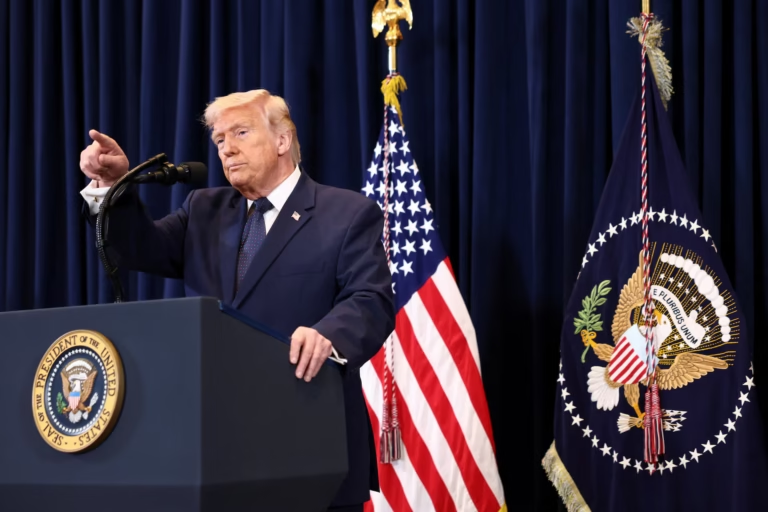
The story did not remain within the bounds of Australian domestic policy for long. On March 9, 2026, U.S. President Donald Trump became publicly involved — posting on Truth Social that Australia was making a “terrible humanitarian mistake” by potentially returning the players to Iran, where they “will most likely be killed.” He offered U.S. asylum as an alternative: “The U.S. will take them if you won’t.”
“Australia is making a terrible humanitarian mistake. These women will most likely be killed. The U.S. will take them if you won’t.”
Confirmed Australian officials had been working on the situation “for some time,” emphasizing the women’s safety as the paramount concern and extending the visa offer to all team members.
Trump then spoke directly with Prime Minister Albanese in an early-morning call, praising him for handling the “delicate situation.” Trump subsequently updated that five had been “taken care of,” acknowledging some players’ reluctance due to threats against their families. The diplomatic intervention — whatever one makes of its political framing — was widely credited with accelerating the Australian government’s response, though Canberra maintained it was acting independently on humanitarian grounds.
Whatever the political calculations of those who intervened, the outcome was a humanitarian one: six women are alive and free today who might otherwise have faced imprisonment, torture, or death for the act of standing silently before a flag.
How It Unfolded: Day by Day
- Feb. 28, 2026 U.S.-Israel military conflict with Iran begins — two days before Iran’s opening match.
- March 1, 2026 — The Protest Iran’s entire women’s team silently refuses to sing the national anthem before the match against South Korea at the AFC Women’s Asian Cup in Brisbane. Iranian state media brands them “wartime traitors.”
- March 8, 2026 Iran is eliminated from the tournament after a defeat to the Philippines — on International Women’s Day. Team members begin to separate from the delegation.
- March 9–10, 2026 — The Escapes Australian Federal Police escort five players to a safe location in the early hours of March 10. Home Affairs Minister Tony Burke announces humanitarian visas for the first five. Trump posts on Truth Social and calls Albanese.
- March 11, 2026 Two more team members accept visas — total reaches seven. Emotional scenes at Sydney Airport as most of the remaining delegation departs. Crowds chant “Save our girls.” Most players decline, citing fears for families in Iran.
- March 12, 2026 Striker Mohaddeseh Zolfi withdraws her application and returns to Iran — confirmed voluntary. Six Iranian women footballers remain under protection in Australia, with a pathway to permanent residency.
When Sport Becomes a Stage for Survival
The Iranian women footballers’ story is, at its core, a story about the cost of being a woman under the Islamic Republic. Every element of it — the silent anthem, the fear of return, the IRGC handlers, the families held hostage to loyalty — reflects the lived reality of Iranian women who dare to exist publicly, professionally, and defiantly. This is what the “Woman, Life, Freedom” movement has been telling the world since 2022. This is what Mahsa Jina Amini’s death represented. And this is what six women in Australia are now living proof of.
The asylum grants align with international law under the 1951 Refugee Convention, which Australia is a signatory to — protecting individuals from persecution based on political opinion or gender. The legal framework worked. But it worked because individuals at every level — Australian officials, law enforcement, and two heads of government — chose to act. That should not be the exception. It should be the rule.
Questions remain about the nineteen team members who returned to Iran. Their silence — whether chosen or coerced — deserves the same attention and concern as the six who stayed. The threat of reprisal against them, against their families, and against those who chose asylum, has not disappeared. It has simply become less visible.
The threat against the women who returned to Iran has not disappeared — it has simply become less visible. The world must not look away from what happens next.
As Founder and President of the European Association for the Defense of Minorities, I have spent years documenting the ways in which authoritarian regimes use fear — of imprisonment, of torture, of harm to one’s family — as instruments of control against their own citizens. What happened in Australia is a reminder that courage has consequences, and that the international community has both the capacity and the obligation to intervene when those consequences threaten human lives.
These women did not ask to become symbols. They asked to play football. They asked to stand before a flag without being forced to declare loyalty to a government that treats them as less than human. That is not a political act. It is a human one.
Six of them are safe tonight. For the nineteen who returned, and for the millions of Iranian women who cannot leave, the struggle continues. “Woman, Life, Freedom” is not a slogan. It is a demand that the world still owes Iran’s women an answer to.
About The Author

Discover more from Faith & Freedom News - FFN
Subscribe to get the latest posts sent to your email.