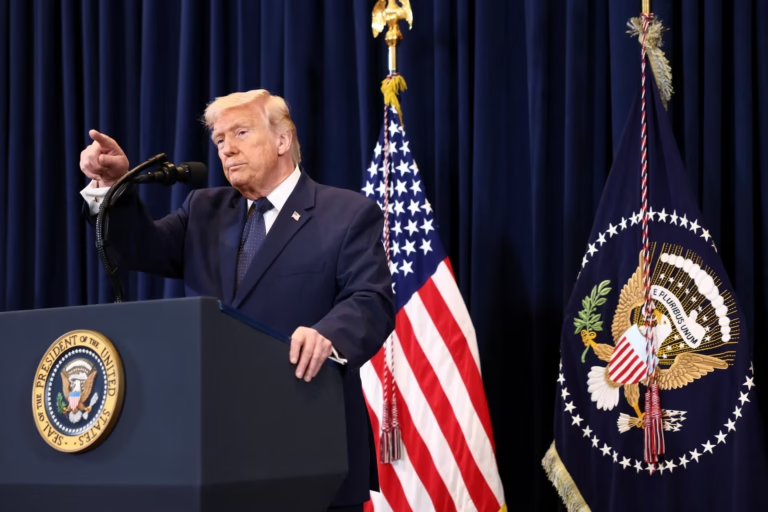
Iran Picked a Fight With Everyone — and Lost the Region
Tehran’s indiscriminate missile campaign was supposed to punish America and Israel. Instead, it handed Washington a coalition it never could have assembled on its own.
Resolution 2817
UAE alone
(Russia & China abstained)
There is an old strategic maxim: never give your enemy a reason to unite his friends. Iran has spent the last two weeks doing exactly that, and the consequences are now plain for anyone watching the United Nations Security Council chamber in New York, where 135 nations — a record — formally condemned Tehran’s missile and drone barrage against its own neighbors.
Let that number sink in. Not just the usual Western suspects. Not just the Gulf states who were under fire. One hundred and thirty-five co-sponsors. The regime in Tehran, which has spent decades cultivating the image of a righteous resistance power standing up to American imperialism, now finds itself more diplomatically isolated than at any point in the Islamic Republic’s history. That is a remarkable achievement — and Iran earned every bit of it.
A Strategy That Ate Itself
When Iran launched its retaliatory campaign following U.S. and Israeli strikes on its territory at the end of February, the logic — to the extent there was any — seemed to be escalation dominance. Hit back hard enough, broad enough, and you force Washington’s coalition partners to blink. Rattle the Gulf states. Make the costs of siding with America too high.
It was a plausible theory. The Gulf states had their own complicated history with Washington. Saudi Arabia had been publicly hedging. Qatar hosts the largest U.S. air base in the region but was quietly making noises about not wanting to be a staging ground for strikes on a Muslim country. Even the UAE, an unofficial American security partner for years, was cautious.
Then Iran started shooting at all of them.
| Country | Reported Strikes / Targets | Diplomatic Response |
|---|---|---|
|
United Arab Emirates
Wikipedia: 2026 Strikes on UAE →
|
1,000+ projectiles; French naval facility, U.S. consulate, Amazon data centers, Burj Al Arab vicinity hit.
1,000+ intercepted |
Closed embassy in Tehran. Ambassador condemned “campaign of terror” at UN. |
|
Kuwait
Wikipedia: 2026 Strikes on Kuwait →
|
Dozens of missiles, hundreds of drones. An eleven-year-old child killed.
Civilian casualties |
Absorbed strikes on civilian areas; formally joined GCC condemnation. |
|
Qatar
—
|
Ballistic missiles struck Doha’s airport area. 63 of 65 ballistic missiles intercepted in a single night.
63/65 intercepted |
Arrested seven IRGC operatives running intelligence cells inside Qatar. |
|
Saudi Arabia
—
|
Largest oil refinery struck twice.
Energy infrastructure |
Deepened security coordination with U.S.; agreed to broaden basing access. |
What Iran Actually Accomplished
Consider what the region looked like before February 28th. The Trump administration’s operation against Iran was controversial even among American allies. The United Kingdom was publicly refusing to allow U.S. aircraft to fly strike missions from British bases. France was making noise about de-escalation. Turkey’s President Erdoğan was positioning his country as a defender of Muslim solidarity, condemning the American strikes as illegal.
Now look at the map today. Britain reversed course after Iranian strikes hit a base in Kuwait being used by Italian forces. France pledged to defend the Gulf after the assault on a French naval installation in the UAE. Greece is deploying assets to Cyprus. Ursula von der Leyen, speaking for the European Union, called for a “credible transition” in Iran — language that, translated from diplomatic into plain English, means regime change.
And then there is Turkey. Whatever the truth about earlier ambiguity, a missile entered Turkish airspace on March 6th, shot down by NATO air defenses. Article 5 discussions began. None of this was inevitable. All of it was a gift from Iran.
People in the Gulf went to bed angry at the United States and Israel, and woke up furious at Iran. That captures something real and important about how alliances actually shift.
— William Wechsler, Atlantic Council
The Geography of Forgiveness
There is also a simple military logic to what has happened. As retired Brigadier General John Teichert explained, with Gulf bases now open to American aircraft, the operational radius for U.S. strikes compresses from roughly a thousand miles to a few hundred. That is not a marginal improvement. That is a different war. Iran may have meant to demonstrate the costs of hosting American power. It managed instead to make hosting American power suddenly feel like survival.
Iran’s unrelenting attacks on Middle East shipping and energy infrastructure sent oil prices soaring and rattled global markets — adding economic grievance to the geopolitical fury already building against Tehran. Gulf countries reported intercepting hundreds of missiles and thousands of drones over the campaign’s first two weeks.
The Resolution and What It Means
Resolution 2817 passed the Security Council on March 11th, 13 votes in favor and two abstentions. The United Arab Emirates ambassador, Mohamed Abushahab, spoke for his counterparts when he said that Iran’s strikes sought to spread terror — and that his people defied it. Qatar rounded up seven IRGC operatives it caught running intelligence cells inside its borders. The UAE closed its embassy in Tehran.
These are not symbolic gestures. The UAE intercepted over 1,000 projectiles in twelve days. Qatar shot down 63 of 65 ballistic missiles in a single night. Kuwait absorbed strikes that killed civilians, including children. The patience with which these governments have responded to outright acts of war against their citizens is remarkable — and it cannot last indefinitely.
What Comes Next — and What Should
The honest answer is that nobody knows. Escalation ladders are notoriously hard to descend once you’ve climbed a few rungs. France is still reportedly in quiet contact with China about a face-saving off-ramp for Iranian leadership, which is either wise contingency planning or a way of buying the regime time, depending on your level of cynicism. Pakistan has a defense agreement with Saudi Arabia that could drag Islamabad into the conflict despite no direct provocation.
What the United States and its partners should be careful not to do is mistake coalition breadth for coalition durability. One hundred and thirty-five co-sponsors on a UN resolution is impressive. It does not mean all 135 are prepared to sustain a prolonged military campaign, absorb economic disruption, or withstand political pressure at home. The Gulf states’ openness to American basing rights could evaporate if civilian casualties in Iran mount and the images reach Arab television screens.
Coalitions built on shared outrage are real, but they have a shorter half-life than coalitions built on shared interest. Washington would do well to convert the anger into institutional arrangements — basing agreements, intelligence-sharing compacts, air-defense integration — before the emotional temperature drops.
The Lesson Iran Won’t Learn
There is something almost tragic about what Tehran has done, if you strip away the body count and look at it coldly. Iran spent years cultivating a posture of regional resistance — the axis of resistance, they called it. It built proxy networks from Lebanon to Yemen. It positioned itself as the defender of the oppressed against American hegemony. And then, in a burst of undisciplined fury, it fired a thousand missiles at the airports and refineries and neighborhoods of the Arab states it claimed to be defending.
The Gulf states remember. The Arab League secretary-general’s comment that Iran had made a “strategic mistake” was not just a diplomatic talking point. It was a verdict. The Islamic Republic, in its rage, has done more to legitimize American military operations in the Middle East than Washington could have managed through a decade of patient alliance-building.
The tragedy, of course, is that the people least responsible for this miscalculation are the ones most likely to pay for it — in Iran and across the region. That is how these things tend to go.
- Pakistan Today — UNSC adopts Bahrain-led resolution on Iran’s Gulf attacks
- Wikipedia — UN Security Council Resolution 2817
- AP News — Iran’s attacks on Mideast shipping and energy infrastructure
- Wikipedia — 2026 Iranian Strikes on the United Arab Emirates
- Wikipedia — 2026 Iranian Strikes on Kuwait
- AP7AM — Gulf nations call for UNSC condemnation; 954 missiles and 2,500 drones intercepted
- Faith & Freedom News — Full coverage of the Iran crisis
About The Author

Discover more from Faith & Freedom News - FFN
Subscribe to get the latest posts sent to your email.